| ➡️ Click here to Join Whatsapp News Group - Get instant updates of all Banking News |
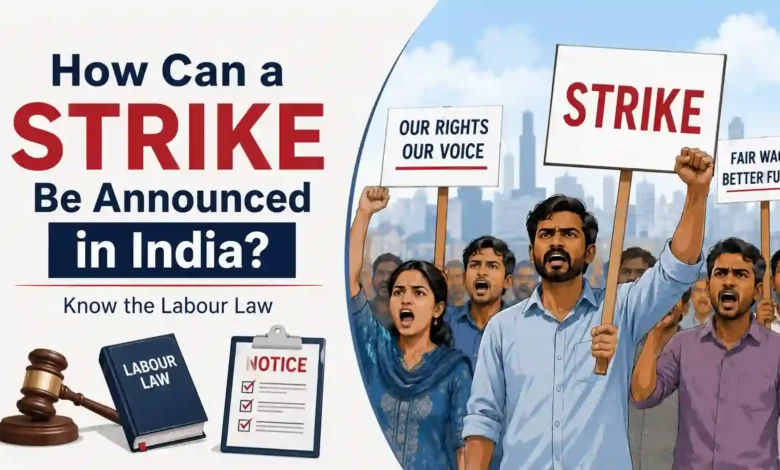
Under the current Indian labour-law framework, a strike cannot simply be started on the day announced by a union. The main provisions are now contained in the Industrial Relations Code, 2020 (IR Code), which came into force on 21 November 2025.
How can a strike be announced legally in India?
1. Employees/union can decide to go on strike
Workers can raise an industrial dispute and their registered trade union can organise a strike. The IR Code does not ban strikes. However, there are mandatory conditions that must be followed. The Labour Ministry specifically says that government permission is not required merely to go on strike, but the 14-day prior notice requirement is mandatory.
2. Strike notice must be given to the employer
Under Section 62 of the Industrial Relations Code, 2020, workers cannot go on strike:
- without giving the required notice to the employer within 60 days before the proposed strike;
- within 14 days of giving the notice;
- before the strike date mentioned in the notice.
So, in simple terms:
Strike Notice → Wait at least 14 days → Strike on the date specified in the notice
The notice cannot be more than 60 days old when the strike takes place.
3. Who should give the notice?
The detailed rules prescribe the manner in which a strike notice is to be given. The 2026 Central Rules provide for the notice to be given to the employer and copies to the concerned conciliation authorities.
For a registered trade union, the rules provide for the notice to be signed by the Secretary and five elected representatives of the concerned registered trade union.
4. What happens after the strike notice?
Once a strike notice is received, the employer has to report the receipt of the notice to the appropriate authority and the Conciliation Officer within five days.
This can trigger the statutory conciliation process, which is intended to try to resolve the dispute before the strike takes place.
5. Strike cannot take place during certain proceedings
Even after giving the required notice, workers cannot legally strike during certain periods, including:
- during conciliation proceedings and 7 days after their conclusion;
- during proceedings before a Tribunal/National Industrial Tribunal and 60 days after their conclusion;
- during specified arbitration proceedings and for the prescribed period afterward;
- while a settlement or award is in operation, in respect of matters covered by that settlement or award.
Example
Suppose a bank employees’ union wants to strike on 30 September. A legally compliant process would broadly be:
1 September: Union gives the required strike notice.
1–14 September: 14-day waiting period.
30 September: Strike may take place, provided no other statutory prohibition applies and the notice/procedure is valid.
Simply announcing on 20 September, “We will go on strike tomorrow,” would not satisfy the 14-day requirement.
| Step | Requirement |
|---|---|
| 1 | Industrial dispute/issue arises |
| 2 | Union decides to organise strike |
| 3 | Proper strike notice given to employer |
| 4 | Notice must be within the 60-day window |
| 5 | Wait at least 14 days |
| 6 | Strike on the date specified in notice |
| 7 | No strike during prohibited conciliation/tribunal/arbitration periods |
| 8 | Other applicable service/settlement rules must also be followed |
Most important: Under the current IR Code, a strike is not automatically illegal, but going on strike without complying with Section 62 can make it an illegal strike. The Code separately provides for illegal strikes and lock-outs under Section 63.