| ➡️ Click here to Join Whatsapp News Group - Get instant updates of all Banking News |
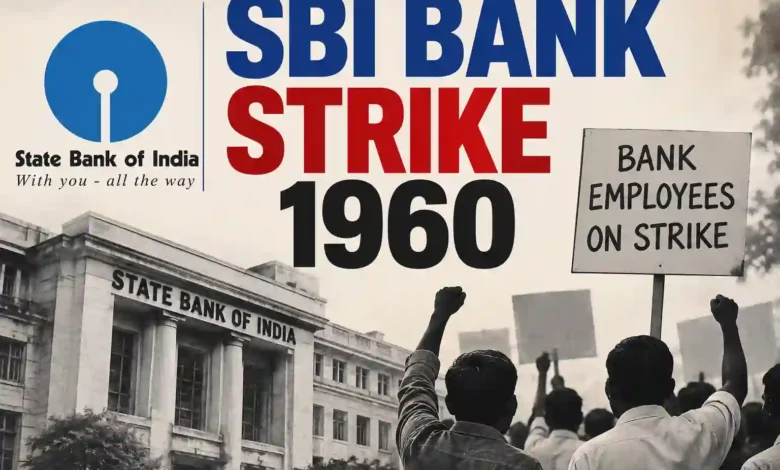
In March 1960, the Indian banking sector witnessed a historic event that changed the future of banking labor movements forever. For 21 days, from March 4 to March 24, 1960, the employees of the State Bank of India (SBI) went on a massive nationwide strike.
This protest was organized by the All India State Bank of India Staff Federation (AISBISF), representing the clerical and subordinate staff. It marked the very first time that workers of a state-owned bank completely shut down operations, proving the immense power of organized union labor in post-independence India.
The 1960 State Bank of India strike was heavily defined by intense internal leadership dynamics, a harsh management crackdown, and a highly anxious public response.
While Charles Coutto signed the ultimate settlement as General Secretary of the Federation, the strike’s daily operations relied on an aggressive network of regional leaders. Figures like C.L. Dudhia in Bombay (Mumbai) and M.R. Awasthi in the Northern Circle organized daily picket lines outside major branches to prevent non-striking officers from opening the vaults.
Why Did the Bank Workers Protest?
The primary reason for the strike was a growing dissatisfaction with working conditions and pay. During the late 1950s, inflation was rising rapidly in India, making standard goods and services much more expensive for the working class. To fight this, the employees demanded immediate monetary relief to cover the rising cost of living.
They also demanded a cash bonus equal to two months’ salary, backdated to 1956. Finally, the staff called for a complete structural rewrite of their general service conditions, including better working hours, fairer leave policies, and a more logical formula for calculating their Dearness Allowance (DA).
The management of SBI and the Government of India did not sit idly by. They used several aggressive tactics to break the morale of the striking workers.
Management quickly approached the courts to declare the strike illegal under the Industrial Disputes Act, warning employees that they faced immediate termination and loss of seniority if they did not return.
Striking employees were legally banned from entering bank premises, forcing them to hold meetings on public streets and pavements outside the buildings.
Management instituted a strict “no work, no pay” rule. For low-income clerical and subordinate staff, surviving 21 days without a paycheck in a high-inflation environment was a grueling test of endurance.
A National Crisis and Political Panic
Because the State Bank of India was the largest financial institution in the country, the total halt of its operations quickly created a massive economic disruption. The strike shook the highest levels of the Indian government.
In 1960, India did not have digital banking, ATMs, or private credit card networks; the economy ran entirely on paper checks and physical cash. Because SBI handled the government’s cash balances and treasury work, the shutdown triggered an immediate financial crisis.
Millions of business cheques were physically stuck in sorting rooms. Merchants could not clear their bills, leading to a massive backlog in import-export docks, particularly at the Bombay and Calcutta ports.
Small traders and shopkeepers who relied on daily cash withdrawals from SBI branches to buy inventory suddenly found themselves completely cut off from their funds.
Major wholesale markets for gold, silver, grain, and cotton ground to a near-total halt because traders refused to ship goods without verified bank guarantees.
What finally forced the government’s hand was the threat of a total systemic collapse. On March 19, 1960, nearly 100,000 workers from other commercial banks across India walked out for a one-day sympathy strike. Seeing that the unrest was about to spread to the Reserve Bank of India (RBI)—which would have frozen the country’s entire monetary system—Finance Minister Morarji Desai dropped his rigid stance and agreed to refer the matter to an independent National Tribunal.
Prime Minister Jawaharlal Nehru expressed deep concern and corresponded urgently with his Labour Minister, Gulzarilal Nanda, and Finance Minister, Morarji Desai, to discuss the issue within the Union Cabinet.
The strike nearly broke the entire country’s financial spine because of a parallel dispute. Just as SBI workers walked out on March 4, the All India Reserve Bank Employees’ Association was locked in its own fierce dispute with the Reserve Bank of India (RBI) management.
The RBI union had formally threatened to launch their own indefinite strike on March 25, 1960. Had the SBI strike continued just one more day, the combination of an SBI shutdown and an RBI freeze would have completely stopped the printing, distribution, and clearing of all currency in India. This terrifying timeline is what forced Finance Minister Morarji Desai to capitulate.
The Resolution and the Famous Desai Award
To ensure a long-term solution, the Government of India handed the dispute over to a special judicial body called the National Industrial Tribunal, chaired by Justice Kantilal T. Desai. The tribunal’s final report, famously known as the Desai Award, completely reshaped Indian banking.
It introduced uniform pay scales, grouped bank branches logically by geographic area, and linked allowances to the consumer price index. Most importantly, it laid the foundation for the system of Bipartite Settlements that Indian banks still use to negotiate wages today.
The strike continued for 21 days and the deadlock finally broke after intense negotiations. The General Secretary of the Federation, Charles Coutto, sent a telegram directing all bank employees to return to their posts, and workers officially resumed duties on March 25, 1960.
Impact of Strike
Before 1960, if bank employees had a grievance, the government would simply appoint a judge to hand down an arbitrary “Award” (like the Sastry Award of 1953) that everyone had to follow. The 1960 strike permanently broke this one-sided cycle.
By proving that bank staff could successfully freeze the national economy, the strike forced the government to view bank unions as equal partners. This hard-fought leverage directly paved the way for the historic First Bipartite Settlement on October 19, 1966. Ever since, bank wages in India have been decided through direct, face-to-face bilateral negotiations rather than court mandates.


![DFS PLI Scheme for Senior Executives of Public Sector Banks (Scale IV and Above including Directors) [PDF]](https://hellobanker.in/wp-content/uploads/2026/03/DFS-PLI-Scheme-for-Senior-Executives-of-Public-Sector-Banks-Scale-IV-and-Above-including-Directors-PDF-390x220.webp)