| ➡️ Click here to Join Whatsapp News Group - Get instant updates of all Banking News |
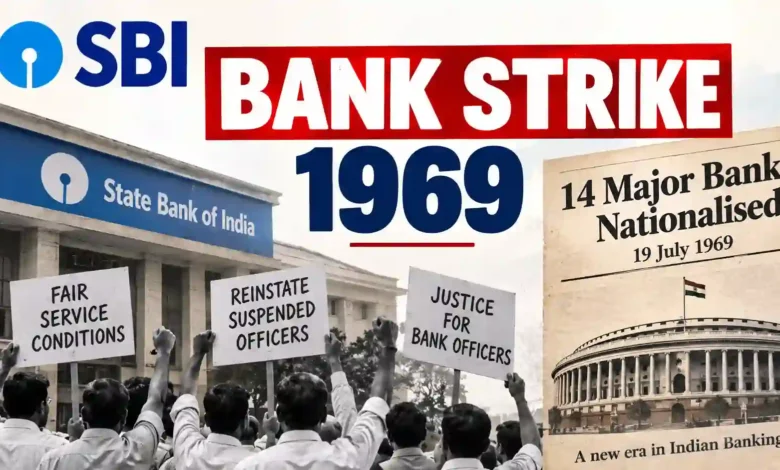
The year 1969 was an important period in the history of Indian banking. Apart from the nationalisation of 14 major commercial banks, the banking sector also witnessed a major strike by officers of the State Bank of India (SBI). The strike was related mainly to service conditions, disciplinary action and issues concerning trade-union activities.
SBI Officers’ Strike in June 1969
In June 1969, SBI officers went on a major strike after differences developed between the bank management and the officers’ organisation. The strike began on 16 June 1969 and spread to different parts of the country. The officers raised several demands relating to their service conditions and the treatment of officers who had participated in trade-union activities.
One of the important issues was the suspension of officers. Protests were conducted against the suspension and victimisation of four bank officers in Bombay (Mumbai).
It was the first major indefinite strike by officer-level bank employees conducted without explicit protection under the Industrial Disputes Act.
The officers’ organisation demanded the reinstatement of suspended officers and opposed the disciplinary action taken against them. The dispute eventually resulted in an indefinite strike, which affected the functioning of SBI branches in several areas.
The strike lasted from June 10 to June 26, 1969 (17 successive days). The strike ended on June 27, 1969, with management agreeing to reinstate the suspended officers and open bilateral dialogues. Just weeks after the strike concluded, Prime Minister Indira Gandhi dramatically nationalised 14 major private commercial banks via an ordinance on July 19, 1969.
The four senior State Bank of India (SBI) officers were suspended in June 1969 due to their legitimate trade union and non-cooperation activities at the SBI Bombay Main Branch.
At the time, the management did not recognize the right of managerial-level and supervisory officers to form a trade union or take collective action.
The employees started agitation seeking better service conditions and the right to collectively bargain. The newly forming officers’ association engaged in a non-cooperation movement. As part of this protest, Head Cashiers and supervisory staff refused to part with or hand over the vault keys to the management.
On June 9, 1969, the supervisory staff and key-holders took a unified mass casual leave.
Viewing this as a direct breach of discipline and an existential threat to management authority, the bank retaliated. On June 11, 1969, the bank relieved four senior key-holding officers (including prominent union leader Com V.H. Khedgikar) of their duties and officially placed them under suspension pending disciplinary action.
The management thought that the fear of these suspensions would break the agitation through intimidation. Instead, the move backfired completely, triggering a spontaneous, furious wave of solidarity that erupted into the historic 17-day nationwide strike.
Faced with an unprecedented global anomaly—the BBC reported it as the first indefinite strike by supervisory cadre in the world—the bank was forced to capitulate.
The suspension of Com V.H. Khedgikar and the three other comrades was revoked completely. Not only were they brought back, but they were also paid full salaries and allowances for the duration of the suspension, with the entire period legally treated as being “on duty”. This was an extraordinary victory, ensuring zero disciplinary marks on their professional records.
Before the strike, management relied on “imperial and draconian rules” to claim that officers, as part of administration, had no legal right to unionize or engage in collective bargaining under the Industrial Disputes Act.
The bank agreed to establish Central and Circle Negotiation Councils. This ended the era where officers were entirely at the mercy of their superiors for pay or leave. It introduced regularized, structured bilateral meetings to resolve grievances professionally.
The management formally recognized the All India State Bank Officers’ Federation (AISBOF) (spearheaded by early leaders like Com L.V. Subramanyam, Com S.K. Mishra, and Com A.V. Rajwade) as the sole collective bargaining representative for all officer-level staff.
The success of AISBOF triggered a domino effect across the nation. Following the nationalisation of 14 major commercial banks just weeks later in July 1969, officers across all banks used this blueprint to form their own trade unions, culminating in massive apex bodies like the All India Bank Officers’ Confederation (AIBOC).
Once AISBOF secured its seat at the negotiating table, it systematically dismantled the exploitative working conditions of the 1960s. Some of their earliest major structural achievements included:
- Introduction of basic workplace rights like Casual Leave and Sick Leave for officers (prior to this, officers had no fixed leave structures).
- Formulation of fair and transparent placement, transfer, and promotion policies, ending arbitrary managerial victimization.
- Ensuring the right to defend a colleague during disciplinary inquiries using principles of natural justice.
Strike Came Before Bank Nationalisation
The SBI strike took place only about one month before one of the biggest developments in Indian banking history. On 19 July 1969, the Government of India nationalised 14 major commercial banks.
At that time, Prime Minister Indira Gandhi was leading the government. The nationalisation was carried out through the Banking Companies (Acquisition and Transfer of Undertakings) Ordinance, 1969.
14 Banks Were Nationalised
The 14 banks nationalised in July 1969 were Central Bank of India, Bank of Maharashtra, Dena Bank, Punjab National Bank, Syndicate Bank, Canara Bank, Indian Overseas Bank, Indian Bank, Bank of Baroda, Union Bank of India, Allahabad Bank, United Bank of India, UCO Bank and Bank of India.
These banks were among the country’s major commercial banks and had deposits above the prescribed threshold of ₹50 crore.
Why Was Bank Nationalisation Important?
Bank nationalisation changed the structure and direction of Indian banking. The government wanted banking resources to be used for wider economic development rather than being concentrated mainly in large businesses and urban areas.
After nationalisation, greater emphasis was placed on expanding banking services to rural and semi-urban areas, increasing credit availability for agriculture and small businesses, and supporting weaker sections of society.
The move also resulted in a greater government role in the banking sector. Public sector banks subsequently became an important part of India’s financial system.


![DFS PLI Scheme for Senior Executives of Public Sector Banks (Scale IV and Above including Directors) [PDF]](https://hellobanker.in/wp-content/uploads/2026/03/DFS-PLI-Scheme-for-Senior-Executives-of-Public-Sector-Banks-Scale-IV-and-Above-including-Directors-PDF-390x220.webp)