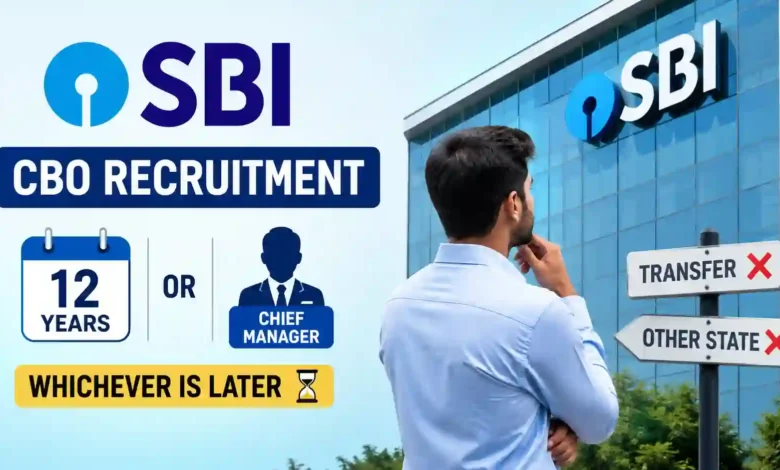
The State Bank of India (SBI) recruites candidates for the post of Circle Based Officer (CBO). Under this recruitment, candidates are selected to work in the state for which they apply. For example, if a candidate applies for the Uttar Pradesh circle, they will normally be posted and serve in Uttar Pradesh. The recruitment is a good opportunity for experienced banking professionals, but one service condition in the notification has started a discussion among candidates.
What is the Service Bond Condition?
According to the SBI CBO recruitment notification, a selected candidate must serve in the allotted circle for at least 12 years or until promotion to the post of Chief Manager, whichever is later.
At first glance, this condition may not seem unusual. However, the words “whichever is later” have become the main point of discussion among banking aspirants.
What Does “Whichever is Later” Mean?
The phrase “whichever is later” means that a candidate must satisfy both conditions before becoming eligible for an inter-circle transfer.
For example, if a candidate joins as an SBI CBO in Uttar Pradesh, they will have to continue serving in Uttar Pradesh until they complete 12 years of service and also become a Chief Manager. If one of these conditions is not fulfilled, they cannot move to another state.
Example 1: Employee Completes 12 Years but Does Not Become Chief Manager
Suppose an employee completes 12 years of service but has not been promoted to the post of Chief Manager. This may happen if the employee does not opt for promotion or is promoted slowly.
Under the current SBI rule, the employee will still have to remain in the same state. Even after completing 12 years, they cannot seek transfer to another state until they become a Chief Manager.
Example 2: Employee Becomes Chief Manager Before 12 Years
Now consider another case where an employee becomes a Chief Manager before completing 12 years of service.
Even in this situation, the employee cannot move to another state immediately. They must continue serving in the same state until they complete 12 years of service.
This is because the notification says “whichever is later.”
How is This Different from Other Public Sector Banks?
Many candidates have compared SBI’s rule with the recruitment policies of other public sector banks such as Punjab National Bank (PNB), Bank of Baroda, Union Bank of India, and Indian Bank.
These banks recruit officers under the name Local Bank Officer (LBO), which is similar to SBI’s Circle Based Officer (CBO) recruitment. In both cases, candidates are recruited for a particular state or region.
However, the notifications of these banks generally use the phrase “whichever is earlier” instead of “whichever is later.”
What Does “Whichever is Earlier” Mean?
Under the “whichever is earlier” rule, an employee can become eligible for transfer if either of the two conditions is fulfilled first.
For example:
- If the employee completes 12 years of service, they can apply for transfer even if they have not become a Chief Manager.
- If the employee becomes a Chief Manager before completing 12 years, they can also become eligible for transfer.
Many candidates believe this rule is more flexible because it gives employees an opportunity to move to another state after meeting either one of the conditions.
Why Are Candidates Raising This Issue?
Every year, many candidates apply for banking jobs outside their home state due to limited vacancies and high competition. For example, candidates from Uttar Pradesh may apply for vacancies in Madhya Pradesh, while candidates from Madhya Pradesh may apply in other states where more vacancies are available.
After joining the bank, many employees hope to return to their home state after serving for a reasonable period. Critics argue that if other public sector banks allow employees to change their state after a fixed period or after promotion, SBI should also provide a similar option.
According to them, the condition of “whichever is later” keeps employees in one state for a much longer period, even after they have completed 12 years of service or received a promotion.
What Are Critics Demanding?
Critics believe SBI should review this service condition. They suggest that the bank should replace the words “whichever is later” with “whichever is earlier.”
According to this view, employees should become eligible for transfer after completing 12 years of service or after becoming a Chief Manager, whichever happens first. They believe this would make SBI’s policy similar to that followed by several other public sector banks and provide more flexibility to employees.
Final Thoughts
The SBI CBO recruitment offers a stable career and the opportunity to work in a specific state. However, the service condition requiring employees to stay in the allotted circle for 12 years or until becoming a Chief Manager, whichever is later, has become a topic of discussion among banking aspirants. While some believe the rule helps maintain continuity in staffing, others feel it is more restrictive than the policies followed by several other public sector banks.
What do you think? Should SBI continue with the “whichever is later” rule, or should it change the condition to “whichever is earlier”? Share your opinion in the comments.
References 👇
PNB LBO Notification PDF – latest notification Out
Indian Bank LBO Notification PDF
Bank of Baroda LBO Notification PDF
Union Bank of India LBO Notification PDF