| ➡️ Click here to Join Whatsapp News Group - Get instant updates of all Banking News |
The Reserve Bank of India (RBI) has released preliminary data on India’s Balance of Payments (BoP) for the fourth quarter (January-March) of the financial year 2025-26. The data shows that India continued to record a current account surplus during the quarter, although the surplus was lower than the previous year.
First understand what is current account surplus?
Current Account Surplus means a country is earning more money from the rest of the world than it is spending on international transactions during a specific period.
The current account mainly includes:
- Exports and imports of goods (trade)
- Exports and imports of services (IT services, tourism, consulting, etc.)
- Investment income (interest, dividends, profits)
- Remittances (money sent home by Indians working abroad)
In simple terms, Imagine India receives $100 from exports of goods and services and $20 from remittances and other income. Total money coming in = $120. At the same time, India spends $110 on imports and other payments abroad.
Total money going out = $110 So Current Account Surplus = $120 – $110 = $10. This means India earned $10 billion more than it spent.
Current Account Surplus Declines
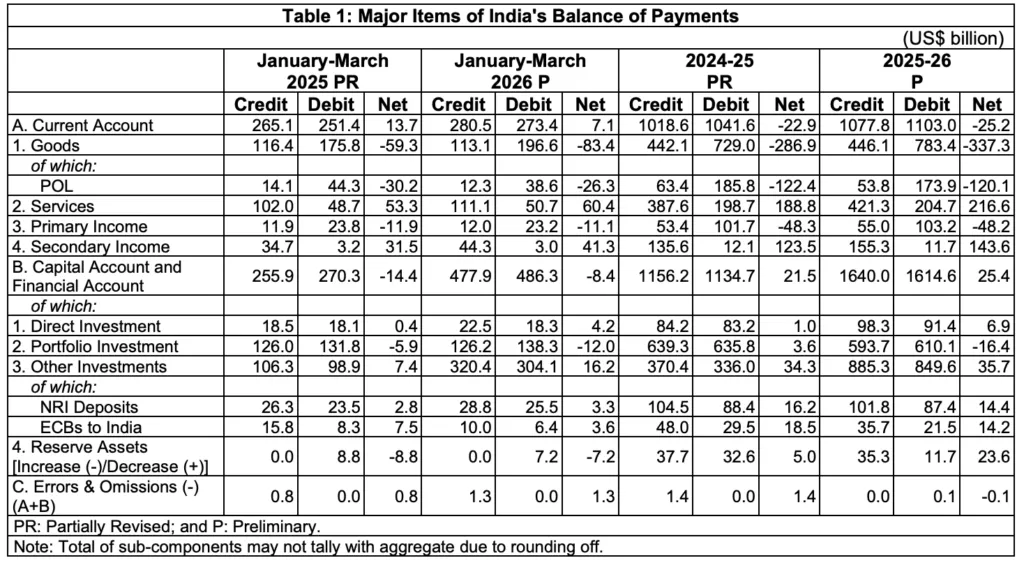
India’s current account surplus stood at US$ 7.1 billion, equivalent to 0.7% of GDP, during the January-March 2025-26 quarter. In the same quarter of the previous financial year, the surplus was US$ 13.7 billion, or 1.4% of GDP. This indicates that while India remained in surplus, the amount of surplus reduced significantly.
Trade Deficit Widens
One of the major reasons for the lower current account surplus was the increase in the merchandise trade deficit. India’s goods trade deficit rose to US$ 83.4 billion during the quarter, compared to US$ 59.3 billion in the corresponding quarter of 2024-25.
A trade deficit occurs when a country imports more goods than it exports. The higher deficit shows that India’s import bill increased more rapidly than its merchandise exports during the quarter.
Services Sector Provides Strong Support
The services sector continued to be a major strength for the Indian economy. Net services receipts increased to US$ 60.4 billion in the January-March 2025-26 quarter, up from US$ 53.3 billion a year earlier.
According to RBI data, exports of services such as computer services, IT services, and other business services registered healthy growth compared to the previous year. Strong performance of these sectors helped offset part of the higher trade deficit.
Investment Income Payments Decline
The net outflow under the primary income account, which mainly includes payments related to investments and earnings by foreign investors, declined slightly.
The net outflow stood at US$ 11.1 billion in the fourth quarter of 2025-26, compared to US$ 11.9 billion in the same period last year. This reduction provided some support to India’s external balance.
Overseas Remittances Reach Higher Levels
Money sent home by Indians working abroad remained one of the biggest contributors to India’s external sector.
Personal transfer receipts, mainly representing remittances from overseas Indians, increased sharply to US$ 43.5 billion during the quarter. In the same quarter last year, remittance inflows stood at US$ 33.9 billion.
The strong growth in remittances helped strengthen India’s current account position despite the wider trade deficit.
FDI Inflows Improve
Foreign Direct Investment (FDI), which represents long-term investment by foreign companies and investors, showed improvement during the quarter.
Net FDI inflows stood at US$ 4.2 billion in January-March 2025-26, compared to just US$ 0.4 billion during the same quarter of 2024-25. This indicates increased investor confidence in India’s long-term growth prospects.
Foreign Portfolio Investors Continue to Withdraw Funds
While FDI improved, foreign portfolio investments (FPI) remained under pressure.
FPIs recorded a net outflow of US$ 12.0 billion during the quarter, compared to a net outflow of US$ 5.9 billion a year earlier. This means foreign investors sold more Indian financial assets than they purchased during the period.
NRI Deposits Increase
Deposits made by Non-Resident Indians (NRIs) with Indian banks continued to grow.
Net inflows under NRI deposits reached US$ 3.3 billion in the fourth quarter of 2025-26, higher than US$ 2.8 billion in the corresponding quarter of the previous year.
External Commercial Borrowings Decline
Net inflows through External Commercial Borrowings (ECBs), which are loans taken by Indian companies from foreign lenders, stood at US$ 3.6 billion during the quarter. This was lower than the US$ 7.5 billion recorded in the same quarter of 2024-25.
Forex Reserves Rise During the Quarter
India’s foreign exchange reserves increased by US$ 7.2 billion on a Balance of Payments basis during the January-March quarter. However, the increase was lower than the US$ 8.8 billion rise recorded in the same quarter of the previous year.
Full-Year 2025-26 Performance
Looking at the entire financial year 2025-26, India’s current account deficit stood at US$ 25.2 billion, equivalent to 0.6% of GDP. In 2024-25, the deficit was US$ 22.9 billion, also equal to 0.6% of GDP.
Although the deficit increased slightly in absolute terms, it remained stable as a percentage of GDP.
Invisibles Receipts Show Strong Growth
Net invisibles receipts, which include services exports, investment income, and remittances, increased significantly during 2025-26.
These receipts rose to US$ 312 billion, compared to US$ 264 billion in the previous financial year. The increase was mainly driven by higher services earnings and stronger remittance inflows.
FDI Improves, FPI Turns Negative for the Year
For the entire financial year 2025-26, net FDI inflows increased to US$ 6.9 billion, compared to US$ 1.0 billion in 2024-25.
However, foreign portfolio investors recorded net outflows of US$ 16.4 billion during the year. In contrast, they had recorded net inflows of US$ 3.6 billion in the previous year.
Forex Reserves Decline During FY 2025-26
Despite the increase during the March quarter, India’s foreign exchange reserves declined by US$ 23.6 billion during the full financial year 2025-26 on a Balance of Payments basis. This was significantly higher than the decline of US$ 5.0 billion recorded in 2024-25.
The RBI data shows that India’s external sector remained resilient during 2025-26. Strong growth in services exports, rising remittances from overseas Indians, and higher FDI inflows supported the economy. However, a wider merchandise trade deficit, continued FPI outflows, and a decline in foreign exchange reserves posed challenges. Overall, India’s current account deficit remained manageable at 0.6% of GDP, highlighting the economy’s ability to maintain external stability despite global uncertainties.