Public Sector Banks Reduce NPA by Nearly 60% Since 2021, Check Last 5 years NPA in PSU Banks

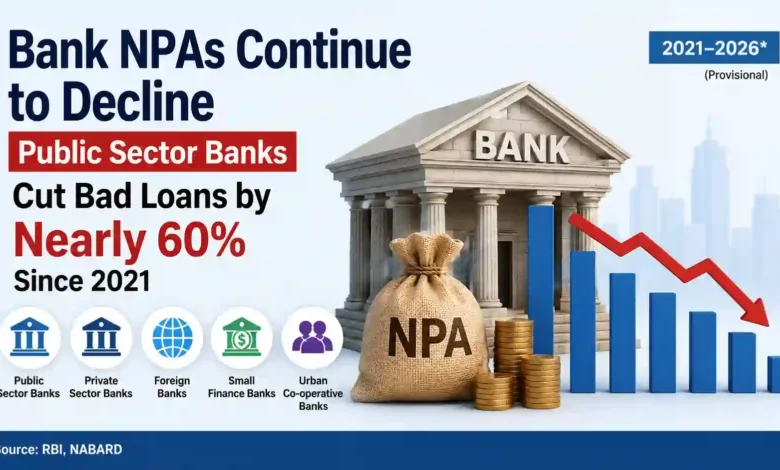
The Government has released the latest data on Non-Performing Assets (NPAs) of different categories of banks in India. Public Sector Banks have witnessed the biggest improvement in asset quality since 2021. Their NPAs declined from Rs. 6,16,616 crore as on 31 March 2021 to Rs. 2,45,634 crore as on 31 March 2026 (provisional). This represents a reduction of nearly 60% over five years.
The Details of the Non-Performing Assets (NPAs) in Public Sector Banks, Private Sector Banks, Foreign Banks, Small Finance Banks and Urban Co-operative Banks since 2021
(Amounts in crore Rs.)
| NPA as on | PSBs | PVBs | Foreign Banks | Small Finance Banks | Urban Co-operative Banks |
|---|---|---|---|---|---|
| 31.3.2021 | 6,16,616 | 2,02,266 | 10,199 | 5,971 | 37,993 |
| 31.3.2022 | 5,40,958 | 1,80,742 | 13,786 | 6,911 | 32,348 |
| 31.3.2023 | 4,28,197 | 1,25,212 | 9,526 | 8,608 | 29,203 |
| 31.3.2024 | 3,39,541 | 1,29,047 | 6,523 | 5,590 | 25,320 |
| 31.3.2025 | 2,83,650 | 1,32,646 | 5,321 | 9,989 | 23,432 |
| 31.3.2026* | 2,45,634 | 1,26,410 | 3,990 | 10,448 | 21,769 |
Source: RBI
*(Provisional data for 2025–26)
NPA in Rural Co-operative Banks
(Amounts in crore Rs.)
| NPA as on | State Co-operative Banks | District Co-operative Banks |
|---|---|---|
| 31.3.2021 | 14,113 | 34,610 |
| 31.3.2022 | 14,332 | 36,322 |
| 31.3.2023 | 14,296 | 35,723 |
| 31.3.2024 | 14,513 | 37,077 |
| 31.3.2025 | 15,539 | 38,368 |
| 31.3.2026 | 16,422 | 35,483 |
Source: NABARD
Public Sector Banks Record Sharp Decline in NPAs
Public Sector Banks have witnessed the biggest improvement in asset quality since 2021. Their NPAs declined from Rs. 6,16,616 crore as on 31 March 2021 to Rs. 2,45,634 crore as on 31 March 2026 (provisional). This represents a reduction of nearly 60% over five years, indicating better loan recovery, improved credit monitoring, and stronger financial health of public sector banks.
Private Sector Banks Also Show Improvement
Private Sector Banks have also reduced their bad loans compared to 2021. NPAs declined from Rs. 2,02,266 crore in March 2021 to Rs. 1,26,410 crore in March 2026 (provisional). Although there was a slight increase during 2024 and 2025, the overall trend shows that private banks have maintained better asset quality compared to five years ago.
Foreign Banks Register Continuous Improvement
Foreign Banks operating in India have recorded one of the strongest improvements in NPA levels. Their NPAs have fallen from Rs. 10,199 crore in March 2021 to Rs. 3,990 crore in March 2026 (provisional). This steady decline indicates better loan recovery and improved management of credit risk.
Small Finance Banks See Rise in Bad Loans
Unlike most other banking categories, Small Finance Banks (SFBs) have experienced an increase in NPAs over the last five years. Their NPAs increased from Rs. 5,971 crore in March 2021 to Rs. 10,448 crore in March 2026 (provisional). Although there was a temporary decline in 2024, NPAs increased again in 2025 and 2026, indicating that these banks continue to face challenges in maintaining asset quality.
Urban Co-operative Banks Continue to Improve
Urban Co-operative Banks have also shown steady improvement in reducing bad loans. Their NPAs declined from Rs. 37,993 crore in March 2021 to Rs. 21,769 crore in March 2026 (provisional). The data reflects a consistent downward trend over the years, suggesting better recovery efforts and improved financial performance.
Rural Co-operative Banks Show Mixed Trend
The data for Rural Co-operative Banks presents a mixed picture. State Co-operative Banks have seen a gradual increase in NPAs, rising from Rs. 14,113 crore in March 2021 to Rs. 16,422 crore in March 2026. On the other hand, District Co-operative Banks reported NPAs of Rs. 34,610 crore in March 2021, which increased to Rs. 38,368 crore by March 2025 before declining to Rs. 35,483 crore in March 2026. This indicates that while there has been some improvement recently, NPAs remain relatively high in the rural co-operative banking sector.