| ➡️ Click here to Join Whatsapp News Group - Get instant updates of all Banking News |
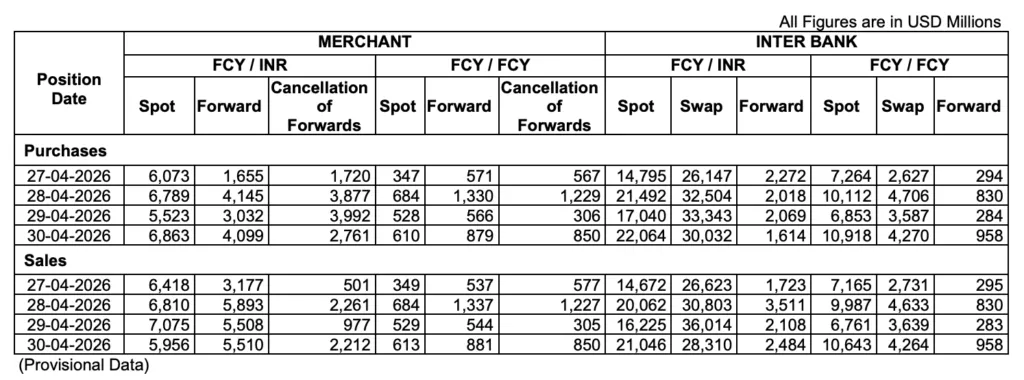
The Reserve Bank of India (RBI) has released data showing how much foreign currency was bought and sold in India’s foreign exchange (forex) market between April 27 and April 30, 2026.
The data tracks daily transactions carried out by businesses, customers, and banks. It helps understand how actively foreign currencies such as the US Dollar, Euro, Pound, and Yen are being traded in India.
Who Participates in the Forex Market?
The RBI data covers two main groups:
Merchant Transactions: These are transactions carried out by exporters, importers, companies, and individual customers. For example, an importer buying US Dollars to pay a foreign supplier or an exporter selling Dollars received from overseas customers.
Inter-Bank Transactions: These are transactions between banks. Banks regularly buy and sell foreign currencies among themselves to meet customer demand and manage their own currency requirements.
Understanding the Different Types of Transactions
The report includes different types of foreign exchange deals:
- FCY/INR Transactions: Exchange of foreign currency with Indian Rupees. For example, converting US Dollars into Rupees.
- FCY/FCY Transactions: Exchange of one foreign currency for another, such as US Dollars for Euros.
- Spot Transactions: Currency is bought or sold immediately at the current market rate.
- Forward Contracts: A future exchange rate is fixed today for a transaction that will happen later.
- Swap Transactions: Banks buy and sell currencies simultaneously for different dates to manage liquidity and currency risk.
- Cancellation of Forward Contracts: Previously booked forward contracts that are cancelled before maturity.
Business and Customer Transactions Remain Strong
The data shows that businesses and customers remained active in the forex market during the four-day period.
On April 30, merchants purchased foreign currency worth US$ 6.86 billion in the spot market and sold foreign currency worth US$ 5.96 billion.
Businesses also continued to use forward contracts to protect themselves from future currency fluctuations. Forward purchases stood at US$ 4.10 billion, while forward sales were US$ 5.51 billion.
The report also shows that some companies cancelled previously booked forward contracts. On April 30 alone, forward contract cancellations amounted to US$ 2.76 billion on the purchase side and US$ 2.21 billion on the sales side.
Banks Handle Much Larger Volumes
The inter-bank market recorded much larger trading volumes than customer transactions.
On April 30, banks purchased foreign currency worth US$ 22.06 billion in the spot market and sold US$ 21.05 billion.
The biggest activity was seen in swap transactions. Banks carried out swap purchases worth US$ 30.03 billion and swap sales worth US$ 28.31 billion.
This indicates that banks were actively managing their foreign currency positions and ensuring adequate liquidity in the market.
April 28 Sees Highest Trading Activity
Among the four days covered in the report, April 28 witnessed some of the highest trading volumes.
Inter-bank swap purchases touched US$ 32.50 billion, while foreign currency-to-foreign currency spot purchases crossed US$ 10.11 billion.
Merchant forward purchases also exceeded US$ 4.14 billion, showing that companies were actively hedging against future currency movements.
Trading Between Foreign Currencies Also Remains High
Apart from Rupee-related transactions, banks and businesses also traded large amounts of foreign currencies with each other.
On April 30, merchant purchases in foreign currency-to-foreign currency transactions reached US$ 610 million in the spot market and US$ 879 million in forward contracts.
In the inter-bank market, banks purchased foreign currencies worth US$ 10.92 billion against other foreign currencies, highlighting significant international currency trading activity.
Why Is This Data Important?
Foreign exchange turnover data helps measure activity in the forex market. High trading volumes usually indicate strong participation from exporters, importers, banks, investors, and multinational companies.
The data also provides clues about:
- Demand for foreign currencies
- Business confidence in international trade
- Hedging activity by companies
- Liquidity available in the forex market
- Overall movement in India’s foreign exchange market
The RBI data shows that India’s forex market remained highly active between April 27 and April 30, 2026. Businesses continued to buy and sell foreign currencies for trade and investment purposes, while banks handled much larger volumes to manage liquidity and currency risks. The strong trading activity reflects the importance of foreign exchange transactions in supporting India’s growing international trade and financial activities.