India’s Foreign Exchange Reserves Rise by $22.8 Billion in FY26 Despite Balance of Payments Pressure: RBI

| ➡️ Click here to Join Whatsapp News Group - Get instant updates of all Banking News |
The Reserve Bank of India (RBI) has released data on India’s Foreign Exchange Reserves. The data shows that while India’s foreign exchange reserves increased by US$ 22.8 billion during the year, the rise was mainly due to valuation gains rather than actual foreign currency inflows.
What Are Foreign Exchange Reserves?
Foreign exchange reserves are assets held by the RBI in foreign currencies, gold, Special Drawing Rights (SDRs), and reserve positions with international institutions. These reserves help the country meet international payment obligations, stabilize the currency, and deal with external economic shocks.
Current Account Deficit Remains High
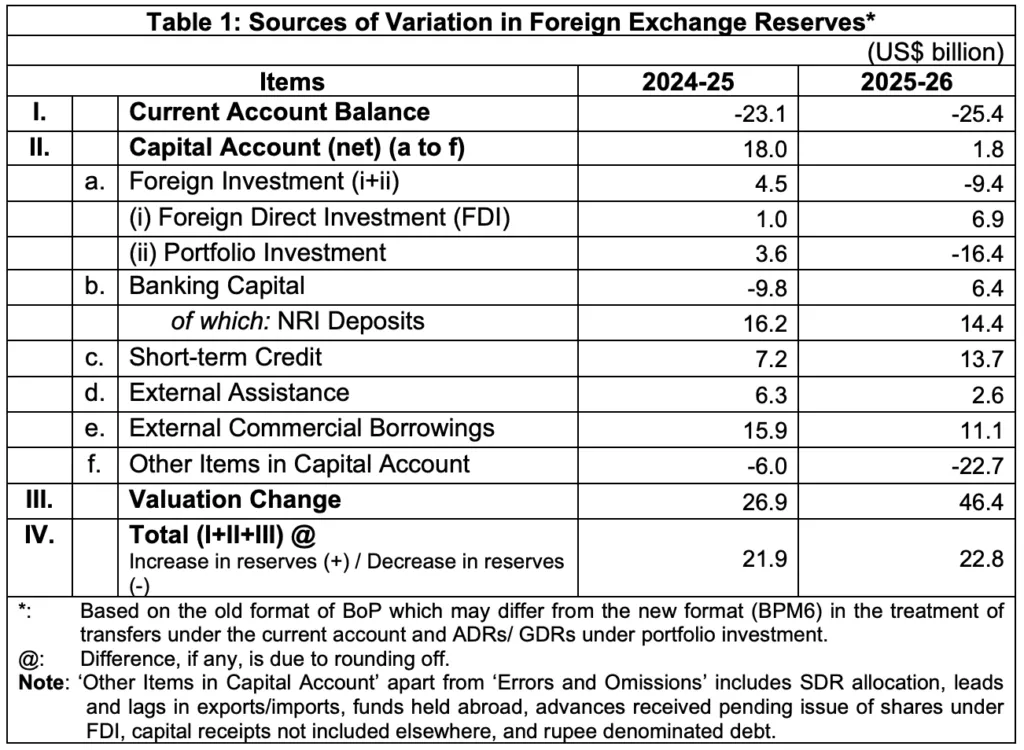
According to RBI data, India’s current account balance remained negative during FY26. The current account deficit stood at US$ 25.4 billion, compared to a deficit of US$ 23.1 billion in FY25. A current account deficit occurs when a country spends more on imports, overseas payments, and other international transactions than it earns from exports and foreign income.
The larger deficit placed pressure on the country’s external sector and contributed to the decline in reserves on a Balance of Payments basis.
Capital Inflows Slow Sharply
The capital account, which includes foreign investments, loans, deposits, and borrowings, recorded net inflows of only US$ 1.8 billion during FY26. In the previous financial year, capital account inflows were much higher at US$ 18.0 billion. This sharp decline indicates that foreign capital entered India at a much slower pace during FY26.
Foreign Investment Sees Major Change
Foreign investment showed mixed trends during the year.
FDI Inflows Increase
Foreign Direct Investment (FDI), which represents long-term investment by foreign companies in India, increased significantly. Net FDI inflows rose to US$ 6.9 billion in FY26 from US$ 1.0 billion in FY25. This suggests continued confidence among long-term investors in India’s economic growth prospects.
Portfolio Investments Turn Negative
However, Foreign Portfolio Investment (FPI) recorded a sharp reversal. FPIs registered net outflows of US$ 16.4 billion during FY26, compared to net inflows of US$ 3.6 billion in FY25. This means foreign investors withdrew substantial funds from Indian stock and debt markets during the year.
As a result, total foreign investment moved from a positive US$ 4.5 billion in FY25 to a negative US$ 9.4 billion in FY26.
Banking Capital Improves
India received stronger support from banking-related capital flows. Banking capital increased to US$ 6.4 billion in FY26 compared to a negative US$ 9.8 billion in FY25. This improvement helped offset some of the weakness in foreign investment flows.
Within banking capital, NRI deposits remained an important source of foreign funds. Net inflows under NRI deposits stood at US$ 14.4 billion during FY26, although this was slightly lower than US$ 16.2 billion recorded in FY25.
Growth in Short-Term Credit
Short-term credit inflows increased significantly during the year. These inflows rose to US$ 13.7 billion in FY26 from US$ 7.2 billion in FY25. This indicates greater use of short-term international credit facilities by businesses and financial institutions.
External Assistance and Borrowings
External assistance, which includes aid and loans from international institutions and foreign governments, declined to US$ 2.6 billion from US$ 6.3 billion a year earlier.
Similarly, net inflows under External Commercial Borrowings (ECBs) fell to US$ 11.1 billion in FY26 from US$ 15.9 billion in FY25. ECBs are loans taken by Indian companies from overseas lenders.
Other Capital Account Items Record Large Outflow
A significant drag came from “Other Items in Capital Account,” which recorded a negative US$ 22.7 billion during FY26 compared to a negative US$ 6.0 billion in FY25. According to RBI, this category includes SDR allocations, export-import payment timing differences, funds held abroad, advances received for FDI, and rupee-denominated debt.
Why Did Reserves Increase Despite Weak External Flows?
The most important factor behind the rise in reserves was the valuation gain.
Valuation gains increased sharply to US$ 46.4 billion in FY26 from US$ 26.9 billion in FY25. RBI said this gain was mainly due to the increase in global gold prices and the depreciation of the US dollar against major international currencies. When these factors change, the value of RBI’s reserve assets rises even without any additional inflow of foreign currency.
Reserves Fall on BoP Basis but Rise in Nominal Terms
The RBI highlighted an important difference between reserves measured on a Balance of Payments (BoP) basis and reserves measured in nominal terms.
On a BoP basis, which excludes valuation effects, India’s foreign exchange reserves actually declined by US$ 23.6 billion during FY26. This was much larger than the decline of US$ 5.0 billion recorded in FY25.
However, after including valuation gains, India’s foreign exchange reserves increased by US$ 22.8 billion during FY26, slightly higher than the increase of US$ 21.9 billion recorded in FY25.
The RBI data shows that India’s foreign exchange reserves remained strong during FY26, but the increase was largely driven by favourable valuation gains rather than actual foreign currency inflows. Higher gold prices and movements in global currencies helped boost reserve values. At the same time, a wider current account deficit, large FPI outflows, and weaker capital inflows put pressure on India’s external sector. Despite these challenges, the country’s reserve position remained resilient, providing an important cushion against global economic uncertainties.