| ➡️ Click here to Join Whatsapp News Group - Get instant updates of all Banking News |
The Government of India has stated in the Lok Sabha and Rajya Sabha that there is currently no proposal under consideration to revise the basic pension of retirees of Public Sector Banks (PSBs).
The information was shared by Minister of State for Finance Pankaj Chaudhary in response to an unstarred question (No. 2709) asked by Konda Vishweshwar Reddy in the Lok Sabha on March 9, 2026 and in the Rajya Sabha in response to a question raised by MP S. Selvaganabathy.
Lok Sabha Letter

Rajya Sabha Letter
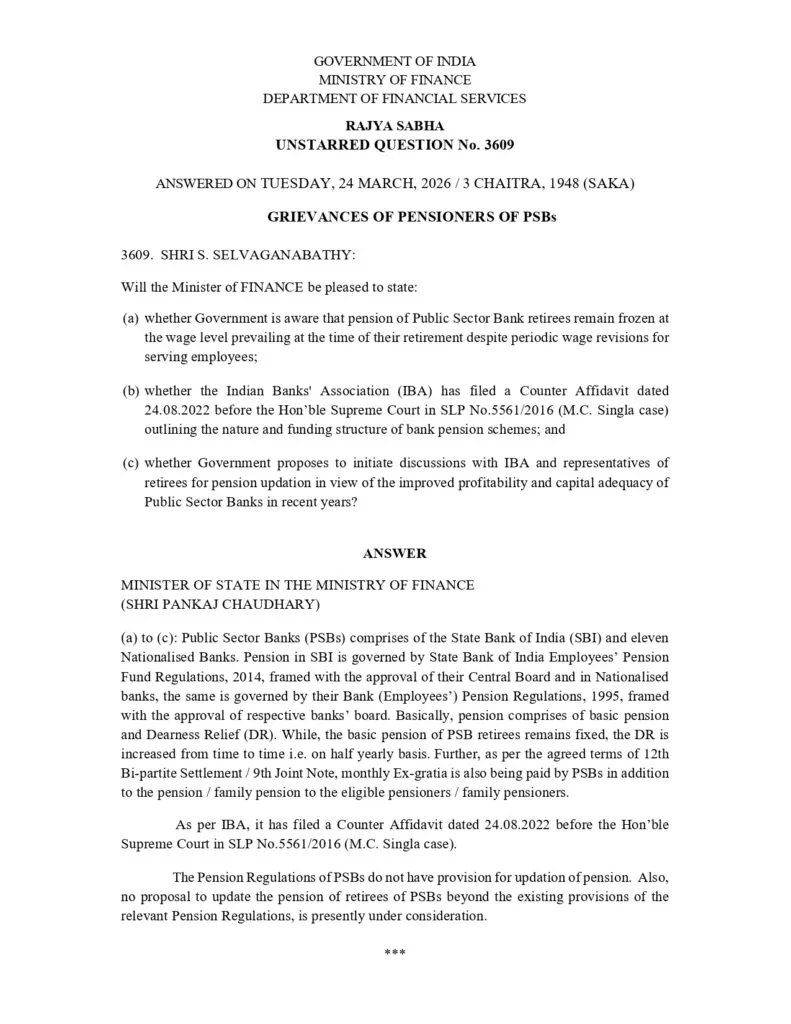
The government clarified that pension rules for PSB employees are governed by existing regulations. In the State Bank of India (SBI), pension is managed under the 2014 pension rules, while in other nationalised banks, it is governed by the 1995 pension regulations. The government stated that these regulations do not contain any provision for revision of pension.
The Government said that although there is no provision for pension revision, the pensioners of Public Sector Banks receive Dearness Relief (DR) on their pensions. This Dearness Relief is revised every six months, which provides periodic increases in pension payments.
In addition, as per the 12th Bipartite Settlement and the 9th Joint Note, monthly ex-gratia payments are also being provided by Public Sector Banks. This ex-gratia amount is paid in addition to pension or family pension to pensioners and family pensioners who became eligible to receive pension on or before October 31, 2022.
The Indian Banks’ Association (IBA) has already filed a counter affidavit in the Supreme Court in the M.C. Singla case related to pension issues. Importantly, the government stated that current pension rules do not provide for pension updation, and no proposal is under consideration to revise pensions beyond existing provisions. This means that despite improved performance and profits of banks, retired employees will continue to receive pensions as per the existing rules.
10% Increase in RBI Pension Approved
Recently, the Government of India has increased the basic pension of RBI Employees by 10% along with dearness relief. The increase will be applicable with effect from November 1, 2022, and will benefit all RBI pensioners who retired before November 1, 2022.
Pension Revision in NABARD
The pensions of all NABARD employees who retired before November 1, 2017 have also been revised. The revised pension became effective from:
- March 1, 2019 for retirees who retired before November 1, 2012
- June 12, 2023 for retirees who retired before November 1, 2017
A pension is a regular payment given to employees after retirement. It provides financial support when a person stops working due to age. Pension is an important part of financial security for employees and their families.
Financial Security
Pension provides a steady source of income after retirement, helping retirees manage their daily expenses.
Support in Old Age
As people grow older, their ability to work decreases. Pension helps them live with dignity and independence.
Medical and Living Expenses
After retirement, medical expenses often increase. Pension helps cover healthcare and other essential costs.
Family Protection
Many pension schemes provide family pension, which supports the spouse or dependents after the employee’s death.
A strong pension system helps employees feel secure about their future and motivates them to work with confidence during their service years.
In another update, the Government of India has introduced a new PLI scheme for Public Sector Banks. As per this new scheme, senior executives of banks (Scale IV and above) will be paid PLI up to 100% of their Basic Pay. This means they will get almost double salary, whereas junior officers (up to) Scale III will get only 15 days of basic pay as PLI.
Bankers are criticizing that the government can pay crores of rupees as PLI to senior executives but can not revise the pension of bank employees. What you think – do let us know in the comment section below.