| ➡️ Click here to Join Whatsapp News Group - Get instant updates of all Banking News |
Goods and Services Tax (GST) is an indirect tax system introduced in India on 1 July 2017. It replaced many old taxes such as VAT, service tax, excise duty, and other indirect taxes. GST is charged on the supply of goods and services across the country.
The main purpose of introducing GST was to create a simple and uniform tax system in India. Today, most businesses and service providers in the country come under the GST system.
GST registration means enrolling a business under the GST system. After registration, the business receives a GSTIN (Goods and Services Tax Identification Number). Businesses registered under GST can collect tax from customers and deposit it with the government.
GST registration becomes mandatory once a business crosses the turnover limit fixed by the government in a financial year.
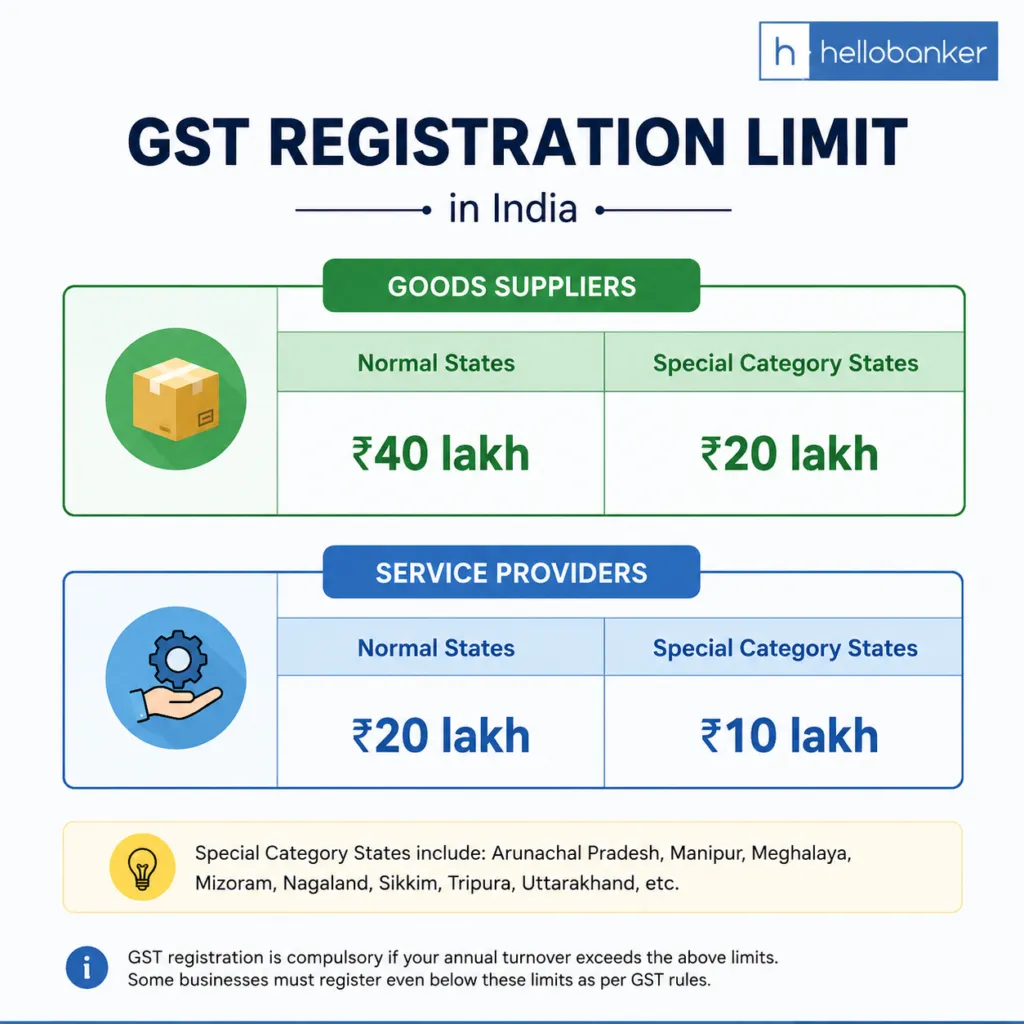
As per GST Department, For goods suppliers, the GST registration limit is ₹40 lakh in normal states and ₹20 lakh in special category states.
For service providers, the registration limit is ₹20 lakh in normal states and ₹10 lakh in special category states.
| Category | Normal States | Special Category States |
|---|---|---|
| Goods Suppliers | ₹40 lakh | ₹20 lakh |
| Service Providers | ₹20 lakh | ₹10 lakh |
Special category states mainly include northeastern and hill states such as Manipur, Mizoram, Nagaland, Tripura, Meghalaya, Arunachal Pradesh, Sikkim, and Uttarakhand.
These states have lower GST limits due to their special economic conditions. Some businesses must register for GST even if their turnover is below the prescribed limit. These include e-commerce sellers, online service providers, businesses making interstate supply in certain cases, casual taxable persons, and non-resident taxable persons.
The government also provides a Composition Scheme for small taxpayers. Under this scheme, businesses can pay tax at lower rates and follow simpler compliance rules.
The turnover limit under the Composition Scheme is ₹1.5 crore for traders and manufacturers and ₹50 lakh for service providers.
However, businesses registered under this scheme cannot claim input tax credit and must follow certain restrictions. GST has provided many benefits to businesses and consumers.
Businesses should regularly monitor their annual turnover and register under GST once they cross the prescribed limit to avoid penalties and legal issues.