
| ➡️ Click here to Join Whatsapp News Group - Get instant updates of all Banking News |
Recently, the trailer of a movie Governor: The Silent Saviour, starring Manoj Bajpayee, has been released. The movie explains about the 1990-91 economic crisis in India and how the crisis was solved. In this article, we will understand the economic crisis in detail. First watch the trailer of the movie below.
The movie (Governor – the silent saviour) explains about the economic crisis of 1990-91. India had very less foreign reserves left and had to pledge its gold.
Understand the economic Crisis of 1990: https://t.co/49lMvB7ace pic.twitter.com/tRwWta4D4xAdvertisement— Hellobanker (@Hellobanker_in) May 10, 2026
Who was the RBI Governor and Finance Minister during economic crisis 1990-91?
During the 1990-91 economic crisis, the key people holding important positions in India were:
- RBI Governor: S. Venkitaramanan
He served as the Governor of the Reserve Bank of India from 1990 to 1992 and played a major role in handling the foreign exchange crisis and gold pledge operation. - Finance Minister: Manmohan Singh
He became Finance Minister in 1991 and introduced major economic reforms that changed India’s economy. - Prime Minister: P. V. Narasimha Rao
He led the government during the crisis and supported the historic 1991 economic reforms. - President of India: Ramaswamy Venkataraman
He was the President of India during the peak crisis period.
These leaders are remembered for helping India come out of one of its toughest economic situations.
What was 1990-91 economic crisis?
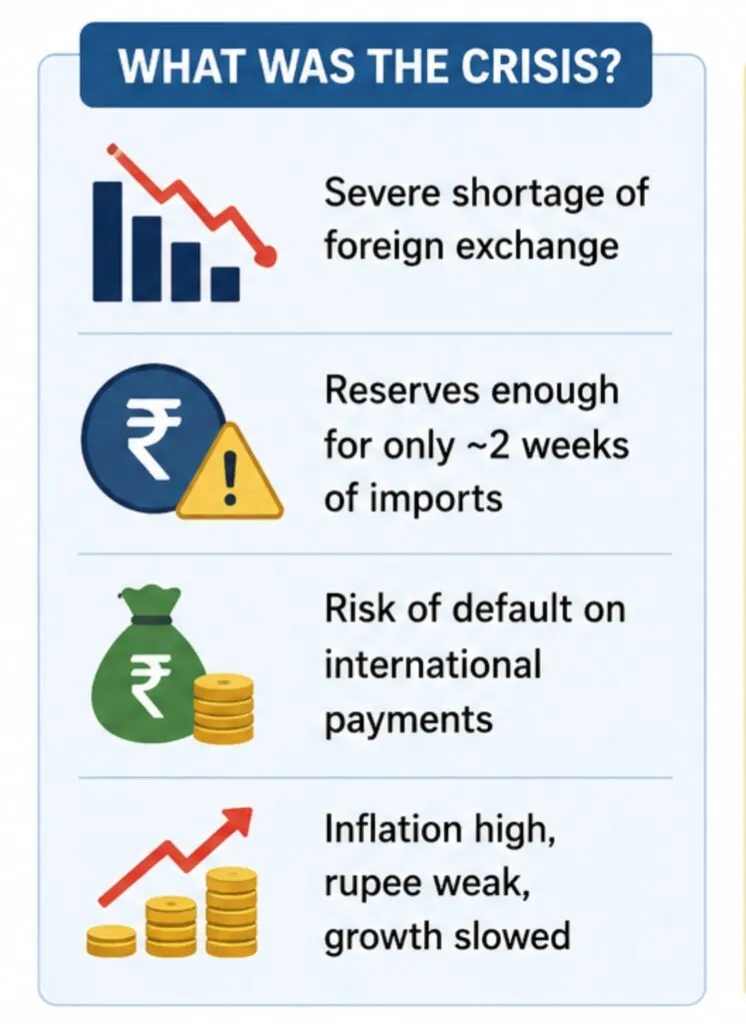
The 1990-91 economic crisis was one of the worst financial crises in India’s history. During this period, India was facing a severe shortage of money needed to pay for imports from other countries. The country’s foreign exchange reserves had become extremely low, and India was close to defaulting on its international payments. At one point, India had enough foreign currency to pay for only about two weeks of imports such as crude oil, machinery, and essential goods.
The crisis created fear across the country because the government was struggling to manage the economy. Inflation was rising, industries were under pressure, and international lenders had started losing confidence in India.
Why Did the Crisis Happen? What was the reason?
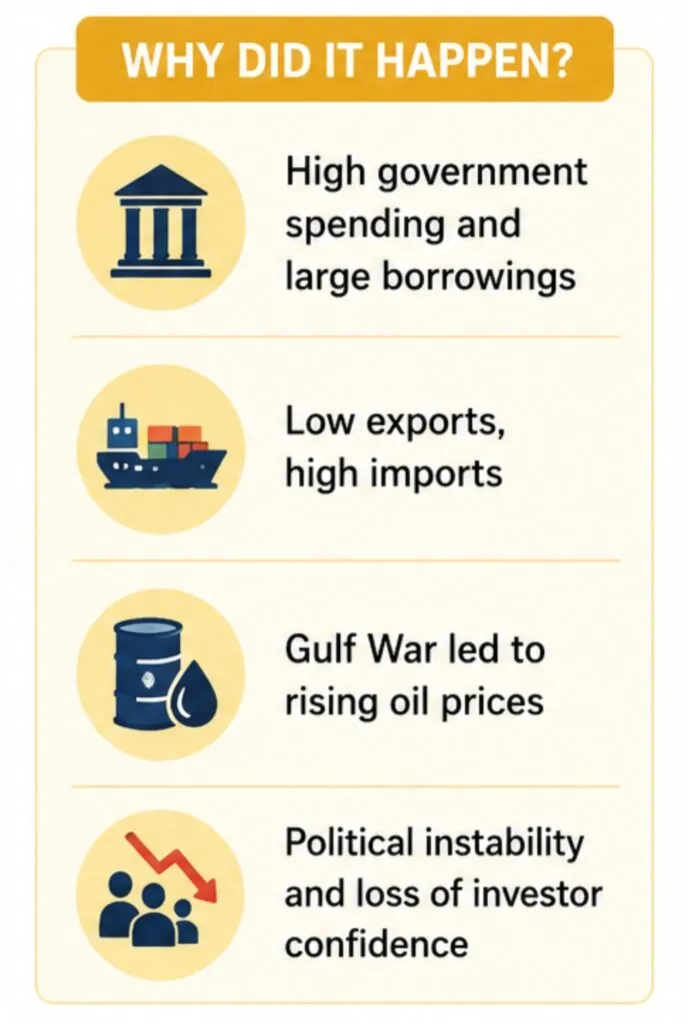
The crisis of 1990 happened due to various reasons such as excessive government spending, weak export earnings, etc. let’s understand one by one.
1. Excessive Government Spending
During the 1980s, the Indian government spent heavily on development projects, subsidies, and welfare schemes. However, government income was not increasing at the same pace. To manage expenses, India started borrowing large amounts of money from foreign countries and international institutions.
As debt increased, India had to pay large amounts of interest on these loans every year.
2. Weak Export Earnings
India’s exports were not strong enough to earn sufficient foreign currency. At that time, India’s economy was more closed and less competitive globally. Since exports were low but imports were high, India’s foreign exchange reserves kept falling.
3. Gulf War and Rising Oil Prices
In 1990, the Gulf War began after Iraq invaded Kuwait. This caused crude oil prices to rise sharply in the international market.
India depended heavily on imported oil, so the country suddenly had to spend much more money on oil imports. This increased pressure on India’s already weak foreign exchange reserves.
4. Political Instability in India
India was also facing political instability during that period. Governments were changing frequently, and investors became worried about the country’s economic future. Foreign investors and lenders started losing confidence in India’s ability to repay loans.
As a result, foreign money coming into India reduced significantly.
What Problems Did India Face During the Crisis?
The crisis created many serious problems:
- Foreign exchange reserves almost disappeared.
- India struggled to pay for imports.
- Inflation increased rapidly.
- The value of the Indian Rupee weakened.
- International lenders became hesitant to give loans.
- Economic growth slowed down.
- There was fear that India could officially default on its payments.
The situation became so serious that India had to take emergency measures to avoid complete financial collapse.
India Sent Gold Abroad
One of the most emotional moments during the crisis was when India had to pledge its gold reserves.
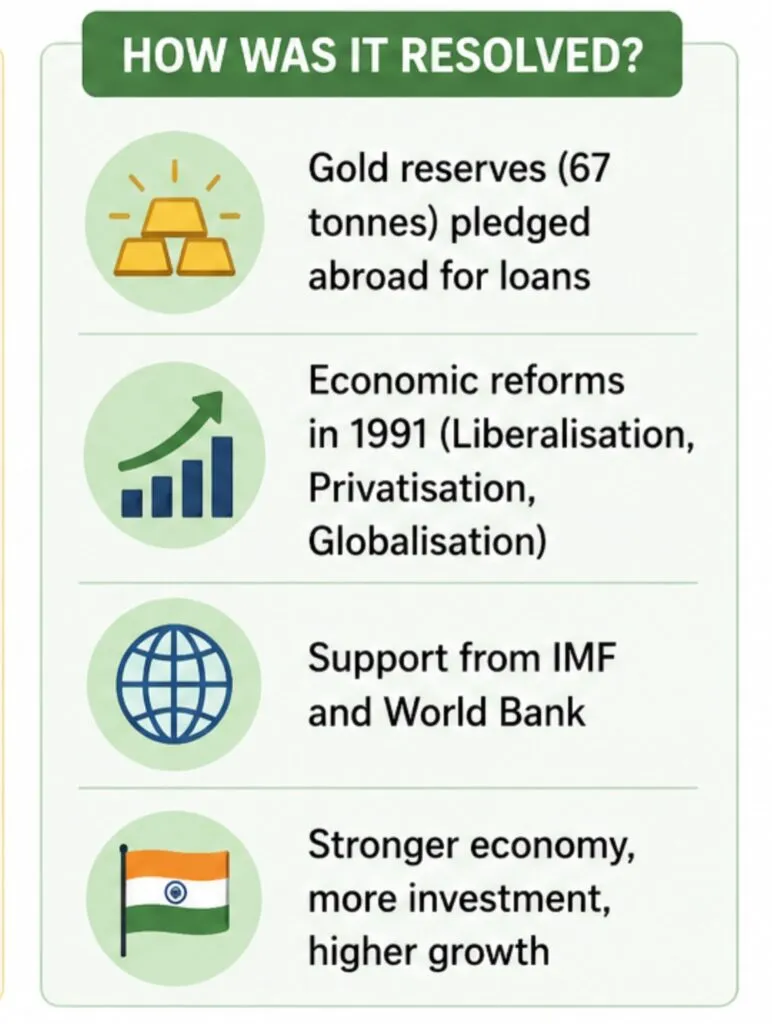
The government sent around 67 tonnes of gold to foreign banks in countries like the United Kingdom and Switzerland to obtain emergency loans. This step was taken to raise foreign currency and restore confidence among international lenders.
Many people saw this as a matter of national embarrassment, but it helped India avoid default.
How Was the Crisis Handled?
1. Economic Reforms of 1991
The crisis forced India to make major economic reforms in 1991 under Prime Minister P. V. Narasimha Rao and Finance Minister Manmohan Singh.
These reforms completely changed the Indian economy.
2. Opening the Economy
Before 1991, India had many government controls on businesses. Companies needed licenses for many activities, imports were heavily restricted, and foreign investment was limited.
After the reforms:
- Many business restrictions were removed.
- Private companies received more freedom.
- Foreign companies were allowed to invest in India.
- Import duties were reduced.
- Industries became more competitive.
This process is known as Liberalisation, Privatisation, and Globalisation (LPG Reforms).
3. Support from International Institutions
India also received financial assistance from organizations like the International Monetary Fund and the World Bank.
These institutions provided loans and support, but India also had to implement economic reforms in return.
What Happened After the Crisis?
The reforms gradually improved India’s economy. Foreign investment started coming into the country, industries expanded, exports increased, and economic growth improved over the next few years.
Many experts believe that the 1991 reforms transformed India into a modern market-based economy. Sectors like IT, banking, telecom, manufacturing, and services grew rapidly after the reforms.
Today, the 1990-91 crisis is considered a turning point in India’s economic history.
Why Is This Crisis Still Important Today?
The 1990-91 crisis taught India several important lessons:
- A country must maintain strong foreign exchange reserves.
- Excessive borrowing can become dangerous.
- Stable economic policies are important for investor confidence.
- Economic reforms can help improve long-term growth.
The crisis also showed the important role played by the government, the Reserve Bank of India, and policymakers in saving the economy during difficult times.