Supreme Court orders UCO Bank to release Retirement Benefits, Says Show-Cause Notice Cannot Stop Voluntary Retirement

| ➡️ Click here to Join Whatsapp News Group - Get instant updates of all Banking News |
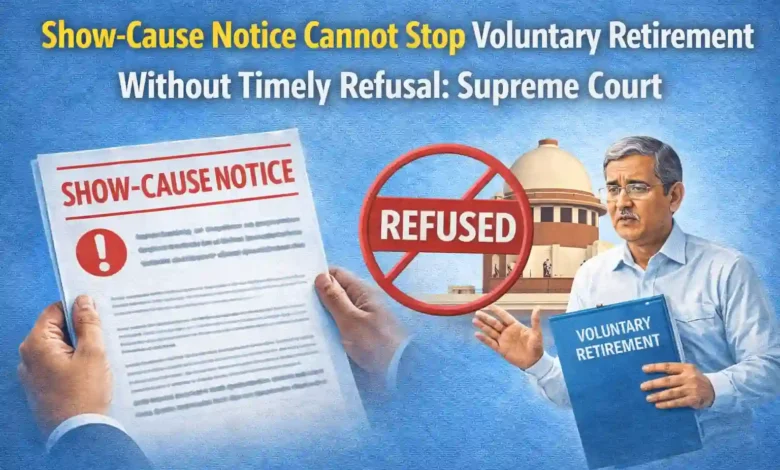
The Supreme Court on Tuesday (April 7) said that an employer cannot stop an employee from taking voluntary retirement just by issuing a show-cause notice. The employer must start proper disciplinary proceedings and refuse permission within the notice period.
A bench of Justice J.K. Maheshwari and Justice Vijay Bishnoi heard the case. In this case, a bank employee was given a show-cause notice while his request for voluntary retirement (VRS) was pending. The bank was required to take a decision within three months, but it did not do so. Instead, it issued a show-cause notice about certain transactions without starting formal disciplinary proceedings.
The Respondent was appointed as Clerk-cum-Godown Keeper in UCO Bank on 10.09.1983 and was promoted as Assistant Manager with effect from 01.01.2000. He was further promoted as Manager with effect from 26.04.2007. In July 2010, while working as Branch Manager at Raipur Branch, some suspicious transactions in the accounts of M/s. Bhanu Road Carriers and M/s. Progressive Exim Ltd. came to the notice of the Appellant. Internal correspondence was made from the Head Office to the Zonal Office regarding the same.
In the meantime, the Respondent applied for voluntary retirement on 04.10.2010 by sending a notice to the General Manager, Kolkata. The Zonal Office asked him to submit a fresh application under the Pension Rules. The Head Office also asked for details about any vigilance or court cases and required an undertaking that he would not take any commercial job for two years after retirement.
Later, on 11.11.2010, the Zonal Office issued a show-cause notice asking him to explain the suspicious transactions in the accounts mentioned earlier. On 11.12.2010, internal communication between the Head Office and Zonal Office stated that his voluntary retirement request was not considered due to proposed changes in pension rules, and he was asked to continue working. On 20.12.2010, the Zonal Office informed the Chief Manager at Bilaspur about this. Again, on 06.04.2011, the Head Office said that since a show-cause notice had already been issued, his voluntary retirement request could not be accepted.
The Respondent submitted his reply to the show-cause notice on 09.05.2011. Earlier, on 11.04.2011, he had also given an undertaking that he would not take any commercial job. Since the notice period for voluntary retirement had ended, he stopped working in the bank from 16.05.2011 after sending a letter dated 14.05.2011.
Later, on 29.06.2011, the bank sent him a letter informing that his voluntary retirement request was rejected. However, this letter was never delivered to him, as confirmed by the Postal Department, and this fact was also noted by the High Court.
After about eight months, on 05.03.2012, the bank issued a charge sheet against him for the same suspicious transactions. He challenged the rejection of his retirement and the disciplinary action in court. The Single Judge allowed his petition, and the High Court also upheld the decision.
The Chhattisgarh High Court ruled in favour of the employee. It said that the employee had already retired before any disciplinary action started. The bank then appealed to the Supreme Court.
The Supreme Court agreed with the High Court. It said that the show-cause notice did not show any clear intention to start disciplinary proceedings. Since the bank did not refuse the VRS within the required time, the retirement became effective automatically.
The Court explained that if a VRS request is not refused within the notice period, it is considered approved automatically. The Court also said that just issuing a show-cause notice is not enough to stop voluntary retirement. There must be a proper refusal order by the competent authority within the time limit. In this case, no such order was passed.
Therefore, the Court held that the employee’s voluntary retirement became effective on January 4, 2011, after the three-month period ended. Since the employee had already retired, the employer-employee relationship ended before the chargesheet was issued in March 2012. As a result, the disciplinary proceedings and dismissal order were declared invalid.
Finally, the Supreme Court dismissed the bank’s appeal and upheld the High Court’s order to give retiral benefits to the employee.
- Download Court Order PDF (This PDF is available for Premium Users Only. Click here to join premium)