| ➡️ Click here to Join Whatsapp News Group - Get instant updates of all Banking News |
Summary
The Reserve Bank of India (RBI) has introduced new rules for banks, small finance banks (SFBs), and NBFCs to make the recovery of bad loans more transparent. From 1 October 2026, lenders will not be allowed to sell properties taken from defaulting borrowers back to the same borrower or their related parties. The new rules also require proper valuation, public auctions, board-approved policies, and separate disclosure of these assets in financial statements. These changes aim to improve transparency and strengthen the loan recovery process.
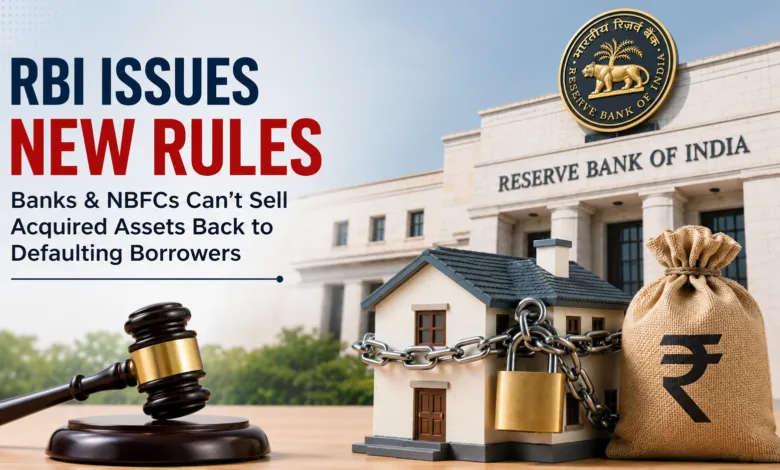
The Reserve Bank of India (RBI) has issued new prudential norms for commercial banks, small finance banks (SFBs), and non-banking financial companies (NBFCs). Under the new rules, lenders cannot sell certain non-financial assets acquired during the resolution of stressed loans back to the defaulting borrower or any of its related parties.
The new guidelines have been issued under the Resolution of Stressed Assets Directions, 2025 and will come into effect from 1 October 2026.
What Are Specified Non-Financial Assets (SNFAs)?
According to the RBI, a Specified Non-Financial Asset (SNFA) is an immovable property acquired by a lender in full or partial settlement of a borrower’s outstanding loan. For banks, the definition also includes non-banking assets (NBAs) acquired under the Banking Regulation Act, 1949.
Assets Cannot Be Sold Back to Borrowers
The RBI has clearly stated that an SNFA cannot be sold back to the borrower who defaulted on the loan or to any of the borrower’s related parties. The term “related parties” will have the same meaning as defined under the Insolvency and Bankruptcy Code (IBC), 2016. This restriction will continue even if the asset is no longer classified as an SNFA.
For borrowers, the new norms mean that once an immovable property is acquired by a lender in settlement of a defaulted loan, it cannot be repurchased directly or indirectly through related parties.
When Can Lenders Acquire These Assets?
The RBI said lenders can acquire such assets only when the borrower’s loan account has become a Non-Performing Asset (NPA). The asset may be acquired in full or partial settlement of the outstanding loan on a non-recourse basis. If only part of the loan is settled, the remaining loan will be treated as a restructured loan and will follow the applicable prudential norms.
Banks Must Have a Board-Approved Policy
The RBI has directed banks, small finance banks, and NBFCs to prepare a board-approved policy for acquiring and disposing of SNFAs. The policy should include:
- Limits on the amount of SNFAs that can be held.
- Eligibility criteria for acquiring such assets.
- Delegation of approval powers.
- Recovery efforts before acquiring the asset.
- A maximum disposal period of seven years.
Valuation and Disposal of Assets
SNFAs must be recorded in the lender’s balance sheet at the lower of:
- The net book value of the loan settled, or
- The distress sale value determined by at least two independent external valuers.
The RBI has also instructed lenders to make every effort to sell these assets through public auctions by following the principles of the SARFAESI Act, 2002.
Timeline for Existing Assets
The new rules will become effective from 1 October 2026. Any existing SNFAs held by banks, SFBs, or NBFCs as of 30 September 2026 must comply with the new rules by 30 September 2027.
Separate Disclosure in Financial Statements
The RBI has also introduced separate disclosure requirements for these assets. SNFAs will not be included in:
- Gross NPA
- Net NPA
- Stressed exposures
- Provisioning Coverage Ratio (PCR)
Instead, they will be shown under separate accounting heads in the balance sheets of banks, small finance banks, and NBFCs.