| ➡️ Click here to Join Whatsapp News Group - Get instant updates of all Banking News |
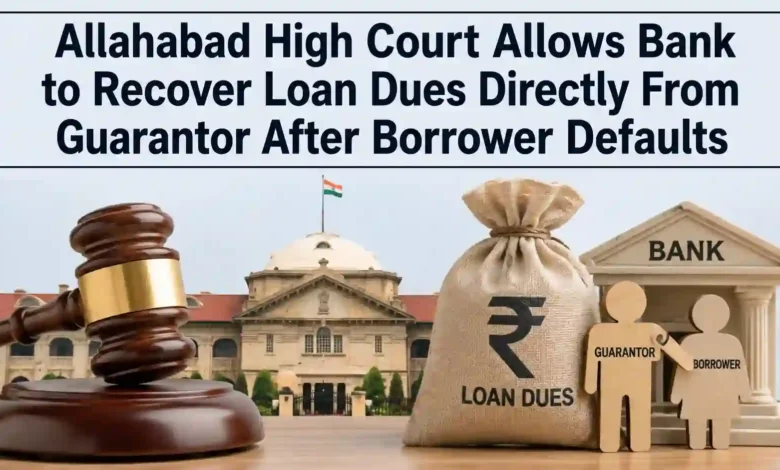
The Allahabad High Court has ruled that a bank can recover loan dues from a guarantor when the principal borrower fails to repay the loan. The bank does not have to first complete all recovery steps against the main borrower before taking action against the guarantor.
Guarantor’s Liability Under Section 128
The court referred to Section 128 of the Indian Contract Act, 1872, which deals with the liability of a surety or guarantor. The court explained that the liability of a guarantor is co-extensive with that of the principal borrower. This means that, unless the guarantee agreement says otherwise, the guarantor can be held responsible for the same amount that the borrower is required to pay.
The court also said that the liability of the borrower and guarantor is joint and several. Therefore, the creditor can proceed against the borrower, the guarantor, or both at the same time.
Case Involving UP Postal Employees
The ruling came while the court was hearing petitions filed by two employees who had acted as guarantors for loans taken by their colleague from UP Postal Primary Cooperative Bank Limited.
The principal borrower, Vikrant Dubey, had taken three loans from the bank during 2022-23. These included a ₹50,000 festival loan, a ₹3 lakh short-term loan and an ₹18 lakh personal loan.
After the borrower failed to repay the loans, the bank started recovery proceedings against him. At the same time, it also sought recovery of the outstanding amount from the two guarantors.
Bank Sought Salary Deduction
The bank asked the Postal Department, where the two petitioners were employed, to deduct ₹10,000 per month from the salary of each guarantor towards repayment of the outstanding loan.
The two employees challenged the proposed salary deductions before the Allahabad High Court. They argued that the bank should first recover the money from the principal borrower and could approach the guarantors only for any amount that remained unpaid.
They also argued that simultaneous recovery from the borrower and guarantors was not legally permissible.
Guarantors Relied on Supreme Court Judgment
The petitioners relied on the Supreme Court judgment in Ram Kishun v. State of U.P. They also referred to a communication dated March 6, 2026, in which an official had questioned why recovery was not first being made from the principal borrower.
Despite this, the bank issued a letter on April 15, 2026, seeking recovery of ₹10,000 per month from the salary of each petitioner.
Court Says Bank Can Proceed Against Guarantor
A division bench comprising Justice Shekhar B. Saraf and Justice Abdhesh Kumar Chaudhary rejected the petitioners’ arguments.
The court explained that under Section 128 of the Indian Contract Act, the liability of a guarantor is immediate and co-extensive with that of the principal borrower, subject to the terms of the guarantee agreement.
The court relied on earlier Supreme Court decisions, including Bank of Bihar Ltd. v. Dr. Damodar Prasad, State Bank of India v. M/s Indexport Registered and Industrial Investment Bank of India Ltd. v. Biswanath Jhunjhunwala.
These judgments establish that a creditor is not required to first exhaust its remedies against the principal borrower before proceeding against the guarantor.
No Need to Wait for Borrower Recovery
The High Court clearly stated that a creditor is free to proceed against a guarantor without first exhausting its recovery options against the principal borrower.
The court also rejected the petitioners’ reliance on the Ram Kishun judgment. It observed that the judgment itself supports the principle that a surety cannot stop recovery proceedings against him merely because the creditor has not yet exhausted its remedies against the principal borrower.
Guarantee Agreement Was Important
The court noted that the two petitioners had voluntarily agreed to act as guarantors for the loans.
Importantly, they could not produce any material showing that their guarantee agreements contained a condition requiring the bank to first recover the money from the principal borrower.
Therefore, the court held that there was no contractual reason to postpone the guarantors’ liability.
Salary Deduction Was Held Valid
The court concluded that the bank was legally entitled to seek recovery through monthly deductions from the petitioners’ salaries.
It also held that the communication dated March 6, 2026, could not override the statutory liability of the guarantors or the settled legal position laid down by the Supreme Court.
Court Rejects Natural Justice Argument
The petitioners also argued that the proposed salary deductions violated the principles of natural justice because they had not been given a personal hearing before the bank’s April 15, 2026, recovery request.
The court rejected this argument. It said that the liability arose from the guarantee contract and was co-extensive with the borrower’s liability under Section 128 of the Indian Contract Act.
The court observed that the petitioners had other legal remedies available to them and could not use writ petitions to avoid their contractual and statutory obligations.
Guarantor Can Recover Money From Borrower
The court clarified that a guarantor who pays the borrower’s dues is not without a remedy. After making the payment, the guarantor can exercise available rights of subrogation or contribution against the principal borrower.
However, these rights do not allow the guarantor to stop the bank from enforcing the guarantee.
Allahabad High Court Dismisses Petitions
The Allahabad High Court ultimately held that the proposed recovery of ₹10,000 per month from each petitioner’s salary was legally sustainable. Since the guarantors had no contractual protection requiring the bank to proceed against the principal borrower first, the bank was entitled to recover the dues from them. The court therefore dismissed both writ petitions.
- Download Court Order PDF (This PDF is available for Premium Users Only. Click here to join premium)