| ➡️ Click here to Join Whatsapp News Group - Get instant updates of all Banking News |
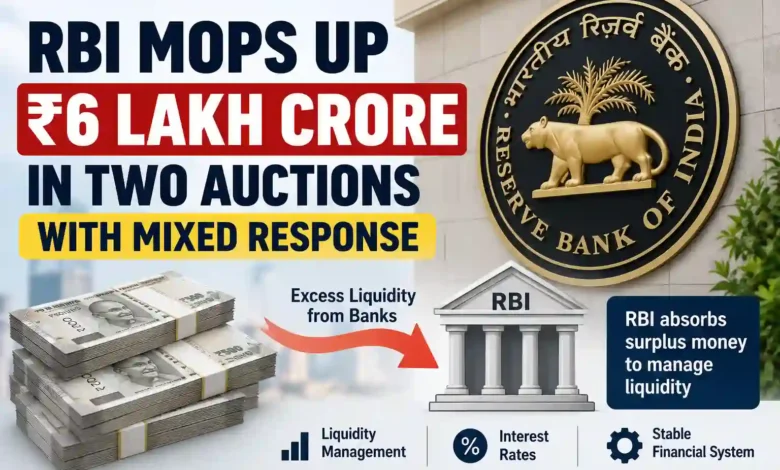
The Reserve Bank of India (RBI) has taken more than ₹6 lakh crore out of the banking system through two Variable Rate Reverse Repo (VRRR) auctions. The move comes at a time when banks are holding a very large amount of surplus money.
The RBI’s action is aimed at managing excess liquidity and keeping short-term interest rates closer to its monetary-policy target.
What happened?
On 7 September 2026, the RBI conducted a 30-day VRRR auction with a notified amount of ₹7 lakh crore.
However, banks submitted bids worth only about ₹2.59 lakh crore. The accepted bids carried a cut-off and weighted average rate of 5.24%.
After seeing the weak response to the 30-day auction, the RBI conducted another overnight VRRR auction.
This time, the RBI offered to absorb ₹5 lakh crore, and banks submitted bids worth around ₹3.53 lakh crore. The RBI accepted the full amount at 5.24%.
Together, the two operations absorbed about ₹6.02 lakh crore from the banking system.
| VRRR Auction | Amount Offered | Bids Received |
|---|---|---|
| 30-day | ₹7 lakh crore | ₹2.59 lakh crore |
| Overnight | ₹5 lakh crore | ₹3.53 lakh crore |
| Total | ₹12 lakh crore | ₹6.02 lakh crore |
What is VRRR?
VRRR stands for Variable Rate Reverse Repo.
In simple words, it is a tool used by the RBI to take excess money away from banks temporarily.
When banks have more money than they need, they can deposit that money with the RBI through a VRRR auction and earn interest.
So:
Banks have excess money → Banks give money to RBI → RBI pays interest → Liquidity in the banking system falls
This is the opposite of injecting liquidity into the banking system.
Why does the RBI want to absorb money?
The Indian banking system currently has a very large liquidity surplus. As of September 6, the surplus was estimated at around ₹11.16 lakh crore.
A major reason behind this increase in liquidity is the large inflow of foreign currency through special measures introduced by the RBI.
These measures mobilised around $136.38 billion by August 31, including $127.23 billion through FCNR(B) deposits. The subsequent forex swaps with the RBI added rupee liquidity to banks.
In simple terms:
Foreign currency comes into banks → RBI swaps the foreign currency → banks receive rupees → banking-system liquidity increases
Because the banking system received so much additional rupee liquidity, the RBI has been using VRRR auctions to absorb some of it.
Why did banks prefer the overnight auction?
The response to the two auctions was different. Banks showed much greater interest in the overnight auction than the 30-day auction.
This suggests that banks are more comfortable parking their surplus funds with the RBI for a short period rather than locking the money away for 30 days.
Banks may want to keep their money available because they could need it for lending or other payments in the coming days.
There were also reports of technical issues affecting participation in the 30-day auction, although a person familiar with the RBI’s systems disputed that there had been a technical glitch.
Why is this important?
The RBI needs to maintain a balance.
Too little liquidity can make borrowing expensive and hurt economic activity.
Too much liquidity can push short-term interest rates down and, if it persists, may create inflationary or financial-market risks.
Therefore, the RBI is trying to remove the excess money without creating unnecessary disruption in the financial system.
The RBI has already conducted numerous VRRR operations in recent weeks as it manages the unusually high liquidity surplus.
What does this mean for ordinary people?
The move does not directly mean that people’s bank deposits are being taken away.
Instead, the RBI is managing the surplus funds held by banks.
For borrowers and depositors, the bigger issue is what happens to interest rates and bank lending as the RBI manages liquidity.
Conclusion
The RBI’s ₹6.02 lakh crore liquidity absorption operation shows that the banking system currently has a very large surplus of funds.
The mixed response from banks is also important: banks were much more willing to park money with the RBI overnight than for 30 days.
The RBI may therefore continue using different tools to manage the excess liquidity in the banking system.