| ➡️ Click here to Join Whatsapp News Group - Get instant updates of all Banking News |
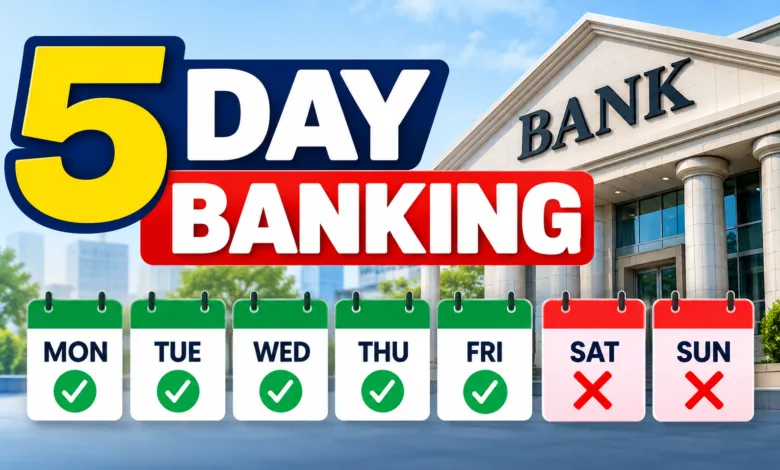
The United Forum of Bank Unions (UFBU) has deferred the bank strike that was proposed from 28 to 30 September 2026. UFBU said that a high-level committee will be formed to discuss the issue of 5-day banking, as some stakeholders have not agreed to the proposal. Earlier, the Government of India had also said that the stakeholders concerned were not ready for 5-day banking.
In this article, we explain who these stakeholders are and what role they may play in the implementation of 5-day banking in India.
Who are the Stakeholders denying 5-day banking?
The implementation of a 5-day banking week involves several government, regulatory, banking and public-interest stakeholders. The main stakeholders include the Department of Financial Services (DFS) under the Ministry of Finance, the Reserve Bank of India (RBI), the Indian Banks’ Association (IBA), State Governments and other groups affected by banking operations.
Department of Financial Services (DFS)
The Department of Financial Services under the Ministry of Finance is one of the key stakeholders in this matter. It deals with important issues related to the banking sector and public sector banks. Any major change in the working days of banks requires consideration of its impact on government banking transactions, public services, payment systems and other financial operations.
Reserve Bank of India (RBI)
The Reserve Bank of India is another important stakeholder. RBI regulates the banking system and oversees payment and settlement systems in India. The implementation of 5-day banking would require an assessment of how the change in bank working days could affect payment systems, clearing operations, government transactions and other banking activities. Systems such as RTGS and NEFT operate throughout the week, but the overall impact of closing physical bank branches on Saturdays has to be considered.
Government of India and Ministry of Finance
The Government of India also has an important role because changing the working days of banks can affect government transactions and other financial activities. Government and Finance Ministry sources have indicated that the proposal requires consultation with different stakeholders before a final decision is taken. The government has to consider issues such as public access to banking services, government transactions, clearing operations and the overall impact on the banking system.
State Governments
State Governments can also have a role because bank holidays are connected with legal provisions, including Section 25 of the Negotiable Instruments Act, 1881. If the working calendar of banks is changed, related holiday arrangements may also need to be reviewed at the appropriate level.
Indian Banks’ Association (IBA)
The Indian Banks’ Association represents bank management and is an important party in discussions with bank employees’ unions. The IBA had agreed to the 5-day banking proposal as part of the 12th Bipartite Settlement in March 2024. However, the issue of implementation has not yet been completed. Following the recent discussions with UFBU, a high-level committee is being formed to discuss the modalities and other issues related to 5-day banking.
Business and Trade Associations
Business groups, including MSMEs, traders and retail businesses, are another important stakeholder. Many businesses deposit cash, withdraw cash and carry out other banking-related activities during working days, including Saturdays. Therefore, the impact of Saturday closure on businesses and cash-related operations also needs to be considered.
General Public and Bank Customers
The general public and bank customers are also important stakeholders. Customers who visit branches for services such as cash deposits, withdrawals, account-related work, document submission and other physical banking services may be affected if branches remain closed on all Saturdays. At the same time, many banking services are now available digitally through internet banking, mobile banking, ATMs and other electronic channels. Therefore, the government and banking authorities have to consider both customer convenience and the increasing use of digital banking services.
| Stakeholder | Position / role on 5-day banking |
|---|---|
| Government of India / Ministry of Finance (DFS) | Key decision-maker whose approval is still pending. Government sources have said that the government has not agreed to a 5-day workweek. |
| Department of Financial Services (DFS) | The issue is under its consideration. DFS has told unions that the government has to consider the interests of various stakeholders and has not given a timeline for approval. |
| Indian Banks’ Association (IBA) | Not currently opposing the demand outright. IBA had agreed to the proposal and, on 27 September 2026, agreed with UFBU to constitute a high-level committee to work on implementation and alternatives. |
| Public-sector bank managements | Represented through IBA in the negotiations. Their position is part of the management side of the discussions rather than the principal formal approval authority. |
| UFBU / bank unions | Supporting 5-day banking. UFBU has made it a principal demand and has been pressing for implementation of the proposal. |
| Customers / general public | The latest agreement specifically says the committee will consult stakeholders, including customers, because Saturday banking availability is one of the considerations. |
| RBI / other regulators | They can have an operational/regulatory role, but there is no current evidence showing that RBI has formally rejected 5-day banking. It should therefore not be described as the stakeholder “denying” it without evidence. |
Who Is Actually Denying 5-Day Banking?
It would not be correct to say that one particular organisation or stakeholder has officially rejected 5-day banking unless there is a specific official statement confirming this.
The issue involves concurrence and consultation among several stakeholders, particularly the Government of India, the Department of Financial Services, RBI and other authorities and groups affected by the change.
The Government has earlier referred to the lack of concurrence among stakeholders as one of the reasons why 5-day banking has not yet been implemented.
The newly formed high-level committee is expected to discuss these concerns and examine the modalities for implementing a 5-day banking week.