| ➡️ Click here to Join Whatsapp News Group - Get instant updates of all Banking News |
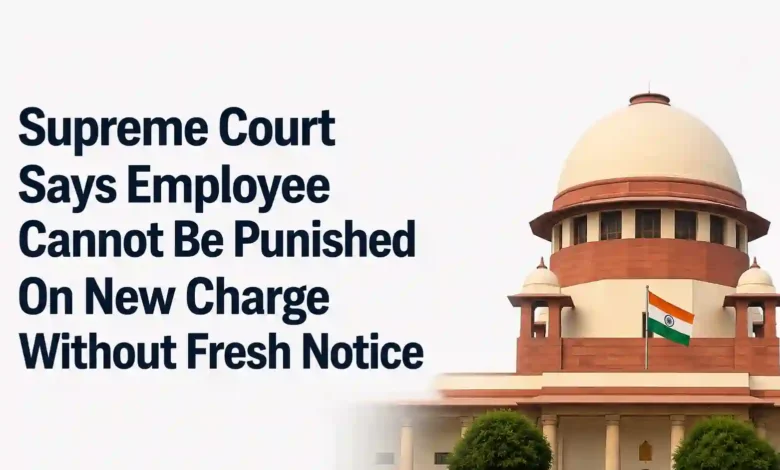
In an important ruling protecting the rights of employees in disciplinary proceedings, the Supreme Court has held that once an employee successfully defends a particular charge, the disciplinary authority cannot punish him on a completely different allegation without issuing a fresh show-cause notice.
The court observed that imposing punishment on new grounds without giving the employee an opportunity to respond violates the principles of natural justice and fair procedure. The judgment is expected to have significant implications for departmental inquiries and service matters involving government and private employees.
Let’s understand the case
The Supreme Court on Wednesday (May 6) said that an employee who has successfully defended the original charge against him cannot be punished on a new charge without being given a chance to defend himself.
A bench of Justice Dipankar Datta and Justice Satish Chandra Sharma heard an appeal filed by a retired paediatrician. His name had been removed from the Indian Medical Register for three months because he did not disclose in a declaration form that he had earlier worked as a faculty member at another medical institution. The form was submitted during a National Medical Commission inspection at Patna Medical College.
At first, the Appellant was charged with submitting a fake faculty declaration form. He successfully defended himself before the Ethics Committee. However, when the matter was sent back for reconsideration, he was found guilty of omission. This was different from the original charge of submitting a fake declaration form.
After the Medical Council of India upheld the Ethics Committee’s order, the Appellant filed a writ petition before the Patna High Court.
The Single Judge ruled in favour of the Appellant and allowed the writ petition. However, the Division Bench later reversed that decision in an intra-court appeal. This led the Appellant to approach the Supreme Court.
The Supreme Court disagreed with the High Court’s decision that supported the MCI’s action based on a new charge for which the Appellant was never given a chance to defend himself.
In the judgment written by Justice Datta, the Court referred to Ravi Oraon v. State of Jharkhand. In that case, the Court had said that once an employee successfully defends a charge, the disciplinary authority cannot punish him on a completely different charge without issuing a fresh show-cause notice.
The Court said – The Executive Committee could not have imposed the punishment without issuing a fresh show-cause notice and without giving the employee a fair opportunity to reply to the new charge.
At the same time, the Court also questioned the conduct of the Appellant. It noted that he failed to properly explain why he did not mention his earlier employment in the declaration form.
The Court observed that he could not convincingly explain the incorrect declaration. It said that such a false declaration could amount to misconduct and could not be ignored by the Executive Committee.
However, considering that the Appellant was 76 years old, the Supreme Court decided not to uphold the earlier punishment. Using its powers under Article 142 of the Constitution, the Court reduced the punishment from removal of his name from the Indian Medical Register for three months to a warning/censure.
What this means for Employees?
This ruling is a major safeguard for employees facing departmental inquiries or disciplinary action. It ensures that authorities cannot arbitrarily change allegations or impose punishment on grounds that were never communicated to the employee.
The judgment reinforces the principle of natural justice by guaranteeing employees a fair opportunity to defend themselves against every specific charge. For employees, this means greater transparency, protection from unfair disciplinary practices, and stronger legal rights during service-related proceedings.
- Download Court Order PDF (This PDF is available for Premium Users Only. Click here to join premium)