| ➡️ Click here to Join Whatsapp News Group - Get instant updates of all Banking News |
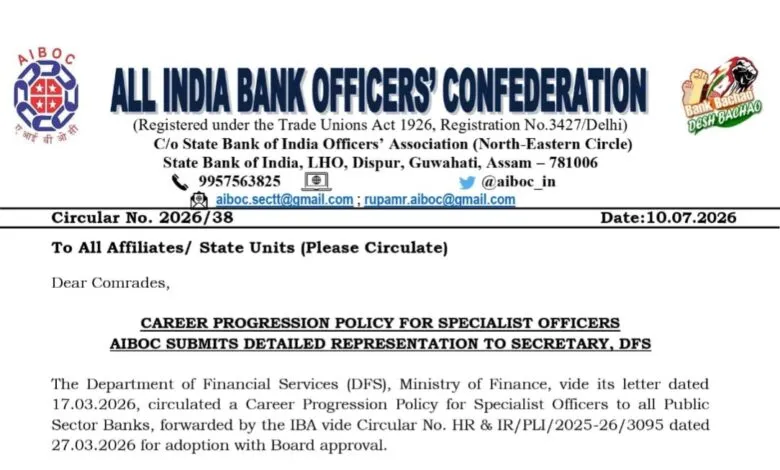
The All India Bank Officers’ Confederation (AIBOC) has raised serious concerns over the new Career Progression Policy for Specialist Officers in Public Sector Banks. AIBOC has submitted a detailed representation to the Secretary of the Department of Financial Services (DFS), Ministry of Finance, seeking a review, withdrawal or modification of several provisions in the policy.
AIBOC has also requested that the policy should be kept on hold for the time being until an amicable solution is provided.
The Department of Financial Services had circulated the Career Progression Policy for Specialist Officers on March 17, 2026. AIBOC has cited several loopholes in the new policy.
Issue 1: Mandatory CAIIB for Conversion
AIBOC said Specialist Officers are recruited because of their expertise in a particular field. The policy requires them to qualify in CAIIB for conversion, which is an examination outside the specialised domain of many officers.
AIBOC’s Suggestion: The existing educational qualifications, required years of service and field experience of Specialist Officers should be considered sufficient. JAIIB and CAIIB should be encouraged and incentivised instead of being made compulsory.
Issue 2: Three-Year Promotion Restriction After Conversion
Under the policy, converted officers cannot be considered for further promotion for three years. AIBOC said this effectively works like a fresh probation period for serving officers.
The Confederation said the rule could disturb the seniority of converted officers compared with their batchmates and discourage officers from opting for conversion.
AIBOC’s Suggestion: The three-year promotion restriction should be reviewed. Officers recruited under earlier rules should also receive protection through a grandfathering provision because the policy is being applied retrospectively to them.
Issue 3: Conversion Depends on Absolute Discretion
AIBOC said the policy clearly states that conversion is not a right of an officer. The conversion window may also open only once in three years, while the selection criteria remain open-ended.
The Confederation said clauses such as “any other criteria as decided by the Bank” may create uncertainty among eligible Specialist Officers.
AIBOC’s Suggestion: Banks should provide annual conversion opportunities. Selection criteria should be objective, transparent and published in advance. Proper weightage should also be given to the field experience of Specialist Officers.
Issue 4: Promotion Ceilings and Vacancy-Based Career Stagnation
AIBOC said several categories of Specialist Officers have their career progression capped at Scale V, while officers in the residual “Others” category are capped at Scale IV.
Even promotion within these limits depends on vacancies identified by the administration. AIBOC said an administrative decision on vacancies could block the career growth of an entire specialist cadre in a region.
AIBOC’s Suggestion: Specialist Officers should be given the option to continue in their specialist stream with clearly defined roles at higher scales or opt for conversion according to their choice.
Issue 5: Distance and Part-Time Qualifications Not Properly Recognised
AIBOC said some bank-level policies provide additional marks mainly for full-time courses. This may ignore qualifications obtained through distance or part-time education by serving officers.
The Confederation said a working bank officer can rarely leave service to pursue a full-time course.
AIBOC’s Suggestion: Properly accredited distance, part-time and professional qualifications should be recognised. Appropriate weightage should also be given to professional qualifications such as CA, CS, CFA, ICWA and Ph.D.
Issue 6: Strict APAR and Assessment Rules
AIBOC raised concerns over the 75% APAR threshold, a single merit-only channel, the introduction of Group Discussion as an additional assessment stage and residual service requirements.
According to the Confederation, these conditions together may exclude a large number of competent Specialist Officers.
AIBOC also said field specialists attached to multiple branches may face problems because the appraisal system may record the performance of only one branch and fail to properly recognise their overall contribution.
AIBOC’s Suggestion: Eligibility thresholds should be properly calibrated. Special appraisal safeguards should be introduced for field cadres and officers working with multiple branches.
Issue 7: No Clear Recruitment Plan for Specialist Officers
AIBOC said the policy allows officers to move out of the specialist cadre through conversion but does not provide a corresponding mechanism for fresh recruitment into the cadre.
According to the Confederation, several banks and specialist cadres have not recruited Specialist Officers for years. Continued conversion and retirement may further reduce staff strength, increase workload and affect the work-life balance of existing officers.
The issue is particularly important as responsibilities related to risk management, information technology and compliance are increasing.
AIBOC’s Suggestion: A clear Specialist Officer recruitment and succession plan should be introduced along with the Career Progression Policy.
Issue 8: Bank Boards and Officers’ Organisations Should Be Consulted
AIBOC said promotion and career progression policies have traditionally been formulated by individual bank Boards in consultation with officers’ organisations.
The Confederation expressed concern that a largely finalised central policy may limit the effective role and discretion of bank Boards.
AIBOC’s Suggestion: The DFS framework should be treated as an indicative policy. Individual bank Boards should be allowed to design the detailed framework through the established consultation process.
AIBOC also said career progression, conversion and promotion directly affect the service conditions of officers. Therefore, these matters should be discussed through the established bilateral negotiation mechanism between officers’ organisations and the IBA.
What you think of this – do let us know in the comments section below.