| ➡️ Click here to Join Whatsapp News Group - Get instant updates of all Banking News |
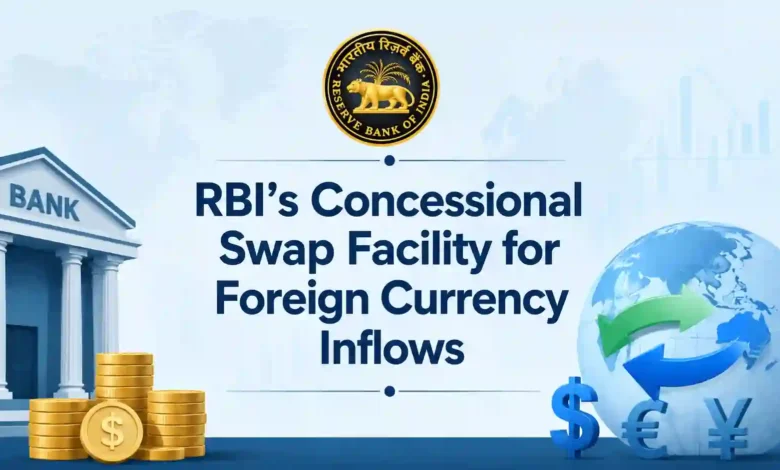
RBI’s Concessional Swap Facility has brought in USD 40.82 Billion. This facility was announced by RBI on June 5, 2026, to encourage fresh foreign currency inflows into India. The facility became operational on June 8, 2026. Under the facility, concessional swaps are available for fresh FCNR(B) deposits, OFCBs and External Commercial Borrowings (ECBs).
Let’s understand what is the facility and all details.
What is a Concessional Swap Facility?
A foreign currency swap, in simple terms, is an arrangement through which foreign currency brought into India can be exchanged for Indian rupees, with an arrangement to reverse the exchange later.
Under a concessional swap facility, the RBI provides this facility on more favourable terms than would otherwise be available. The objective is to make it more attractive for banks and eligible entities to bring fresh foreign currency into India.
Therefore, the money mobilised under the scheme is foreign exchange coming into India through specified channels rather than a grant or payment made by the RBI.
What is FCNR(B)?
FCNR(B) stands for Foreign Currency Non-Resident (Bank) Account. It is a type of term deposit that Indian banks can accept from Non-Resident Indians (NRIs) and certain other eligible overseas Indians in permitted foreign currencies.
The important feature of an FCNR(B) deposit is that the money is maintained in foreign currency rather than Indian rupees. This reduces the depositor’s exposure to fluctuations in the value of the rupee against the currency in which the deposit is maintained.
For example, an eligible NRI may place funds with an Indian bank in an FCNR(B) deposit denominated in a permitted foreign currency. For India, such deposits are also a source of foreign currency inflows.
Under the RBI’s concessional swap facility, fresh FCNR(B) deposits are eligible for concessional swaps.
What are OFCBs?
OFCB refers to Overseas Foreign Currency Borrowings. In simple terms, these are foreign currency funds borrowed from overseas sources by eligible entities.
Such borrowings bring foreign currency into India. Under the RBI’s announced facility, eligible fresh OFCB inflows can also receive the benefit of the concessional swap arrangement.
What are External Commercial Borrowings (ECBs)?
ECB stands for External Commercial Borrowing. It is a mechanism through which eligible Indian entities can borrow money from eligible lenders outside India, subject to the applicable RBI framework.
For example, instead of raising the entire funding requirement from domestic sources in India, an eligible Indian company may borrow funds from an overseas lender. Since the funds are raised from abroad, ECBs can result in foreign currency inflows into India.
Fresh ECBs covered by the RBI’s announced facility are also eligible for concessional swaps.
How Long Will the RBI Facility Remain Available?
The validity period is different for different types of foreign currency inflows.
For fresh FCNR(B) deposits, the concessional swap facility is available until September 30, 2026.
For OFCBs and ECBs, the facility will remain available for a longer period, until December 31, 2026.
Forex Inflows Reach USD 40.82 Billion
The facility has resulted in significant foreign exchange mobilisation. According to data received from Authorised Dealer Banks, foreign exchange inflows worth USD 40.816 billion had been mobilised under the facility up to July 31, 2026.
Authorised Dealer Banks are banks authorised by the RBI to undertake specified foreign exchange transactions. These banks reported the foreign currency mobilised through the different eligible routes.
| Type of Inflow | Amount (USD Million) |
|---|---|
| FCNR(B) Deposits | 36,725 |
| OFCBs | 2,575 |
| ECBs | 1,516 |
| Total | 40,816 |
FCNR(B) Deposits Bring in the Maximum Foreign Currency
FCNR(B) deposits were by far the biggest contributor to the foreign exchange mobilised under the facility. They brought in USD 36.725 billion out of the total USD 40.816 billion.
OFCBs contributed another USD 2.575 billion, while External Commercial Borrowings contributed USD 1.516 billion.
This means that nearly 90% of the foreign exchange mobilised under the facility up to July 31 came through fresh FCNR(B) deposits.
Why is the RBI Encouraging Foreign Currency Inflows?
The basic purpose of such a facility is to encourage additional foreign currency to enter the country through eligible channels. By offering concessional swap terms, the RBI makes it more attractive to mobilise fresh foreign currency through FCNR(B) deposits and eligible overseas borrowings.
In simple terms, FCNR(B) brings foreign currency into Indian banks through deposits from eligible non-residents, while OFCBs and ECBs bring foreign currency through overseas borrowing. The concessional swap facility provides favourable terms for converting these eligible foreign currency inflows into rupees and reversing the transaction later.
By July 31, 2026, these three routes together had mobilised approximately USD 40.82 billion, with FCNR(B) deposits accounting for the overwhelming majority of the inflows.