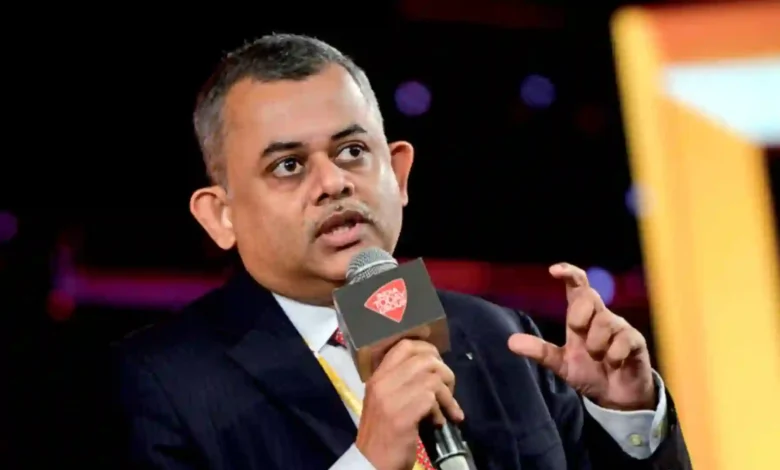
The newly appointed World Bank Executive Director Neelkanth Mishra said the current pressure on the Indian currency is mainly due to a liquidity issue and not because of any weakness in India’s economy.
The value of Indian Rupee is decreasing and at present 1 US Dollar = INR 95.66.
Mishra said the fall in the rupee is being driven by panic in the market rather than concerns about India’s financial strength or external position.
He pointed out that India’s foreign debt-to-GDP ratio remains low. Therefore, policymakers should focus on reducing panic in the currency market and provide a clear outlook on expected capital inflows of $70-100 billion over the next two years.
Mishra said that the exchange rate level itself is not the main concern. Instead, large fluctuations in the currency are more harmful.
“The 100 mark is just a number. Whether the rupee is at 99, 100, or 101 does not matter much. What hurts the economy is when the currency moves sharply from 95 to 105 or 110,” he said.
According to Mishra, high currency volatility increases India’s long-term cost of capital because foreign investors demand higher returns to compensate for the additional risk. It also delays investments, as many fund managers prefer to wait until the currency becomes stable before investing.
He said volatility affects India in three ways. First, it increases the country’s long-term borrowing costs. Second, it slows economic growth because investors delay their decisions. Third, small and medium enterprises (SMEs) are often hit hard by sudden currency movements.
Recalling his experience from 2013, Mishra said many SMEs hedge their foreign exchange exposure too late and suffer losses when exchange rates move in the opposite direction.
Explaining the recent situation, Mishra said economists usually look at the balance of payments on an accrual basis, while the Reserve Bank of India (RBI) has to respond to actual cash demand in the market.
He noted that India’s balance of payments deficit was around $24 billion between October 2025 and March 2026. However, RBI intervention during the same period reached about $75 billion. He said the gap was mainly due to importers increasing their hedging activities, SMEs entering the hedging market for the first time, and foreign portfolio investors raising their hedge positions.
Mishra said he noticed this trend among investors in Singapore and Hong Kong earlier this year.
“People who normally would not hedge had started doing so,” he said.
Describing the situation as a mismatch between demand and supply in the currency market, he explained that exporters are willing to sell dollars over longer periods, while importers are seeking short-term protection.
“There is no George Soros behind this. It is mainly small businesses and individuals panicking, which is making the situation worse,” he said.
Mishra said the immediate priority should be to calm the currency market and show a credible path for strong capital inflows.
He referred to reports about removing withholding tax for bond investors linked to major global indices and said such steps could attract more foreign investment. He also suggested a temporary exemption from withholding tax on external commercial borrowings to encourage overseas borrowing.
If required, he said authorities could consider temporary market-control measures similar to those used at the end of March, even if such measures are unpopular with investors.
Mishra also highlighted that RBI’s foreign exchange reserves of around $690 billion give it enough strength to intervene in the currency market if necessary.
“You have $70-100 billion being added to reserves. If someone wants to bet against the rupee, I will not allow it to fall,” he said.
He added that fears of a large balance of payments deficit due to higher oil prices may not come true, noting that oil futures for March 2027 are currently trading at around $80 per barrel.
According to Mishra, once volatility in the rupee decreases, investor confidence and the overall outlook for the Indian economy are also likely to improve.