| ➡️ Click here to Join Whatsapp News Group - Get instant updates of all Banking News |
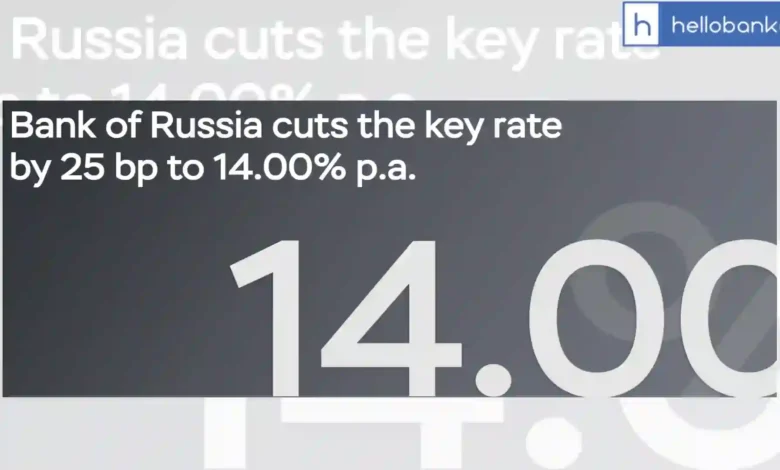
The Bank of Russia has reduced its key interest rate by 25 basis points, bringing it down from 14.25% to 14.00% per annum. The decision was announced by the Bank’s Board of Directors on 24 July 2026. According to the central bank, the Russian economy continued to grow at a moderate pace during the second quarter of 2026. However, inflationary pressures and economic uncertainties require a cautious approach to future rate cuts.
Benchmark Rates
| Indicator | Value |
|---|---|
| Inflation Target | 4.0% |
| Inflation (June 2026) | 6.0% |
| Key Rate (from 27.07.2026) | 14.00% |
| Previous Key Rate (from 22.06.2026) | 14.25% |
| Next Board of Directors’ Key Rate Meeting | 11.09.2026 |
| RUONIA (23.07.2026) | 14.03% |
RUONIA stands for Ruble Overnight Index Average, which is the benchmark reference rate for overnight ruble loans, a measure of borrowing costs, and an indicator of market liquidity in Russia.
Inflation Remains a Key Concern
The Bank of Russia said that recent increases in prices and higher inflation expectations were mainly caused by temporary factors, including rising fuel prices and changes in food prices such as fruits and vegetables. Despite these short-term increases, underlying inflation remained within the target range of 4% to 5% on an annualized basis.
As of 20 July 2026, Russia’s annual inflation stood at 5.9%. The central bank now expects inflation to remain between 6.0% and 7.0% during 2026 before returning to its target level in 2027.
Future Interest Rate Decisions
The central bank said that future decisions on the key interest rate will depend on inflation trends, inflation expectations, and both domestic and global economic conditions.
According to its baseline forecast:
- The average key interest rate is expected to remain around 14.5%–14.6% in 2026.
- It is projected to decline further to 10.5%–12.5% during 2027.
The Bank emphasized that any future reduction in interest rates will be gradual to ensure inflation remains under control.
Russian Economy Continues Moderate Growth
The Bank of Russia stated that the economy grew at a moderate pace during the second quarter of 2026. Consumer spending remained the main driver of economic growth, while investment activity showed some improvement but continued to remain moderate.
However, temporary disruptions in production capacity affected several industries, leading businesses to lower their expectations for future demand and production. As a result, the central bank revised Russia’s GDP growth forecast for 2026 downward to 0.0%–1.0%, while keeping its forecasts for 2027 and 2028 unchanged.
Labour Market Shows Signs of Improvement
The labour market remained strong, although shortages eased slightly. Business surveys indicated that staffing levels improved and unemployment continued to stay at record-low levels.
While wage growth has slowed compared to previous months, salaries are still increasing faster than labour productivity, which remains a concern for inflation.
Lending Growth Slows
The Bank reported that lending activity slowed during June, mainly due to weaker corporate lending. Monetary conditions remain moderately tight, with interest rates rising in most financial market segments.
At the same time, households showed a slightly lower tendency to save, while banks continued to maintain strict lending standards.
Risks to the Economy
The Bank of Russia believes that inflation risks continue to outweigh the risks of lower inflation over the medium term.
Some of the major inflation risks include:
- Rising production costs due to temporary shutdowns in certain industries.
- High inflation expectations among consumers and businesses.
- Wage growth remaining higher than productivity growth.
- Global economic uncertainty and geopolitical tensions leading to higher international prices.
On the other hand, weaker domestic demand could reduce inflationary pressures in the future.
Fiscal Policy to Influence Future Decisions
The Bank noted that Russia’s fiscal policy will also play an important role in future monetary policy decisions. If the government adopts a more expansionary budget than currently expected, the central bank may need to maintain a tighter monetary policy to control inflation.
Updated budget projections from the Russian government are expected later this year and will be considered in the Bank’s October economic forecast.
Upcoming Policy Announcements
The Bank of Russia has updated its medium-term economic forecast following the July policy meeting. Further details, including the Summary of the Key Rate Discussion and the Commentary on the Medium-term Forecast, will be released on 5 August 2026. The next meeting of the Bank of Russia’s Board of Directors to decide the key interest rate is scheduled for 11 September 2026, with the official policy announcement to be published at 1:30 PM Moscow time.