Central Government Vacancies Double in 10 Years, Contract Workers in PSUs Rise to almost 50%

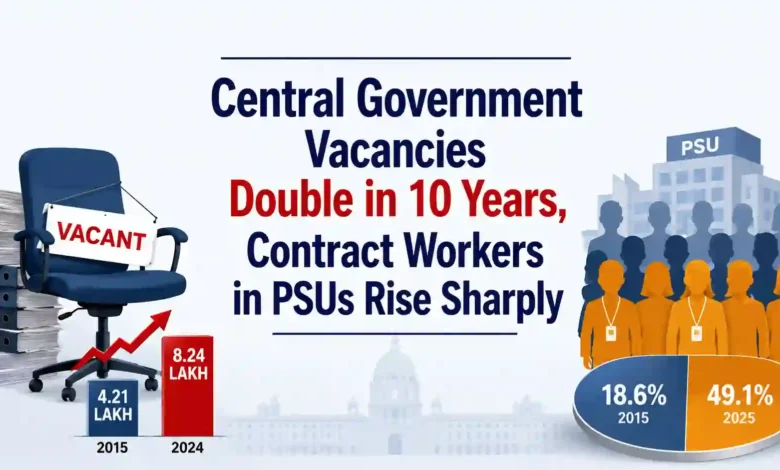
Central government vacancies have nearly doubled over the past decade, rising from 4.21 lakh in 2015 to 8.24 lakh in 2024. The vacancy rate also increased from 11.5% to 21% of sanctioned posts. Defence (Civilian) had the highest number of vacancies at 2.42 lakh, while Commerce recorded the highest vacancy rate at 55.4%. The government is also increasingly relying on outsourced and contractual workers. Around 10 lakh workers were outsourced through GeM, while the share of contract workers in PSUs increased sharply from 18.6% in 2015 to 49.1% in 2025.
The number of vacant posts in the Central government has almost doubled in the last 10 years. Vacant posts increased from 4.21 lakh in 2015 to 8.24 lakh in 2024. During the same period, vacancies as a share of total sanctioned posts increased from 11.5% to 21%.
The total number of sanctioned posts across Central government departments increased by 2.74 lakh during this period. However, the number of employees actually working in these posts fell by 1.29 lakh.
Over 8 Lakh Posts Vacant
According to a Department of Expenditure report on the salaries and allowances of Central civil employees, 39,23,212 posts are sanctioned across 80 ministries and departments. Of these, 30,99,656 posts are currently filled, while 8,23,556 posts are vacant. In 2015, there were 36,49,468 sanctioned posts. At that time, 32,28,921 posts were filled and 4,20,547 posts were vacant.
As per a report by Dainik Bhaskar, the number of vacant posts are as follows:
| Ministry/Department | Vacant Posts (2024) | Vacant Posts (2015) |
|---|---|---|
| Railways | 2,40,125 (16.2%) | 00 |
| Home Affairs | 1,10,885 (9.9%) | 58,774 (5.8%) |
| Defense (Civilian) | 2,41,643 (43.4%) | 1,87,054 (31.9%) |
| Department of Posts | 61,546 (24.3%) | 7,561 (3.8%) |
| Revenue | 69,652 (38.8%) | 81,032 (45.6%) |
| Audit/Accounts | 21,505 (31.7%) | 21,457 (31.4%) |
| Atomic Energy | 10,234 (27.5%) | 5,368 (14.3%) |
| Health | 1,582 (5.8%) | 00 (0.0%) |
| Space | 4,126 (21.5%) | 3,035 (19.7%) |
| Housing/Urban Affairs | 4,592 (24.0%) | 12,067 (39.5%) |
| External Affairs | 2,028 (16.1%) | 1,850 (21.5%) |
| Water Resources | 3,191 (27.9%) | 4,024 (35.3%) |
| DoPT | 2,429 (21.6%) | 1,771 (16.6%) |
| Mines | 3,501 (33.7%) | 5,748 (40.7%) |
| Earth Sciences | 2,895 (38.6%) | 2,526 (33.7%) |
| Labour | 2,618 (41.5%) | 2,574 (23.8%) |
| Science and Technology | 1,582 (29.4%) | 5,104 (41.4%) |
| Commerce | 2,435 (55.4%) | 863 (37.1%) |
| Law and Justice | 1,267 (36.4%) | 313 (23.0%) |
| Civil Aviation | 1,247 (45.2%) | 903 (46.5%) |
| Higher Education | 522 (36.9%) | 474 (34.0%) |
| Total Posts | 8,23,556 (21%) | 4,20,547 (11.5%) |
Large Increase in Railways Vacancies
The Railways had reported no vacancies in 2015, but by 2024 it had 2.40 lakh vacant posts. These vacancies accounted for 16.2% of its total sanctioned posts. The health sector also saw a rise in vacancies. Its vacancy rate increased from zero in 2015 to 6% in 2024.
Home Ministry Vacancies Rise
The Ministry of Home Affairs added around 1.02 lakh sanctioned posts during the period. However, the number of recruitments increased by only around 49,621. As sanctioned posts increased faster than recruitment, vacancies in the ministry rose sharply from 58,774 in 2015 to 1,10,885 in 2024.
Defence Has Highest Number of Vacancies
The Defence (Civilian) sector had the highest number of vacant posts at around 2.42 lakh in 2024. Its vacancy rate also increased significantly, from 31.9% in 2015 to 43.4% in 2024. The Postal Department also saw a major increase in vacant posts. Vacancies increased from 7,561 in 2015 to 61,546 in 2024.
High Vacancy Rate in Commerce
The Commerce sector recorded the highest vacancy rate among the departments mentioned in the report. In 2024, 55.4% of its sanctioned posts were vacant, compared with 37.1% in 2015. The Civil Aviation sector had a vacancy rate of 45.2%, while 41.5% of posts in the Labour sector were vacant.
Government Increasingly Uses Outsourcing
Government departments are also increasingly using outsourcing to meet their staffing requirements. The Government e-Marketplace (GeM) platform is used to outsource workers for various jobs.
Around 10 lakh employees were outsourced through the platform last year, according to the information provided. Experts say many ministries and departments are choosing to outsource work to companies instead of directly hiring employees on contract.
Contract Workers Increase in State-Owned Companies
State-owned companies have also become more dependent on contractual workers over the years. According to the Public Enterprises Survey, 15,87,149 employees were working in 298 public sector undertakings (PSUs) in 2015. Of these, 2,95,975 employees, or 18.6%, were contract workers.
By 2025, the total workforce in 475 PSUs stood at 15,42,339. Only 7,83,728 employees were regular workers, while 7,58,611 were working on a contract basis. This means contract workers accounted for around 49.1% of the total workforce in state-owned companies in 2025, compared with 18.6% in 2015. Nearly one out of every two workers was therefore employed on a contractual basis.