Bank Branches can’t reject loans of SC/ST customers, Staff will have to fill Application Form

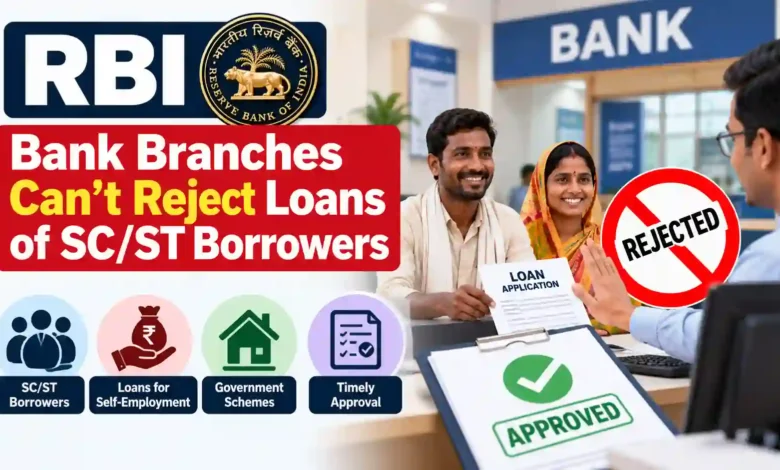
The Reserve Bank of India (RBI) has issued a new Master Circular on “Credit Facilities to Scheduled Castes (SCs) and Scheduled Tribes (STs)”. The guidelines apply to all Scheduled Commercial Banks, including Small Finance Banks. The main objective is to ensure that SC and ST communities get adequate and timely access to bank credit for self-employment, business, income generation and other productive activities.
The important points of the RBI Master Circular are:
- Banks should give special attention to increasing credit flow to SC/ST borrowers.
- Credit planning at the block and district levels should give appropriate weightage to SC/ST communities.
- Bank staff should help SC/ST borrowers complete loan application formalities.
- Banks should create awareness about available credit schemes among SC/ST communities.
- Banks should not insist on deposits for eligible loans under Government-sponsored poverty alleviation and self-employment programmes.
- Applicable subsidy should not be unnecessarily withheld while releasing the loan.
- Rejection of SC/ST loan applications under Government programmes should take place at the next higher level, not at the branch level.
- Reasons for rejection should be clearly recorded.
- SC/ST borrowers should receive at least 40% of total DRI advances.
- Certain landholding conditions under the DRI Scheme do not apply to SC/ST borrowers.
- SC/ST beneficiaries meeting the conditions can get a housing loan of up to ₹20,000 under the DRI provisions in addition to the ₹15,000 individual loan.
- CEGSSC provides credit guarantee support for eligible SC entrepreneurs, ranging from ₹15 lakh to ₹5 crore.
- Banks should maintain a special cell at Head Office to monitor SC/ST credit flow.
- Banks should conduct quarterly reviews of lending to SC/ST borrowers.
- SC/ST credit data should be reported according to RBI’s Priority Sector Lending reporting requirements.
Let’s understand the new circular in detail:
1. Planning Process for SC/ST Lending
Banks have been advised to give special attention to SC and ST borrowers while preparing their credit plans. The District Level Consultative Committees under the Lead Bank Scheme will continue to be the main platform for coordination between banks and development agencies. District credit plans prepared by Lead Banks should clearly show how bank credit is linked with employment and development schemes.
Banks should also maintain close coordination with District Industries Centres, which work to promote self-employment. At the block level, credit planning should give appropriate weightage to SC and ST communities. Banks should develop suitable and bankable schemes for these communities so that more people can obtain loans for self-employment and income-generating activities.
Banks have also been advised to regularly review their lending procedures to ensure that loans are sanctioned on time, are sufficient for the proposed activity and are properly linked to production and income generation. While preparing Block and District Credit Plans, special attention may be given to villages and local areas where there is a sizeable SC/ST population.
2. Banks Should Help SC/ST Borrowers
Bank staff should help SC and ST borrowers in filling out loan application forms and completing other formalities. The objective is to ensure that eligible borrowers receive credit within the stipulated period after submitting their applications. Banks should also create greater awareness among SC/ST communities about various loan schemes. This can be done through brochures, field visits, awareness programmes and meetings.
Branches have been advised to organise meetings specifically for SC/ST beneficiaries more frequently. These meetings can help banks understand their credit requirements and include those requirements in credit planning. RBI and NABARD circulars relating to SC/ST lending should also be properly circulated among bank staff for compliance.
3. No Deposit Should Be Insisted Upon Under Certain Government Schemes
Banks should not insist that SC/ST borrowers maintain or make deposits while considering loan applications under Government-sponsored poverty alleviation schemes and self-employment programmes. Banks should also ensure that the applicable subsidy is not kept pending while releasing the loan amount. The subsidy should be released along with the loan component as applicable. RBI has stated that holding back the subsidy can result in under-financing and may affect the creation of assets and generation of income.
4. Support to SC/ST Finance and Development Corporations
The National Scheduled Tribes Finance & Development Corporation and National Scheduled Castes Finance & Development Corporation have been established under the Ministry of Tribal Affairs and Ministry of Social Justice & Empowerment respectively.
Banks should provide necessary institutional support to these organisations so that they can achieve their objectives. Loans provided to State-sponsored organisations for SC/ST communities for purchasing and supplying inputs or marketing the products of beneficiaries can also qualify for priority sector classification, subject to the applicable rules.
5. Rejection of SC/ST Loan Applications
There is a specific provision regarding rejection of loan applications from SC/ST borrowers under Government programmes. Such applications should not be rejected at the branch level. The rejection should be done at the next higher level. The reasons for rejection must also be clearly recorded. This provision is intended to ensure proper scrutiny of such applications and avoid unnecessary rejection at the branch level.
6. Role of SC/ST Development Corporations
State-level Scheduled Caste and Scheduled Tribe Development Corporations can consider bankable schemes and proposals for bank finance. The Government has advised State Governments regarding the role of these corporations in helping SC/ST beneficiaries obtain bank finance.
7. Reservation and Relaxation Under Major Government Schemes
Several Centrally Sponsored Schemes provide bank credit to beneficiaries along with subsidy or other assistance from Government agencies. Under these schemes, there are specific provisions, reservations or relaxations for SC/ST beneficiaries.
DAY-NRLM
The Deendayal Antyodaya Yojana – National Rural Livelihoods Mission (DAY-NRLM), earlier known as NRLM, was launched by the Ministry of Rural Development from April 1, 2013. The scheme was created by restructuring the earlier Swarnajayanti Gram Swarozgar Yojana. Under DAY-NRLM, adequate coverage of vulnerable sections is to be ensured, with 50% of beneficiaries being SCs/STs.
Differential Rate of Interest (DRI) Scheme
Under the DRI Scheme, banks provide loans of up to ₹15,000 at a concessional interest rate of 4% per annum to eligible weaker sections for productive and income-generating activities. To ensure adequate benefit to SC/ST borrowers, banks have been advised that SC/ST borrowers should receive at least 2/5th, or 40%, of the total DRI advances.
There is also a relaxation in the landholding eligibility condition for SC/ST borrowers. The normal landholding limits of 1 acre of irrigated land and 2.5 acres of unirrigated land do not apply to SC/ST borrowers. SC/ST members who meet the income criteria can also get a housing loan of up to ₹20,000 per beneficiary in addition to the individual DRI loan of ₹15,000.
8. Credit Enhancement Guarantee Scheme for Scheduled Castes
The Credit Enhancement Guarantee Scheme for Scheduled Castes (CEGSSC) was launched by the Ministry of Social Justice & Empowerment on May 6, 2015. The purpose of the scheme is to encourage entrepreneurship among SCs by providing credit enhancement guarantees to lending institutions that provide financial assistance to SC entrepreneurs. IFCI Ltd. has been designated as the nodal agency for providing the guarantee cover to Member Lending Institutions.
Who can get the guarantee?
Individual SC entrepreneurs and certain eligible business entities can qualify. For registered companies, societies, partnership firms and sole proprietorship firms, more than 51% shareholding and management control should have been held by SC entrepreneurs, promoters or members for the previous six months.
Guarantee Amount
The guarantee cover under CEGSSC ranges from:
- Minimum: ₹0.15 crore, or ₹15 lakh
- Maximum: ₹5 crore
The guarantee can be provided for a maximum period of 7 years or the repayment period of the loan, whichever is earlier.
9. Monitoring by Banks
Banks are required to closely monitor the flow of credit to SC/ST beneficiaries. A special cell should be established at the bank’s Head Office to monitor SC/ST credit. This cell will also collect information from branches, consolidate the data and submit the required returns to RBI and the Government.
The Head Office should periodically review the credit extended to SC/ST borrowers. If there is a major gap or significant year-on-year variation in credit flow to SC/ST borrowers, the matter should be reported to the Board or to a committee to which the Board has delegated the relevant powers.
10. Quarterly Review of SC/ST Lending
Banks should review their measures for increasing credit to SC/ST borrowers on a quarterly basis. The review should cover lending provided directly by banks as well as lending provided through State-level SC/ST Corporations. Senior officers from Head Offices and Controlling Offices may also conduct field visits as part of this review.
11. SC/ST Representatives in SLBC Meetings
The SLBC Convenor Bank should invite representatives of the National Commission for Scheduled Castes and the National Commission for Scheduled Tribes to attend State Level Bankers’ Committee (SLBC) meetings. The Convenor Bank may also invite representatives of the National Scheduled Castes and Scheduled Tribes Finance and Development Corporation and State Scheduled Castes and Scheduled Tribes Finance and Development Corporations.
12. Reporting Requirements
Banks must report data relating to advances provided to SC and ST borrowers according to the requirements prescribed under RBI’s Master Direction on Priority Sector Lending. The required data must be submitted within the timelines prescribed by RBI.
Click here to download RBI Circular

