RBI Proposes ₹1 Crore Minimum Investment in Securitisation Notes: What It Means for Investors

| ➡️ Click here to Join Whatsapp News Group - Get instant updates of all Banking News |
The Reserve Bank of India (RBI) has proposed major changes to the rules governing securitisation notes in India. The draft amendments aim to make the securitisation market more transparent, efficient and secure while keeping these investment products mainly for institutional and large investors. If approved, the new rules will come into effect from October 1, 2026.
What Is Securitisation?
Securitisation is a process in which banks and financial institutions combine different types of loans, such as home loans, vehicle loans and personal loans, into a single pool. These loan pools are then transferred to a Special Purpose Entity (SPE), which issues securitisation notes backed by the repayments received from borrowers.
Investors who purchase these notes earn returns from the loan repayments. This process helps banks free up capital, improve liquidity and transfer part of the credit risk to investors.
Key Changes Proposed by RBI
RBI has proposed that all securitisation notes should be issued, held and transferred only in dematerialised (demat) form. This will reduce paperwork, improve transparency, simplify ownership transfers and strengthen record-keeping.
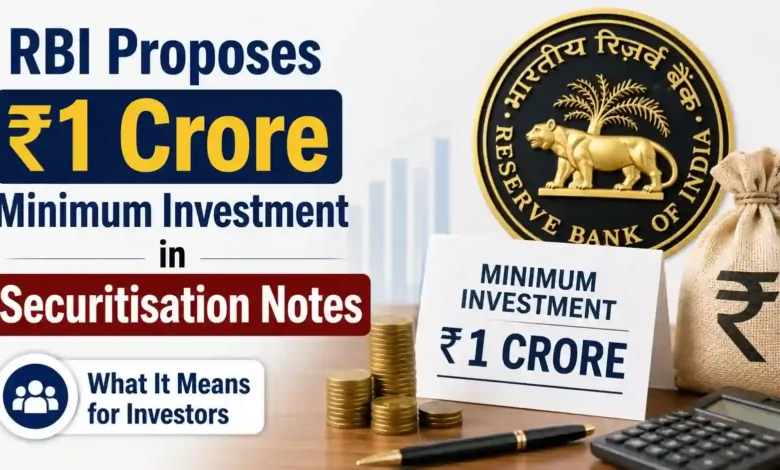
The central bank has also proposed a minimum investment of ₹1 crore for securitisation notes. This minimum investment will apply both when the notes are first issued and when they are transferred later. RBI has clarified that the ₹1 crore ticket size refers to the investment made by a single investor. The agreement between the originating bank and the Special Purpose Entity (SPE) must also include a clause to ensure that this requirement is always followed.
Changes in Public Offer Rules
RBI has also proposed changing the definition of a public offer for securitisation notes. Under the draft rules, an offer will be treated as a public offer if it is made to a number of persons equal to or more than the limit prescribed under Regulation 21 of the SEBI (Issue and Listing of Securitised Debt Instruments and Security Receipts) Regulations, 2008, as amended from time to time.
What It Means for Investors
The proposed ₹1 crore minimum investment means that retail investors are unlikely to participate directly in this market. Instead, securitisation notes will mainly be purchased by institutional investors such as banks, insurance companies, mutual funds, pension funds and ultra-high-net-worth individuals.
RBI believes that experienced investors are better equipped to understand and assess the risks associated with complex loan-backed investment products.
Why RBI Is Making These Changes
According to RBI, the proposed changes will improve transparency, strengthen the transfer process and support the digitisation of India’s financial system. The securitisation market has grown steadily in recent years as banks increasingly use it to manage their balance sheets and raise funds.
By introducing standardised rules, mandatory demat holding and a higher minimum investment requirement, RBI aims to build a stronger and more efficient securitisation market.
Draft Rules Open for Consultation
The proposed amendments have been released for public consultation. If the draft rules are finalised, they will come into force from October 1, 2026, and will change the way securitisation notes are issued and traded in India.