ICICI Bank Directed to Remove Lien on Customer’s Account, Consumer Commission Awards Compensation

| ➡️ Click here to Join Whatsapp News Group - Get instant updates of all Banking News |
The District Consumer Disputes Redressal Commission, Kaithal, comprising Smt. Neelam Kashyap (President), Smt. Harisha Mehta (Member), and Shri Sunil Mohan Trikha (Member), held ICICI Bank responsible for deficiency in service and unfair trade practice.
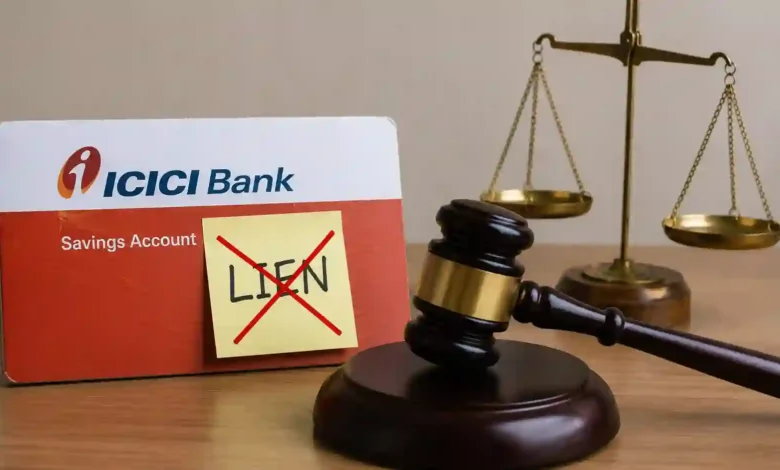
The Commission found that the bank had imposed a lien on the complainant’s savings account without following proper procedure and without producing any evidence to support the alleged fraud dispute on which the lien was based.
What is the case?
The complainant, Shaily Sikka, had a savings account with ICICI Bank. On 12 December 2025, she tried to make a payment for medical expenses, but the transaction failed. When she checked her account, she found that a lien had been placed on it. As a result, her available balance was reduced from ₹14,14,006.82 to ₹2,75,993.18.
On 15 December 2025, she visited the bank branch and asked for an explanation and removal of the lien. According to her, bank officials informed her that the account had been marked under lien because of an alleged fraud dispute. They also told her that only the bank’s backend team could remove the lien.
She later visited the branch again and sent an email seeking the reason for the lien. She also asked whether any FIR or police complaint had been filed. However, she did not receive any satisfactory response from the bank. Therefore, she approached the District Consumer Commission and alleged deficiency in service. She also sought compensation for the mental stress and harassment caused by the bank’s action.
What ICICI Bank said?
ICICI Bank argued that the lien was imposed as a precautionary measure under its internal procedures and guidelines. The bank stated that on 23 November 2025, ₹34.90 lakh had been transferred to the complainant’s account through NEFT by Shilpa Vij, who was stated to be the complainant’s sister.
According to the bank, the person who sent the money later disputed the transaction through customer care. After receiving the dispute, the bank marked a lien on the amount until verification was completed. The bank also claimed that it had tried to contact the remitter and that the lien was necessary to protect the disputed funds.
The Commission found that the bank failed to support its claims with documentary evidence. Although the bank stated that the remitter had raised a dispute through customer care, it did not produce any complaint record, communication, call details, or other documents to prove the claim. The bank also failed to show that it had contacted the remitter or carried out any verification process.
The Commission further observed that the bank relied on its internal guidelines to justify the lien but failed to place those guidelines on record. It also did not produce any FIR, police complaint, cybercrime complaint, or investigation report related to the transaction. The Commission rejected the bank’s claim of an internal investigation and observed that a bank cannot act as a statutory investigating agency without supporting evidence.
After examining RBI circulars placed on record, the Commission noted that the bank had failed to show compliance with the applicable regulatory framework. The Commission also accepted the complainant’s argument that she was not properly informed about the reason for the lien. The bank could not prove that it had sent any communication explaining the action.
Relying on earlier judgments related to arbitrary freezing of bank accounts, the Commission held that the bank had imposed the lien without following due process and without any supporting complaint or investigation. It concluded that the bank’s actions amounted to deficiency in service and unfair trade practice. The Commission observed that the complainant had suffered financial loss, inconvenience, and mental agony because of the bank’s conduct.
Allowing the complaint, the Commission directed the bank and other opposite parties to immediately remove the lien from the complainant’s savings account. The Commission also awarded ₹15,000 as compensation for mental agony and harassment and ₹5,000 towards litigation expenses.
The Commission directed that the amount should be paid within 45 days. If the payment is not made within that period, it will carry interest at 7% per annum from the date of the order until payment is made.
- Download Court Order PDF (This PDF is available for Premium Users Only. Click here to join premium)