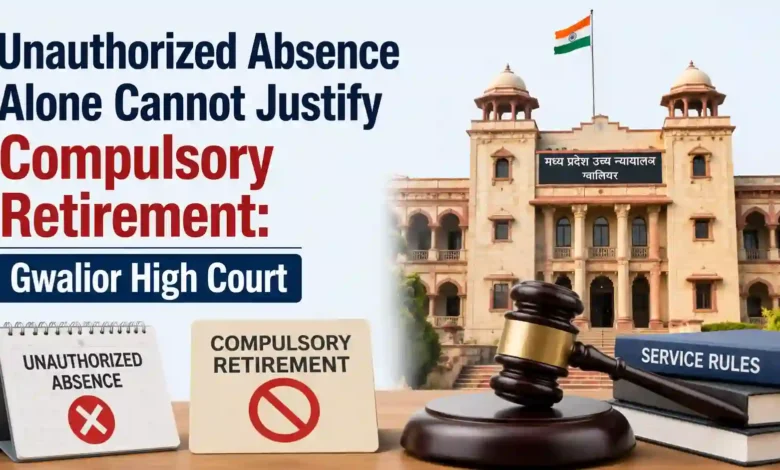
The Gwalior Bench of the Madhya Pradesh High Court has ruled that an employee cannot be dismissed or compulsorily retired only because of unauthorized absence from duty. The Court said that before imposing such a severe punishment, a departmental inquiry must clearly prove that the employee was intentionally and willfully absent. If there is no such finding, the punishment cannot be legally justified.
Court Quashes Compulsory Retirement Order
Justice Anand Singh Baharawat set aside the compulsory retirement order issued against Karan Khare, a Class IV employee of the Central Bank of India. Khare, who has been working with the bank since 1998, was compulsorily retired on July 24, 2024, after the bank alleged that he remained absent from duty without authorization for 586 days.
After his departmental appeal and revision petition were rejected, he approached the High Court seeking relief.
High Court’s Observations
The High Court observed that disciplinary authorities perform quasi-judicial functions, and therefore, their decisions must be based on facts and supported by clear reasons. The Court said that a disciplinary order must explain why the employee’s defence was rejected.
The Court found that the bank’s retirement order did not state anywhere that Karan Khare’s absence was willful. Since there was no such finding, the order did not satisfy the legal requirements for imposing compulsory retirement.
Employee’s Arguments
In his petition, Karan Khare stated that in 2019 he had filed a complaint of caste-based harassment against the then branch manager. According to him, departmental proceedings were started against him after that complaint.
He also told the Court that he was seriously ill during the period of his absence and had submitted medical records to the bank as proof of his treatment. However, the bank questioned his absence without getting his medical condition independently verified.
Employee Opposed Double Punishment
The employee further argued that the bank had already imposed a minor penalty after a departmental inquiry for part of the 2019–2021 period. He claimed that the same period was later used as the basis for imposing compulsory retirement.
According to him, taking another and much harsher action for the same period was unfair and legally unjustified.
Importance of Fair Departmental Proceedings
The High Court emphasized that disciplinary proceedings must be fair and transparent. It said that authorities must follow the prescribed rules, give proper reasons for their decisions, and carefully examine the employee’s defence before imposing a major punishment.
The Court reiterated that an employee’s future cannot be decided solely on allegations without proper evidence and a legally valid departmental inquiry.