| ➡️ Click here to Join Whatsapp News Group - Get instant updates of all Banking News |
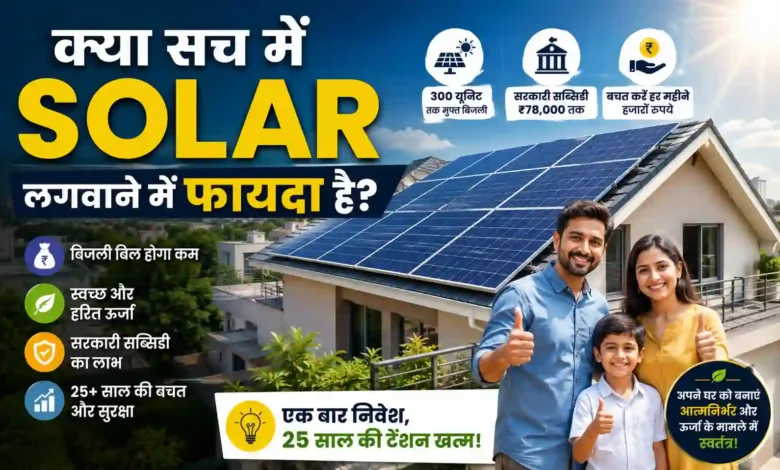
The Government of India launched the PM Surya Ghar Muft Bijli Yojana – a rooftop solar scheme, to help households generate electricity from solar panels installed on their roofs. The scheme is attractive as it provides a subsidy of up to ₹78,000. The government has set a target to benefit 1 crore households and provide up to 300 units of free electricity per month through solar power generation.
This scheme is very attractive as users get low electricity bills and at the same time get subsidy upto Rs.78,000.
Scheme Launch Date
Prime Minister Narendra Modi announced the scheme on 13 February 2024. It is being implemented by the Ministry of New and Renewable Energy (MNRE).
Subsidy Details
The Government is offering subsidy upto Rs.78,000 and this subsidy is available only for residential rooftop solar systems. The subsidy is provided as per the capacity of solar system. The maximum subsidy of Rs.78,000 is provided for installation of solar system of 3kW and more.
| Solar Capacity | Subsidy |
|---|---|
| 1 kW | ₹30,000 |
| 2 kW | ₹60,000 |
| 3 kW | ₹78,000 |
| Above 3 kW | Maximum ₹78,000 |
The subsidy is directly transferred to the consumer’s bank account after installation, inspection, and approval by the DISCOM.
What is the Installation Cost of Solar?
The approximate cost of installation of 1 kW solar system is Rs.60,000-90,000. Users get subsidy of Rs.30,000 in this case. So actual price comes to Rs.30,000 to Rs.60,000.
| Solar Capacity | Approximate Cost | Cost After Subsidy |
|---|---|---|
| 1 kW | ₹60,000–90,000 | ₹30,000–60,000 |
| 2 kW | ₹1.2–1.8 lakh | ₹60,000–1.2 lakh |
| 3 kW | ₹1.8–2.7 lakh | ₹1.0–1.9 lakh |
| 5 kW | ₹3.0–4.0 lakh | ₹2.2–3.2 lakh |
Actual prices vary by state, vendor, and equipment quality.
Is a Loan Mandatory to avail subsidy?
No.
You can pay the full amount yourself and receive the subsidy later or take a bank loan and still receive the subsidy. The subsidy is available in both cases.
Is it worth installation?
First, let’s understand the electricity generation. How much electricity is generated.
| Solar Capacity | Daily Generation | Monthly Generation |
|---|---|---|
| 1 kW | 4–5 units | 120–150 units |
| 2 kW | 8–10 units | 240–300 units |
| 3 kW | 12–15 units | 360–450 units |
| 5 kW | 20–25 units | 600–750 units |
These are average figures for most Indian cities.
Is a 3 kW Solar System Enough for Daily Household Use?
For many families, yes.
A 3 kW system can generally support:
✅ Refrigerator
✅ Television
✅ Wi-Fi Router
✅ LED Lights
✅ Washing Machine
✅ Water Pump
✅ 4–6 Ceiling Fans
✅ One 1.5 Ton Inverter AC (moderate usage)
Typical production of 12–15 units per day is sufficient for a household consuming around 300–450 units per month. However, if you run multiple ACs regularly, a larger system may be required.
Example Household Consumption
| Appliance | Daily Units |
|---|---|
| Refrigerator | 1–2 |
| Fans | 1.5–2 |
| TV | 0.5 |
| Lights | 0.5 |
| Washing Machine | 0.5 |
| 1.5 Ton Inverter AC | 5–8 |
| Total | 9–13 Units |
A 3 kW system can generally cover this usage level.
Does It Work at Night?
Solar panels generate electricity only during daylight.
Without Battery (Most Common)
- Solar powers your home during the day.
- Excess power is sent to the grid through net metering.
- At night, electricity comes from the grid.
With Battery
- Solar energy is stored in batteries.
- Appliances can run during power cuts and at night.
- System cost increases significantly.
For standard 3 kW on-grid systems under the scheme, batteries are generally not required.
Life of Solar System
| Component | Life |
|---|---|
| Solar Panels | 25–30 years |
| Inverter | 8–15 years |
| Structure | 25+ years |
| Wiring | 15–25 years |
Even after 25 years, solar panels typically continue producing around 80–85% of their original output.
Maintenance
Solar systems require very little maintenance:
- Clean panels periodically.
- Check wiring occasionally.
- Replace inverter once during the system’s lifetime.
- Many vendors provide maintenance support for initial years.
How to Apply
- Visit the official PM Surya Ghar portal:
- Register using your electricity consumer number.
- Obtain approval from your DISCOM.
- Install solar panels through an approved vendor.
- Apply for net metering.
- After inspection and commissioning, receive subsidy directly in your bank account.
Should You Install Solar?
For a family with monthly electricity bill above ₹1,500–2,000, rooftop solar is usually a good investment. A 3 kW system can often recover its cost within 4–6 years and continue generating electricity for 20+ more years.
Final Recommendation
For most Indian households using a refrigerator, TV, fans, lights, washing machine, and one inverter AC, a 3 kW rooftop solar system offers the best balance of cost, subsidy, and electricity generation. With the ₹78,000 government subsidy, the effective cost becomes much lower, making it the most popular choice under the PM Surya Ghar Yojana.


