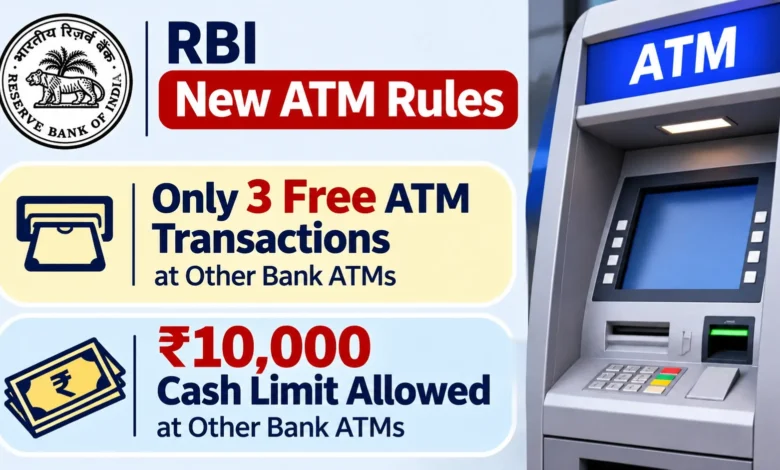
RBI New ATM Rules: Only 3 Free ATM Transactions and Rs 10,000 Cash Limit Allowed at Other Bank ATMs

| ➡️ Click here to Join Whatsapp News Group - Get instant updates of all Banking News |
The Reserve Bank of India (RBI) has issued new consolidated directions governing cash withdrawal transactions through Automated Teller Machines (ATMs) and Point of Sale (PoS) terminals. The new instructions cover free ATM transactions, customer charges, cash withdrawal limits, failed transactions, ATM security, cardless cash withdrawals and cash withdrawal facilities at merchant establishments.
RBI New ATM and PoS Directions 2026: Key Highlights
| Particulars | Details |
|---|---|
| Issuing Authority | Reserve Bank of India |
| Notification Date | November 27, 2026 |
| Name of Directions | RBI (Cash Withdrawal Transactions through ATMs and PoS Terminals) Directions, 2026 |
| Free Transactions at Own Bank ATMs | 5 per month |
| Free Transactions at Other Bank ATMs | 3 in metro centres and 5 in non-metro centres, subject to an overall limit of 5 |
| Maximum Charge Beyond Free ATM Limit | ₹23 per transaction plus applicable taxes |
| Maximum Other-Bank ATM Cash Withdrawal | ₹10,000 per transaction |
| Maximum PoS Cash Withdrawal | ₹2,000 per transaction |
| Monthly PoS Cash Withdrawal Limit | ₹10,000 across all locations |
| Maximum PoS Customer Charge | 1% of transaction amount |
1. Free ATM Transactions: Five Transactions at Own Bank ATMs
The RBI has retained the provision allowing savings bank account holders to carry out five free transactions every month at their own bank’s ATMs. These five transactions include both financial and non-financial transactions.
Financial transactions generally include cash withdrawals, while non-financial transactions include services such as balance enquiries and mini statements. Therefore, customers can use their own bank’s ATM five times a month without paying transaction charges under this provision.
2. Free Transactions at Other Bank ATMs
The RBI has prescribed different free transaction limits for using ATMs operated by other banks. The applicable limits are:
- Metro centres: Three free transactions per month.
- Non-metro centres: Five free transactions per month.
However, if a customer uses ATMs in both metro and non-metro centres during the same month, the total number of free transactions will remain limited to five. The RBI has defined the following six cities as metro centres:
- Mumbai
- New Delhi
- Chennai
- Kolkata
- Bengaluru
- Hyderabad
All other places will be treated as non-metro centres.
For example, if a customer uses two free transactions at another bank’s ATM in Delhi and three free transactions at another bank’s ATM in a non-metro city, the customer will have exhausted the total limit of five free transactions.
3. Maximum Cash Withdrawal Limit of ₹10,000 per Transaction at Other Bank ATMs
The RBI has also prescribed a maximum cash withdrawal limit of ₹10,000 per transaction for withdrawals at other bank ATMs under the new directions. Customers should keep this limit in mind while withdrawing cash from ATMs operated by banks other than their own.
4. Failed ATM Transactions Will Not Be Counted as Valid Transactions
The RBI has clarified that certain failed ATM transactions must not be counted as valid transactions for customers. These include transactions that fail due to:
- Technical problems involving ATM hardware or software.
- Communication or network issues.
- Non-availability of currency notes in the ATM.
- Other declines directly or wholly attributable to the bank or service provider.
- Invalid PINs or validation-related issues.
No charges can be levied for these transactions. This provision is intended to ensure that customers are not charged or deprived of their free transaction limits because of failed transactions covered by the RBI’s instructions.
5. Banks Can Offer More Than Five Free ATM Transactions
The RBI has clarified that the prescribed free transaction limits are minimum requirements. Banks are free to offer a higher number of free ATM transactions every month if they wish to do so.
Banks can also decide the combination of free transactions applicable to metro and non-metro centres, provided they comply with the minimum requirements prescribed by the RBI. For Basic Savings Bank Deposit Accounts (BSBDA), banks must follow the applicable RBI instructions under the Responsible Business Conduct Directions, 2025, or the corresponding directions applicable to their category.
6. Banks Can Charge a Maximum of ₹23 for ATM Transactions Beyond the Free Limit
The RBI has prescribed a maximum limit on the charges that banks can collect from customers for ATM transactions beyond the mandated free monthly limit. Banks may frame a Board-approved policy for collecting charges, but the charge cannot exceed ₹23 per transaction plus applicable taxes.
For example, if a customer has exhausted the applicable free ATM transaction limit, the bank may collect a charge for subsequent transactions, subject to the prescribed maximum. The RBI has also directed banks to establish a suitable mechanism to alert customers about:
- The number of free ATM transactions already used during the month.
- The remaining free transaction limit.
- The charges that may apply to subsequent transactions.
This will help customers understand when they may have to pay additional ATM charges. Banks must also display information about the maximum cash withdrawal limit, free transaction limits and applicable charges at ATMs in English, Hindi and the local language.
7. ATMs Must Clearly Display Whether They Are in Metro or Non-Metro Locations
The RBI has directed banks installing ATMs to clearly indicate whether an ATM is located in a metro or non-metro centre. This information may be displayed through:
- A message on the ATM screen.
- A sticker.
- A poster.
- Any other suitable method.
The purpose is to help customers understand the applicable free transaction limit before using an ATM. Banks must also ensure that the ATM location identifiers maintained in their ATM databases are accurate and updated at all times. This will help reduce disputes regarding the classification of ATM locations and the number of free transactions available to customers.
8. Security and Customer Service Instructions for ATMs
The RBI has prescribed several requirements relating to ATM security and customer service.
- EMV Chip and PIN Cards: All ATMs installed or operated by banks must support transactions using EMV chip and PIN cards.
- Display of Cash Availability: If an ATM does not have cash available, the information must be displayed before the customer initiates a transaction.
- Time-Out Sessions: ATMs must have time-out sessions at different screens and stages of transactions. The time allowed should be reasonable and based on the time normally required to complete the relevant activity.
Banks must ensure that unnecessary extensions are not allowed beyond reasonable limits.
Display of ATM Identification and Contact Details
The following information must be prominently displayed inside ATM premises:
- ATM identification number (ATM ID).
- Telephone numbers of the help desk or contact persons.
- Toll-free customer care numbers of the ATM-owning bank.
The ATM premises must also clearly inform customers that complaints should be lodged at the branches where they maintain the account linked to the ATM card.
Customer Alerts: Banks may proactively register customers’ mobile numbers and email IDs for sending alerts. They should also educate customers to inform the bank whenever their contact details change.
Public Awareness Campaigns: Banks, in collaboration with the Indian Banks’ Association (IBA), may conduct regular advertising campaigns through print and electronic media to educate customers about ATM services and related precautions.
9. Interoperable Cardless Cash Withdrawal (ICCW) Allowed at ATMs
The RBI has clarified that banks, ATM networks and White Label ATM Operators (WLAOs) may provide the facility of Interoperable Cardless Cash Withdrawal (ICCW) at their ATMs. Under this facility, customers can withdraw cash without using a physical ATM card.
Unified Payments Interface (UPI) will be used for customer authorisation, while the settlement of transactions will take place through the National Financial Switch (NFS) or ATM networks.
The RBI has prescribed the following conditions:
- Both on-us and off-us ICCW transactions can be provided.
- Transactions must be processed without additional charges other than the applicable interchange fee and customer charges.
- Withdrawal limits must be in line with the limits applicable to regular on-us and off-us ATM withdrawals.
- The ATM interchange fee will be decided by the relevant ATM network.
The RBI has also clarified that disputes relating to failed ATM transactions must be settled between the card-issuing bank and the acquiring bank through the ATM network.
10. Cash Withdrawal Facility at PoS Terminals
The RBI has also issued instructions regarding cash withdrawals through Point of Sale (PoS) terminals installed at merchant establishments. Under the new directions, customers can withdraw cash through PoS terminals using:
- Debit cards.
- Full-KYC Prepaid Payment Instruments (PPIs) issued by banks.
- Full-KYC PPIs issued by non-bank PPI issuers in India.
- Unified Payments Interface (UPI).
This facility allows customers to obtain cash from eligible merchant establishments without visiting an ATM.
11. Maximum PoS Cash Withdrawal Limit of ₹2,000 per Transaction
The RBI has prescribed a maximum cash withdrawal limit of ₹2,000 per transaction through PoS terminals. The overall monthly cash withdrawal limit is ₹10,000 across all locations, covering Tier 1 to Tier 6 centres. Therefore, customers can withdraw up to ₹2,000 in a single transaction, subject to the overall monthly limit of ₹10,000.
For example, a customer may make multiple withdrawals during a month, but the total amount withdrawn through this facility cannot exceed ₹10,000.
12. Maximum Customer Charge of 1% for PoS Cash Withdrawals
The RBI has clarified that customer charges, if any, for cash withdrawals through PoS terminals cannot exceed 1% of the transaction amount. For example, if a customer withdraws ₹2,000 through a PoS terminal, the maximum charge under this provision would be ₹20. Banks must provide this facility in accordance with their Board-approved policies.
13. Conditions for Providing Cash Withdrawal Services at Merchant Establishments
Banks must follow certain conditions before allowing cash withdrawal facilities through PoS terminals.
Due Diligence of Merchant Establishments: The facility must be provided only at merchant establishments after completing the required due diligence.
Display of Availability and Charges: Merchant establishments must be advised to clearly display whether the cash withdrawal facility is available and what charges, if any, are payable by customers.
Cash Withdrawal Without Purchase: Customers must be allowed to withdraw cash through PoS terminals even if they do not purchase any goods or services from the merchant. This means that buying merchandise cannot be made compulsory for using the cash withdrawal facility.
Separate Mention in Receipt: If a customer withdraws cash along with a purchase, the receipt generated by the PoS terminal must separately show the amount of cash withdrawn.
14. Rules for Cash Withdrawals Using Full-KYC Prepaid Payment Instruments
The RBI has clarified that cash withdrawals using Full-KYC Prepaid Payment Instruments (PPIs) will continue to be governed by the applicable Master Directions on Prepaid Payment Instruments, as amended from time to time. This provision applies to the relevant cash withdrawal facilities offered through such instruments.
15. Charges for Credit Card Cash Withdrawals and Overseas ATMs
The RBI has clarified that banks may determine the service charges applicable to cash withdrawal transactions made using credit cards. Banks may also determine the service charges for cash withdrawals at ATMs located outside India. These charges will be decided by the banks themselves, subject to other applicable regulatory requirements.
16. Complaint Redressal and Compensation for Failed Transactions
The RBI has directed banks and Prepaid Payment Instrument issuers to follow the applicable grievance redressal framework for cash withdrawal transactions at ATMs and PoS terminals.
The following instructions will apply:
Reserve Bank – Integrated Ombudsman Scheme, 2026: Customers can use the applicable grievance redressal mechanism under the RBI Integrated Ombudsman Scheme, 2026, as amended from time to time.
Compensation for Failed Transactions: Banks must follow RBI instructions on harmonisation of turnaround time (TAT) and customer compensation for failed transactions through authorised payment systems.
Online Dispute Resolution: The applicable RBI instructions relating to the Online Dispute Resolution (ODR) system for digital payments will also apply.
Unauthorised Electronic Transactions: Banks must follow the applicable RBI directions regarding the limiting of customer liability in cases of unauthorised electronic banking transactions.
These provisions are intended to ensure that customers receive appropriate assistance and compensation wherever required under the applicable RBI rules.
17. Earlier RBI Circulars Repealed
With the issuance of the new consolidated directions, the RBI has repealed several earlier circulars and instructions relating to ATM and PoS cash withdrawal transactions. These include earlier instructions issued between 2008 and 2022 covering:
- Customer charges for ATM cash withdrawals and balance enquiries.
- Cash withdrawals through PoS terminals.
- ATM transactions by customers of other banks.
- Display of information for lodging ATM complaints.
- Reconciliation of failed ATM transactions.
- Improvement of customer service at ATMs.
- Rationalisation of free ATM transactions.
- Enhanced cash withdrawal limits at PoS terminals in certain centres.
- ATM security and risk mitigation measures.
- Clarifications relating to free ATM transactions.
- Cash withdrawals using Full-KYC prepaid payment instruments.
- ATM interchange fees and customer charges.
- Interoperable cardless cash withdrawals at ATMs.
The new directions consolidate these earlier instructions into a single regulatory framework.
Click here to download RBI Circular
Also Check This

Please login to comment