| ➡️ Click here to Join Whatsapp News Group - Get instant updates of all Banking News |
The RBI has issued important new instructions requiring commercial banks to follow a uniform, time-bound procedure when they identify highly suspicious bank accounts or transactions linked to money mule activities, cyber fraud, financial fraud or terrorist financing. The new rules also introduce safeguards to protect genuine customers from unnecessary inconvenience.
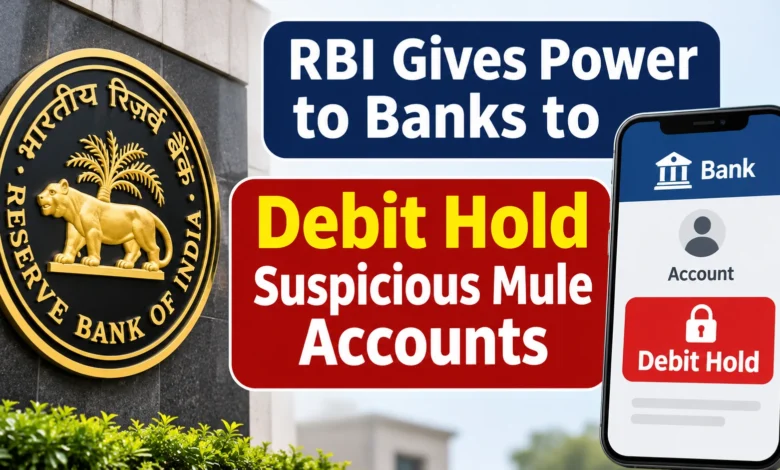
The Reserve Bank of India (RBI) has issued new instructions for commercial banks to identify and deal with highly suspicious bank accounts and transactions, including those linked to money mule activities, cyber fraud, financial fraud and terrorist financing.
Under the new rules, banks can place a debit hold on a suspicious transaction amount or bank account if they have a high degree of suspicion that it is connected with an offence or financial fraud. However, banks will have to follow a prescribed procedure, inform customers about the action and give them an opportunity to explain the genuineness of their transactions.
The new directions will come into effect from July 1, 2027. However, banks can implement the Standard Operating Procedure (SOP) before this date if they decide to do so.
Why Has RBI Issued These New Instructions?
Earlier, the RBI had instructed banks to monitor transactions carefully and identify accounts being used as money mule accounts. These accounts are often used to receive, transfer or move money obtained through illegal activities or financial fraud. After reviewing the existing instructions, the RBI has decided to introduce a more detailed and uniform procedure for identifying highly suspicious accounts and transactions.
The main objective is to prevent the further movement of money linked to financial crimes while protecting genuine customers from unnecessary inconvenience. The new instructions also establish a time-bound process for placing, reviewing and removing debit holds.
What Is a Money Mule Account?
A money mule account is a bank account used on behalf of another person, knowingly or unknowingly, to receive, layer or transfer money obtained through certain offences, financial fraud or transactions involving terrorist financing.
In simple terms, fraudsters may use another person’s bank account to receive money collected through cyber fraud or other illegal activities. The account holder may or may not be aware that the account is being used for such activities. The RBI has clarified that an account can be considered a money mule account even if the account holder does not knowingly participate in the illegal activity.
What Is a Highly Suspicious Account or Transaction?
The RBI has introduced specific definitions of highly suspicious accounts and transactions.
A highly suspicious account may be a money mule account or an account used knowingly or unknowingly to receive, layer or transfer money connected with an offence, financial fraud or terrorist financing.
A highly suspicious transaction is a suspicious transaction for which the bank considers that placing a debit hold would help prevent the further movement of money connected with the suspected offence or fraud.
However, the RBI has made an important clarification: Not every account involving a suspicious transaction will be treated as a highly suspicious account.
A bank must assess the nature of the transaction and determine whether a debit hold is necessary. A hold may also be placed when an authority legally empowered to do so directs the bank.
Banks Can Place Debit Holds on Highly Suspicious Accounts
Under the new instructions, banks must put in place suitable technological systems or other solutions to identify highly suspicious accounts and transactions. Banks may identify such accounts through transaction monitoring systems, early warning systems, internal policies or other available methods.
After identifying a highly suspicious transaction or account, a bank may place a debit hold on the relevant transaction amount or the account, as applicable. A debit hold means that withdrawals or other debit transactions are not allowed from the account, or that a particular amount is kept on hold.
However, banks must follow certain safeguards:
- The decision must be based on objective parameters and a high degree of suspicion.
- The suspected transaction or account must be linked to an offence, financial fraud or terrorist financing.
- The debit hold must receive approval from an appropriately higher authority within the bank.
- Banks must avoid mechanically placing debit holds on entire accounts.
The RBI has also directed banks to frame internal policies to ensure that genuine customer transactions and accounts are not wrongly identified as highly suspicious.
Banks Must Inform Customers After Placing a Debit Hold
One of the important features of the new RBI instructions is that banks must promptly inform customers whenever a debit hold is placed. If the customer’s mobile number or email address is available in the bank’s records, the bank should send the notification through digital mode. In other cases, the bank must inform the customer by the end of the next working day.
The notification must contain the following details:
- The reason for placing the debit hold.
- The procedure for removing the debit hold.
- Contact details of the concerned bank officer.
- A request for the customer to provide an explanation regarding the genuineness of the transaction or account.
- Details of documents, if any, required from the customer.
The customer must be given seven calendar days from the date of the debit hold to submit an explanation and supporting documents.
Banks Must Examine Customer’s Explanation Within Seven Days
After receiving the customer’s explanation and documents, the bank must examine them and take a decision promptly. The RBI has prescribed a maximum period of seven calendar days from the date of receiving the explanation. The bank can take either of the following decisions:
1. Remove the Debit Hold: If the bank is satisfied with the customer’s explanation and finds the transaction or account genuine, it must remove the debit hold.
2. Continue the Debit Hold and Inform Police: If the bank is not satisfied with the explanation, it can continue the debit hold and report the matter to the jurisdictional police authority, giving the reasons for its decision.
The bank must also inform the customer about its decision through digital mode, wherever possible. Otherwise, the customer must be notified by the end of the next working day.
What Happens If the Customer Does Not Submit an Explanation?
If the customer fails to submit an explanation within seven calendar days from the date of receiving the bank’s notification, the bank will continue the debit hold and report the matter to the jurisdictional police authority with reasons. After reporting the matter to the police, the bank must conduct Enhanced Due Diligence (EDD) of the account.
What Happens After the Bank Reports the Matter to Police?
Once the bank reports a highly suspicious account or transaction to the jurisdictional police authority, it must conduct enhanced due diligence. The bank must also follow any valid direction or instruction received from the jurisdictional police authority or another competent authority, including a court or tribunal legally empowered to issue directions regarding a bank account. If such an authority issues a direction under the relevant statutory provisions, the bank must comply with it and inform the account holder about the action taken.
Debit Hold Must Be Removed After 30 Days in Certain Cases
The RBI has prescribed an important time limit for the continuation of debit holds. If the bank does not receive any valid direction specifically requiring the continuation of the debit hold from the jurisdictional police authority or another competent authority within 30 calendar days from the date of referring the matter, the bank must remove the debit hold on the 31st day.
However, this is subject to an important condition. The bank must be satisfied with the Enhanced Due Diligence (EDD) conducted on the account. If the bank is not satisfied with the EDD, it may continue the debit hold. In such cases, the existing RBI instructions relating to inoperative accounts under the Responsible Business Conduct Directions, 2025 will apply. The bank must promptly inform the customer whether the debit hold has been removed or continued.
Banks Must Set Up a Grievance Redressal Mechanism
To address customer complaints arising from action taken under the new SOP, the RBI has directed banks to establish a proper grievance redressal mechanism. Banks must:
- Designate nodal officers at appropriate levels, including Regional Offices, Zonal Offices and Head Offices.
- Display the names, contact numbers, addresses and email IDs of these nodal officers prominently on their websites and at all branches.
- Acknowledge complaints received from customers.
- Resolve complaints within 30 calendar days.
- Maintain a Management Information System (MIS) to record, track and monitor complaints received under the SOP.
This mechanism will allow customers to raise complaints if they believe that a debit hold has been wrongly placed or that their concerns have not been properly addressed.
Banks Must Maintain Records for Five Years
The RBI has also directed banks to maintain complete records relating to accounts and amounts placed under debit hold. These records must include:
- The amount and account placed under debit hold.
- The date on which the debit hold was placed.
- Whether the hold was placed by the bank on its own assessment or on the instructions of a competent authority.
- The date on which the debit hold was released.
- Reasons for placing and releasing the debit hold.
- Correspondence with the account holder.
- Correspondence with the jurisdictional police authority.
Banks must preserve these records for five years from the date of placing the debit hold.
When Will the New RBI Rules Come into Effect?
The RBI issued these amendments on November 27, 2026, under the Reserve Bank of India (Commercial Banks – Know Your Customer) Second Amendment Directions, 2026. The new instructions will become effective from July 1, 2027. However, individual banks may decide to implement the SOP before this date.
Key Highlights of the New RBI Instructions
| Particulars | RBI Instructions |
|---|---|
| Issuing authority | Reserve Bank of India |
| Notification date | November 27, 2026 |
| Amendment | RBI (Commercial Banks – KYC) Second Amendment Directions, 2026 |
| Main objective | Identify and deal with highly suspicious accounts and transactions |
| Debit hold | Banks can restrict debits from an account or hold a transaction amount |
| Customer response time | 7 calendar days |
| Bank’s decision after receiving explanation | Within 7 calendar days |
| Police reference | Required when the bank continues the hold |
| Review after police reference | Debit hold to be removed on the 31st day in specified cases, subject to satisfactory EDD and no valid continuation direction |
| Complaint resolution | Within 30 calendar days |
| Record retention | 5 years |
| Effective date | July 1, 2027, or earlier if a bank decides to implement the SOP |
Click here to download RBI Circular
Also Check This


Please login to comment