Bank Unions Raise 11 Key Issues Over DFS Order on Quarterly Meetings With Minority Unions

| ➡️ Click here to Join Whatsapp News Group - Get instant updates of all Banking News |
Three major banking unions — the All India Bank Employees’ Association (AIBEA), All India Bank Officers’ Confederation (AIBOC) and National Confederation of Bank Employees (NCBE) — have jointly written to the Department of Financial Services (DFS), Ministry of Finance, raising several concerns over the government’s instructions regarding industrial relations meetings with minority unions in Public Sector Banks.
Recently, the DFS directed Public Sector Banks to conduct meetings with minority unions also. But the majority unions say the directions may not be beneficial for the banking industry.
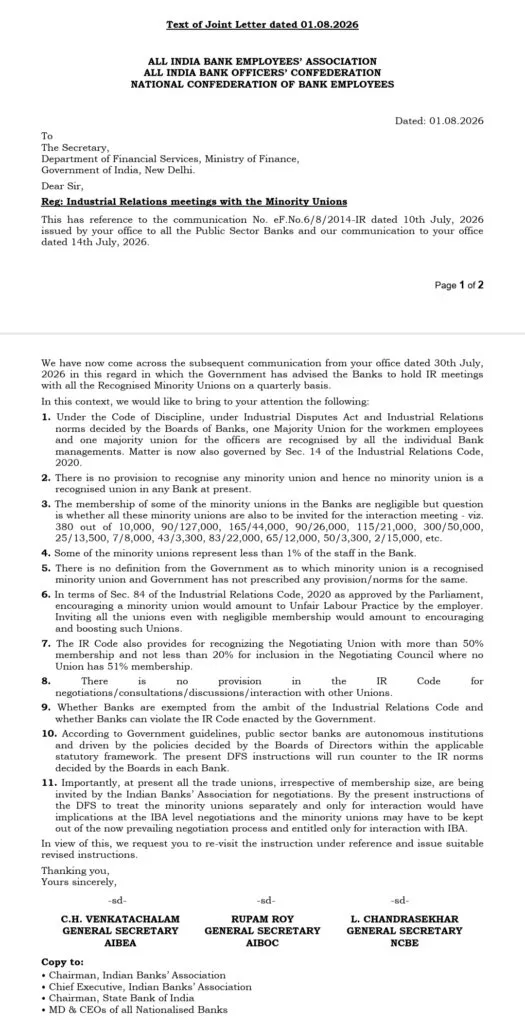
The three organisations have raised 11 major issues over the instructions and requested the government to reconsider them.
Issues Raised by AIBEA, AIBOC and NCBE
1. Existing System Recognises Majority Unions
The unions said that under the Code of Discipline, the Industrial Disputes Act and the industrial relations norms decided by individual bank Boards, bank managements recognise one majority union representing workmen employees and one majority union representing officers.
They added that the matter is now also governed by Section 14 of the Industrial Relations Code, 2020.
2. No Provision for Recognition of Minority Unions
The organisations claimed that there is no provision for recognising a minority union. Therefore, according to their letter, no minority union is presently a “recognised union” in any bank.
This has led them to question the DFS instruction referring to “Recognised Minority Unions.”
3. Some Minority Unions Have Very Small Membership
The unions also questioned whether every minority union should be invited to quarterly interaction meetings regardless of its membership strength.
They cited several examples of membership numbers, such as 380 members out of 10,000 employees, 90 out of 1.27 lakh, 165 out of 44,000, 90 out of 26,000, 115 out of 21,000, 300 out of 50,000, 25 out of 13,500, seven out of 8,000 and even two members out of 15,000 employees.
The unions asked whether organisations with such small membership should also be invited to these meetings.
4. Some Unions Represent Less Than 1% of Employees
The letter specifically pointed out that some minority unions represent less than 1% of the total staff of a bank.
The three organisations have therefore raised concerns over giving such unions a place in the proposed quarterly IR meetings irrespective of their membership strength.
5. No Definition of ‘Recognised Minority Union’
Another major concern is the absence of a clear definition.
AIBEA, AIBOC and NCBE said that the government has not defined which minority union should be treated as a “recognised minority union.” They also said that no provisions or norms have been prescribed by the government for granting such recognition.
6. Unions Raise ‘Unfair Labour Practice’ Concern
The organisations referred to Section 84 of the Industrial Relations Code, 2020. According to their interpretation, encouraging a minority union would amount to an unfair labour practice by an employer.
They argued that inviting all unions, including those with negligible membership, could result in encouraging and boosting such unions.
7. IR Code Provides Membership Criteria for Negotiating Union and Council
The three unions also highlighted the membership requirements mentioned in the Industrial Relations Code.
According to their letter, the Code provides for recognition of a Negotiating Union having more than 50% membership. Where no union has 51% membership, the letter says a union needs at least 20% membership for inclusion in the Negotiating Council.
8. No Provision for Interaction With Other Unions, Letter Says
The unions further claimed that there is no provision in the Industrial Relations Code for negotiations, consultations, discussions or interactions with other unions outside the framework provided under the Code.
This is another reason cited by them for seeking a review of the DFS instructions.
9. Are Banks Exempt From Industrial Relations Code?
The three organisations also raised a direct question about the applicability of the Industrial Relations Code to banks.
They asked whether banks have been exempted from the ambit of the Industrial Relations Code and whether banks can violate the provisions of the Code enacted by the government.
10. DFS Instructions May Conflict With Policies Approved by Bank Boards
The unions also referred to the autonomous status of Public Sector Banks.
They said that according to government guidelines, PSBs are autonomous institutions and operate according to policies decided by their respective Boards of Directors within the applicable statutory framework.
The organisations argued that the latest DFS instructions would run counter to the existing industrial relations norms decided by the Boards of individual banks.
11. Possible Impact on IBA-Level Negotiations
The final major concern raised in the letter relates to negotiations conducted by the Indian Banks’ Association (IBA).
The unions said that currently all trade unions, irrespective of their membership strength, are invited by the IBA for negotiations.
They argued that if the DFS instructions now treat minority unions separately and allow them only an “interaction”, it could have implications for the existing IBA-level negotiation process. According to the letter, this could mean minority unions may have to be kept outside the prevailing negotiation process and instead be entitled only to interaction with the IBA.
Bank Unions Ask DFS to Reconsider Instructions
After raising these 11 issues, AIBEA, AIBOC and NCBE requested the Department of Financial Services to revisit the instructions and issue suitable revised directions.
The joint letter was signed by AIBEA General Secretary C.H. Venkatachalam, AIBOC General Secretary Rupam Roy and NCBE General Secretary L. Chandrasekhar. Copies were also sent to the Chairman and Chief Executive of the Indian Banks’ Association, Chairman of State Bank of India, and the MDs and CEOs of all nationalised banks.