Bank of Baroda Launches ‘bob Green PLUG’ Scheme to Support India’s Electric Vehicle Charging Ecosystem

| ➡️ Click here to Join Whatsapp News Group - Get instant updates of all Banking News |
Bank of Baroda (BoB) – India’s one of the largest public sector banks, has launched ‘bob Green PLUG’ scheme, an initiative aimed at supporting the development of India’s electric vehicle (EV) charging ecosystem. The initiative is expected to support the expansion of EV charging infrastructure and encourage the adoption of electric vehicles in the country.
What is bob Green PLUG scheme?
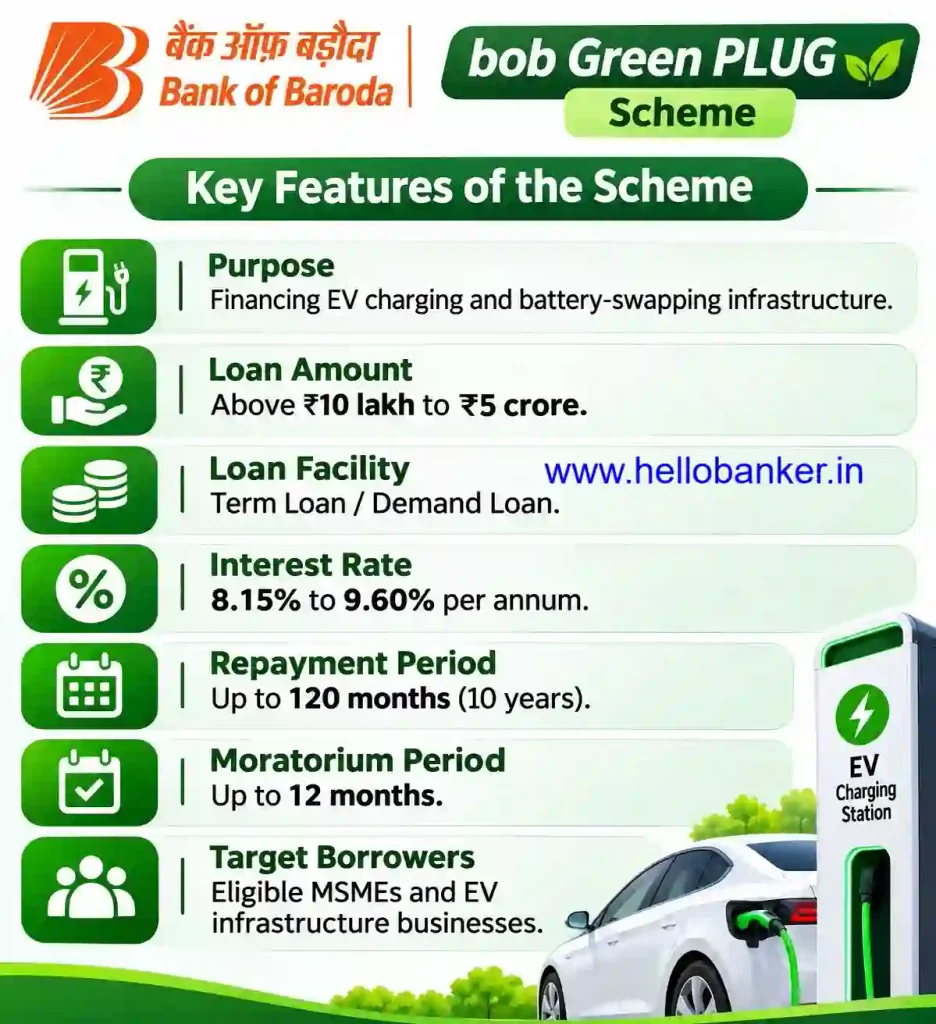
The bob Green PLUG scheme is a specialised financing facility designed for Micro, Small and Medium Enterprises (MSMEs) engaged in establishing or expanding electric vehicle charging stations and battery-swapping infrastructure. Under this scheme, eligible businesses can obtain loans ranging from above ₹10 lakh to ₹5 crore. The financing will be available for setting up new EV charging facilities as well as expanding existing infrastructure.
Key Features of bob Green PLUG Scheme
| Particulars | Details |
|---|---|
| Scheme Name | bob Green PLUG |
| Launched By | Bank of Baroda |
| Purpose | Financing EV charging and battery-swapping infrastructure |
| Minimum Loan Amount | Above ₹10 lakh |
| Maximum Loan Amount | ₹5 crore |
| Loan Facility | Term Loan / Demand Loan |
| Interest Rate | 8.15% to 9.60% p.a. |
| Maximum Repayment Period | 120 months (10 years) |
| Moratorium Period | Up to 12 months |
| Target Borrowers | Eligible MSMEs and EV infrastructure businesses |
What Activities Can Be Financed?
The scheme provides financial assistance for the following activities:
- Establishment of public and private electric vehicle charging stations.
- Setting up battery charging and battery-swapping infrastructure.
- Expansion of existing EV charging facilities.
- Development of supporting infrastructure required for EV charging stations.
- Renewable energy-integrated charging facilities, including rooftop solar-powered charging stations.
The scheme also allows financing for supporting facilities such as cafeterias and utilities, subject to the prescribed limits.
Who Can Apply for bob Green PLUG?
The scheme is available to various categories of eligible borrowers, including:
- Registered MSMEs engaged in EV charging infrastructure.
- Existing and prospective EV charging station operators.
- Petrol pumps and fuel stations planning to establish EV charging facilities.
- Start-ups and franchise operators involved in EV charging and battery swapping.
- Fleet owners and transport operators establishing charging facilities for their electric vehicle fleets.
- Hotels, malls, hospitals, educational institutions and commercial establishments.
- Logistics parks, residential societies and industrial parks.
- Businesses integrating EV charging infrastructure with renewable energy systems.
Interest Rate and Repayment Period
The interest rate under bob Green PLUG ranges from 8.15% to 9.60% per annum. The applicable rate depends on the bank’s BRLLR, loan amount and borrower’s credit rating. Borrowers can repay the loan over a maximum period of 120 months, including a moratorium period of up to 12 months.
Age Eligibility and Documents Required for Bank of Baroda bob Green PLUG Scheme
- Minimum age: 18 years.
- Maximum age: 70 years.
- Documents: KYC documents and other documents applicable to general MSME loans.
- Borrowers must provide applicable regulatory approvals and statutory licences for verification.
Eligible borrowers may also apply directly for government subsidies and incentives, subject to the conditions of the respective schemes.
Bank of Baroda’s Focus on Green Financing
Through bob Green PLUG, Bank of Baroda aims to address the financing requirements of businesses investing in electric vehicle infrastructure. The initiative is expected to encourage private-sector investment in charging stations and battery-swapping facilities, which are important for supporting the growing adoption of electric vehicles in India. The scheme also supports India’s broader efforts towards clean mobility, renewable energy and sustainable development.
Also Check This


Please login to comment