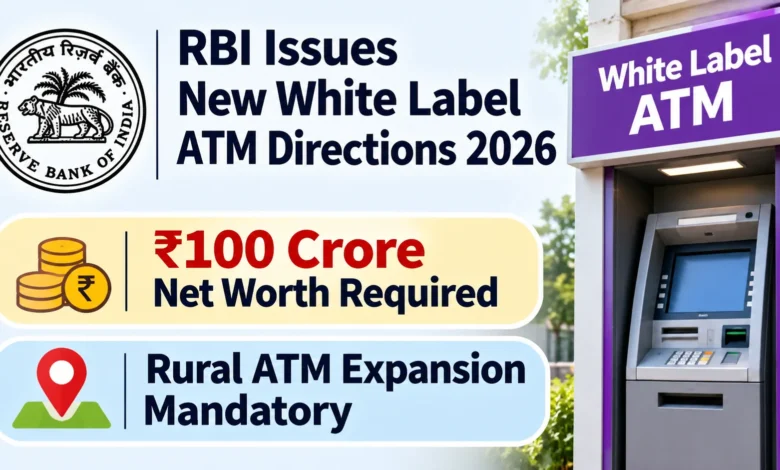
RBI issues New White Label ATM Directions 2026: Rs 100 Crore Net Worth Required, Rural ATM Expansion Mandatory

| ➡️ Click here to Join Whatsapp News Group - Get instant updates of all Banking News |
The Reserve Bank of India (RBI) has issued new directions for White Label ATM Operators (WLAOs), introducing a consolidated regulatory framework for the authorisation, operation and management of White Label ATMs in India.
The new rules cover several important areas, including the minimum net worth requirement for operators, ATM deployment in rural and semi-urban areas, sponsor bank arrangements, cash supply, customer protection, advertisements and reporting requirements.
Under the new directions, non-bank entities intending to set up and operate White Label ATMs must maintain a minimum net worth of ₹100 crore. The RBI has also directed operators to maintain an ATM deployment ratio of at least 1:2:3 across metro/urban, semi-urban and rural areas, respectively.
What Are White Label ATMs?
White Label ATMs are ATMs established, owned and operated by non-bank entities authorised by the RBI. Unlike regular bank ATMs, which are owned and operated by banks, White Label ATMs are managed by companies that are not banks. However, customers of different banks can use these ATMs through the authorised ATM and card payment networks.
The main objective of allowing non-bank companies to operate ATMs is to expand ATM services across the country, particularly in rural and underserved areas where access to banking facilities may be limited. White Label ATM Operators are responsible for deploying and maintaining these ATMs and connecting them with authorised ATM network operators and card payment networks.
RBI White Label ATM Directions 2026: Key Highlights
| Particulars | Details |
|---|---|
| Issuing Authority | Reserve Bank of India |
| Notification Date | November 27, 2026 |
| Name of Directions | RBI (White Label ATM Operators) Directions, 2026 |
| Applicable To | All authorised White Label ATM Operators |
| Minimum Net Worth | ₹100 crore |
| ATM Deployment Ratio | At least 1:2:3 in metro/urban, semi-urban and rural areas |
| Sponsor Bank | More than one sponsor bank permitted |
| Cash Supply | Sponsor banks and other scheduled banks, including cooperative banks and RRBs |
| Reporting | Monthly WLA Statistics (R330) through CIMS |
| Effective Date | Immediately |
1. Minimum Net Worth of ₹100 Crore Required
The RBI has prescribed a minimum net worth requirement for non-bank entities seeking authorisation to operate White Label ATMs. Such entities must have a net worth of at least ₹100 crore, based on their latest audited balance sheet. They must maintain this minimum net worth at all times.
However, companies that want to meet the requirement by infusing additional capital after their balance sheet has been audited may also do so. In such cases, they must submit a certificate from a Chartered Accountant confirming that the additional capital has been infused to meet the minimum net worth requirement.
The certificate may be issued by the existing auditor of the company or by a Chartered Accountant who has conducted a limited review of the company’s latest quarterly or half-yearly accounts.
2. Prior RBI Authorisation Mandatory
Non-bank entities cannot start setting up or operating White Label ATMs without obtaining authorisation from the RBI. They must apply for authorisation in accordance with the RBI’s Master Direction on Authorisation to Operate a Payment System dated June 15, 2026, as amended from time to time.
The company’s Memorandum of Association (MOA) must also include the proposed business activity of operating White Label ATMs. The authorisation granted by the RBI cannot be transferred or assigned to another entity without the central bank’s prior approval. Applicants can also mention the value-added services they propose to offer through their ATMs while applying for authorisation.
3. Mandatory Focus on Rural and Semi-Urban Areas
One of the important requirements under the new directions relates to the geographical deployment of White Label ATMs. The RBI has directed operators to give preference to semi-urban and rural regions while expanding their ATM networks.
WLA Operators must maintain a minimum deployment ratio of 1:2:3 across metro/urban, semi-urban and rural areas, respectively. This means that for every one ATM deployed in a metro or urban area, operators should deploy at least two ATMs in semi-urban areas and three ATMs in rural areas.
The RBI will review compliance with this requirement from time to time and at least once every six months. The directions also clarify that White Label ATM Operators will not be permitted to take over ATMs operated by banks. Further, all ATMs deployed by WLA Operators must support EMV chip and PIN cards.
4. Free ATM Transactions and Customer Charges
The RBI has clarified that transactions conducted at White Label ATMs will be counted while calculating the monthly limit of free ATM transactions available to bank customers for using other banks’ ATMs. For example, customers cannot treat transactions at White Label ATMs as separate from the applicable free transaction limits for other-bank ATM usage.
The WLA Operator will receive fees from banks for the use of ATM facilities by their customers. However, it cannot directly charge customers for using White Label ATMs. The operator will not be entitled to any fee from the card-issuing bank other than the interchange fee payable to the acquiring bank under the bank-owned ATM arrangement. The maintenance and servicing of White Label ATMs will remain the sole responsibility of the WLA Operator.
5. WLA Operators Can Have Multiple Sponsor Banks
The new directions allow White Label ATM Operators to enter into arrangements with more than one sponsor bank. All transactions conducted at the operator’s ATMs will be settled through the relevant sponsor bank.
A sponsor bank must be a member of an RBI-authorised ATM network operator or card payment network operator and must also be a member of the Real Time Gross Settlement (RTGS) system.
The RBI has clarified that operators must ensure that multiple sponsor bank arrangements do not create operational difficulties, particularly in relation to security and customer service.
WLA Operators must also establish connectivity with authorised ATM network operators or card payment network operators. All ATM transactions must be settled through the books of the sponsor bank.
The WLA Operator, sponsor bank and ATM or card network operator must enter into a tripartite Service Level Agreement (SLA).
This agreement must clearly define the responsibilities of each party, particularly regarding inter-bank settlement and the resolution of failed ATM transaction complaints.
6. Acceptance of Domestic and International Cards
White Label ATMs must accept cards issued under authorised card payment network schemes. This includes domestic and international credit cards, debit cards and prepaid cards.
WLA Operators must establish technical connectivity with the relevant card network operators, either directly or through their sponsor banks.
Operators that have already received authorisation and started operations must inform the RBI about the commencement of this service.
The directions also permit White Label ATM Operators to offer Dynamic Currency Conversion (DCC) for international cardholders.
Under this facility, international customers may choose to view and complete transactions in their home currency. The currency conversion rate must be obtained only from an authorised dealer bank.
The operator can convert only the amount requested by the international cardholder using the base exchange rate provided by the authorised dealer bank.
7. Cash Supply from Different Banks Permitted
The RBI has introduced flexibility in the cash supply arrangements for White Label ATMs. Earlier arrangements often linked cash supply to the sponsor bank. Under the new directions, WLA Operators can enter into agreements with their sponsor banks as well as other scheduled banks, including Regional Rural Banks and cooperative banks, for supplying cash to their ATMs.
The cash loaded into these ATMs will belong to the WLA Operator. However, the bank supplying the cash will be responsible for ensuring that the notes are genuine and of good quality.
The operator and cash-supplying bank may enter into a suitable Service Level Agreement to ensure adequate availability of genuine and good-quality currency notes. Operators that have started providing this facility must inform the RBI about the commencement of the service.
8. WLA Operators Can Purchase Wholesale Cash Directly from RBI
The new directions also allow White Label ATM Operators to purchase wholesale cash directly from RBI Issue Offices. Operators can purchase cash in quantities exceeding one lakh pieces of any denomination and in multiples of that quantity. The purchase must be made against full payment.
WLA Operators can approach the respective Issue Departments of RBI Regional Offices with a list of their ATM locations to arrange linkage with Currency Chests.
9. Additional Services: Bill Payments, Cash Deposits and Cardless Withdrawals
The RBI has allowed White Label ATM Operators to provide several additional services, subject to technical feasibility and the required certification. These services include:
Bill Payment Services: WLA Operators can provide bill payment facilities through their ATMs.
Interoperable Cash Deposit: Operators can offer interoperable cash deposit facilities, subject to technical feasibility and certification by the National Payments Corporation of India (NPCI).
Interoperable Cardless Cash Withdrawal (ICCW): Customers may be provided with the facility to withdraw cash without using a physical ATM card.
For interoperable cardless cash withdrawals, NPCI has been advised to facilitate UPI integration with all banks and ATM networks. UPI will be used for customer authentication and authorisation, while the actual settlement of transactions will take place through the National Financial Switch (NFS) or ATM networks.
The RBI has clarified that on-us and off-us ICCW transactions must be processed without any additional charges other than those prescribed under the applicable interchange fee and customer charges instructions.
The withdrawal limits for ICCW transactions must be in line with the limits applicable to regular on-us and off-us ATM withdrawals. Existing RBI instructions relating to turnaround time and customer compensation for failed transactions will continue to apply.
10. Co-Branding Arrangements with Banks Permitted
The new directions allow banks to issue co-branded ATM cards in partnership with authorised White Label ATM Operators. Banks may also extend the benefit of on-us transactions to their White Label ATMs. WLA Operators can enter into co-branding arrangements with banks under their Board-approved policies.
The agreement must clearly specify the roles, responsibilities and obligations of both partners. Co-branding may cover the ATM, ATM card and the main signboard. The name or logo of the partner bank may be displayed as agreed between the parties.
However, the RBI has prescribed an important condition: the name of the White Label ATM Operator must always remain prominently visible on the main signboard and must be displayed in a larger visual size than the co-branding partner.
11. Rules for Displaying Advertisements at White Label ATMs
The RBI has permitted WLA Operators to display advertisements and offer value-added services, subject to applicable regulations. Advertisements relating to financial products must comply with the regulatory framework prescribed by the RBI, SEBI, IRDAI and PFRDA, as applicable. They must also follow the Advertising Standards Council of India (ASCI) codes and other relevant regulations.
Advertisements for non-financial products and services may be displayed anywhere within the ATM premises, including on the ATM screen, but not on the main signboard. Advertisements relating to the partner bank may also be displayed electronically on the main signboard.
The RBI has further directed that advertisements running on the ATM screen must disappear as soon as a customer begins a transaction.
12. Customer Protection and Failed ATM Transaction Complaints
The RBI has clarified the responsibilities of different parties when customers face failed transactions at White Label ATMs. The primary responsibility for resolving customer complaints relating to failed transactions will rest with the card-issuing bank.
The sponsor bank must provide the necessary support and ensure that the WLA Operator supplies all relevant records and information required by the issuing bank. The sponsor bank must also have suitable arrangements with the WLA Operator for this purpose.
Existing RBI instructions regarding complaint resolution timelines and compensation for failed transactions at bank-operated ATMs will also apply to White Label ATMs.
If a delay in resolving a complaint is attributable to the sponsor bank or WLA Operator and the issuing bank has to pay compensation to the customer under RBI rules, the issuing bank must be compensated by the sponsor bank. The sponsor bank may enter into an appropriate agreement with the WLA Operator to recover such amounts.
13. Existing ATM Security and Operational Guidelines Will Also Apply
White Label ATM Operators must comply with other relevant RBI instructions relating to ATM operations. These include applicable guidelines issued by the following RBI departments:
- Department of Payment and Settlement Systems (DPSS).
- Department of Regulation (DoR).
- Consumer Education and Protection Department (CEPD).
- Department of Currency Management (DCM).
- Department of Supervision (DoS).
The relevant instructions relating to services, operations, cybersecurity, cash handling and ATM security will also apply to White Label ATMs.
14. Monthly Reporting Through CIMS Portal
The RBI has prescribed monthly reporting requirements for White Label ATM Operators. Every WLA Operator must submit the WLA Statistics return (R330) through the Centralised Information Management System (CIMS) portal. The return for each month must be submitted by the 7th day of the following month.
15. Earlier RBI Guidelines Repealed
With the introduction of the new consolidated directions, the RBI has repealed several earlier circulars and guidelines relating to White Label ATMs.
These include the earlier guidelines issued in 2012, subsequent clarifications and reviews issued in 2013, 2014, 2019 and 2023, instructions on currency chest linkage, free ATM transactions, interchange fees and interoperable cardless cash withdrawals, as well as the January 2026 instructions on CIMS reporting. The new directions bring these requirements together under one consolidated regulatory framework.
Click here to download RBI Circular
Also Check This

Please login to comment