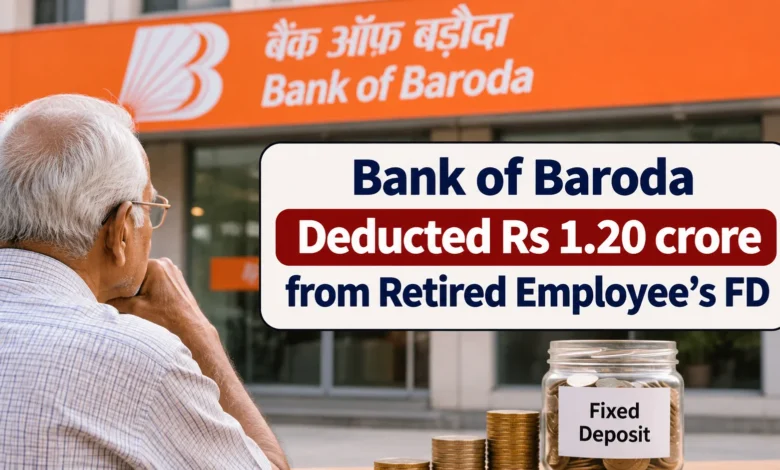
Bank of Baroda Deducted Rs 1.20 crore from Retired Employee’s FD; Employees seeks help from Court

| ➡️ Click here to Join Whatsapp News Group - Get instant updates of all Banking News |
The Bombay High Court has brought relief to an 80-year-old retired Bank of Baroda employee after the bank agreed to pay him Rs 1.47 crore in a long-running dispute over deductions from his fixed deposits (FDs).
The bank had deducted nearly Rs 1.20 crore from his fixed deposits, claiming that an additional 1% interest benefit had been given to him by mistake. The retired employee challenged the deduction, arguing that he was eligible for the additional interest.
Following the intervention of the Bombay High Court, Bank of Baroda agreed to pay Rs 1,47,67,508, including the deducted amount and interest. The court was informed on November 26, 2026, that the entire settlement amount had been credited to the employee’s bank account.
What Is the Case?
The case relates to Ashwin Shantilal Khandwala, an 80-year-old former employee and customer of Bank of Baroda.
According to the petition filed before the Bombay High Court, Bank of Baroda deducted Rs 89,01,253 from his fixed deposits on March 31, 2023. The bank subsequently deducted another Rs 31,18,695 from the interest payable on his FDs from April 1, 2023, until their maturity.
In total, the bank deducted Rs 1,20,19,948 from his fixed deposit accounts. The deductions were made on the grounds that the customer had received an additional 1% interest benefit that was allegedly meant exclusively for retired bank employees and had been extended to him due to a clerical error. However, the retired employee disputed the bank’s claim and maintained that he was eligible for the additional interest benefit.
Why Did the Retired Employee Approach the RBI Ombudsman?
After the bank deducted the amount, Ashwin Shantilal Khandwala filed a complaint with the RBI Ombudsman on August 21, 2023. However, the RBI Ombudsman closed his complaint on December 18, 2023, stating that it was not maintainable under the Reserve Bank – Integrated Ombudsman Scheme, 2021.
The reason given was that the dispute involved an employee-employer relationship, which was excluded under the relevant provisions of the scheme. Following this decision, the retired employee approached the Bombay High Court by filing a writ petition under Article 226 of the Constitution of India. The petition challenged the RBI Ombudsman’s decision and sought relief against the bank’s deductions.
What Did the Bombay High Court Observe?
The Bombay High Court, comprising Chief Justice Mahesh Chandra Tripathi and Justice Advait M. Sethna, heard the matter. During the proceedings, the court examined the bank’s explanation for deducting Rs 1.20 crore.
Bank of Baroda argued that the additional 1% interest benefit was intended exclusively for retired employees and had been extended to the petitioner due to a clerical oversight.
However, the court observed that the records indicated that the petitioner had been eligible for the additional 1% interest since 2011. The bank had reportedly verified his eligibility before extending the benefit, which he had continued to receive.
The court found it difficult to accept the bank’s explanation that the deduction was merely the result of a clerical error. In its order dated November 4, 2026, the court made strong observations and stated that it could not find any justification for the bank’s unilateral deduction of Rs 1,20,19,948.
High Court Expresses Displeasure Over Bank’s Delay
The Bombay High Court had earlier given Bank of Baroda an opportunity to place the matter before its Board of Directors for an appropriate decision. During the October 21, 2026 hearing, the bank informed the court that its Chairman and Managing Director had the authority to approve relief of up to Rs 35 lakh. Any amount above Rs 35 lakh required approval from the Board of Directors.
The court, therefore, gave the bank additional time to place the matter before the Board. However, during the November 4 hearing, the bank informed the court that the Board meeting could not be convened and requested further time.
The court expressed serious displeasure over the bank’s failure to comply with its earlier directions. It observed that the bank had already received reasonable opportunities and could not be granted unlimited extensions.
The court also warned that if the bank failed to comply with its directions, it could initiate contempt proceedings against the bank and its responsible officers, including the Managing Director and Directors.
The court further indicated that the Managing Director and Chief Executive Officer could be directed to appear personally if the bank failed to provide a satisfactory response.
Bank of Baroda Agrees to Pay Rs 1.47 Crore
Following the court’s intervention, Bank of Baroda came forward with a settlement proposal to resolve the dispute. In an additional affidavit dated November 20, 2026, the bank expressed its willingness to pay Rs 1,47,67,508 to the retired employee as a full and final settlement.
The amount included the original deduction of Rs 1,20,19,948 and interest of Rs 27,47,560. The bank calculated interest at 10.55% per annum for 26 months, covering the period from September 2024 to November 2026.
The bank also informed the court that it was ready to transfer the amount directly to the employee’s bank account after completing the necessary banking formalities.
Retired Employee Receives the Entire Settlement Amount
On November 26, 2026, when the matter came up for compliance before the Bombay High Court, the lawyers informed the court that the settlement amount had been credited to the petitioner’s bank account.
The bank also submitted a compliance note containing details of the payment made after deduction of applicable TDS (Tax Deducted at Source). The petitioner’s lawyer accepted the settlement amount of Rs 1,47,67,508 on his instructions.
After confirming that the payment had been received, the Bombay High Court disposed of the writ petition, bringing the long-running dispute to an end.
Download Court Order PDF (This PDF is available for Premium Users Only. Click here to join premium)
Also Check This

Please login to comment