| ➡️ Click here to Join Whatsapp News Group - Get instant updates of all Banking News |
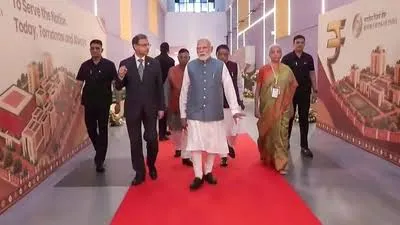
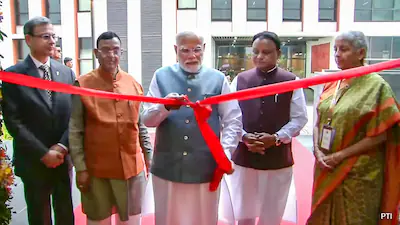
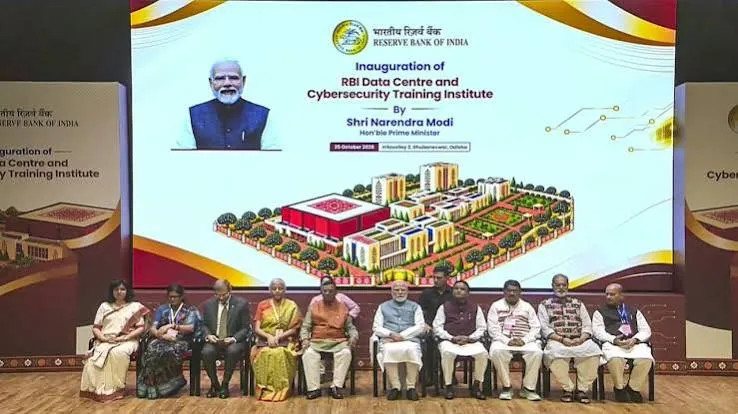
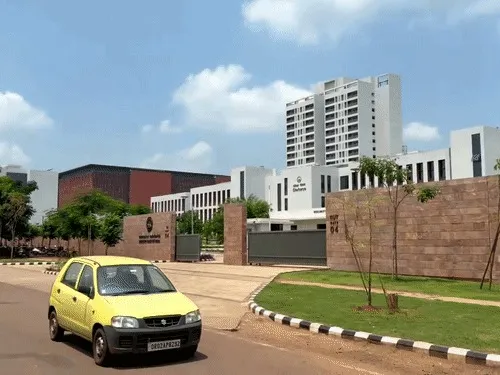
Prime Minister Narendra Modi inaugurated the Reserve Bank of India’s (RBI) new greenfield Data Centre and Cybersecurity Training Institute at Info Valley-II in Jatni, near Bhubaneswar, Odisha, on October 25, 2026. Read his speech below.
Photos of Inauguration

Speech of PM Modi
Jai Jagannath!
Governor of Odisha, Shri Brijmohan Ram Ji; the popular Chief Minister of Odisha, Shri Mohan Charan Majhi Ji; my colleagues in the Union Government, Nirmala Sitharaman Ji and Jual Oram Ji; Governor of the Reserve Bank of India, Shri Sanjay Malhotra Ji; Deputy Chief Ministers of Odisha, Pravati Parida Ji and Kanak Vardhan Singh Deo Ji; all distinguished guests associated with the banking and financial sectors; ladies and gentlemen.
Why is the atmosphere so serious? There is pressure in banking, and there is pressure in technology too. Please relax and sit comfortably.
With the blessings of Mahaprabhu, Bhubaneswar is giving New India a new institution today. The inauguration of the RBI Data Centre and the Cyber Security Training Institute in Bhubaneswar is an important occasion. These facilities will greatly benefit the people of Odisha and the entire country. I extend my heartfelt congratulations to the RBI and everyone associated with this project.
Friends,
Today’s programme is proof of how the approach to governance in India is changing and how rapidly it is changing. Our focus is on prioritising development, expanding its reach, and ensuring that its benefits reach the last person in society.
Friends,
After Independence, large cities developed, and major institutions, big hospitals and large airports were established. However, a significant part of the country continued to wait for basic facilities.
Delhi had large hospitals, but people from smaller cities and remote areas had to travel long distances to receive better medical treatment. Air travel was available in major cities, but connecting smaller cities through air connectivity did not receive the same level of attention.
Major cities had certain facilities, but basic necessities such as roads, electricity and water remained major challenges in many villages. Railway stations were among the most important parts of an ordinary citizen’s journey, yet they lacked modern facilities.
In other words, ensuring that the benefits of development reached every region and every citizen equally remained a major challenge.
We have made an effort to change this approach. We have adopted a model of Pro-People, Pro-Active and Good Governance.
For us, development means balanced development across India, providing opportunities to villages as well as smaller cities. Our goal is to provide better connectivity to remote areas, ensure that poor families have access to facilities that allow them to live with dignity, and continuously reassure every citizen that they will not be left behind in the journey of development.
Today, expressways are connecting smaller cities as well. Institutions such as AIIMS have expanded to several states. Medical colleges are being established in smaller cities. Nearly 175,000 Ayushman Arogya Mandirs have been opened in villages.
Digital connectivity is also expanding into remote areas. This is the real objective of governance today: making citizens’ lives easier and providing new opportunities to fulfil their dreams.
Friends,
Our banking sector is another major example of how ordinary families, poor people and the middle class were kept deprived of opportunities for decades.
Banks were nationalised in the 1960s and 1970s in the name of helping the poor. However, until 2014, more than half of India’s population remained outside the banking ecosystem.
Bank loans and other financial products were a distant dream even for many middle-class families. Poor people, small farmers, landless labourers, women and girls could not even imagine accessing such facilities.
Today, digital banking has connected everyone in India to banking services around the clock.
But before 2014, there was a completely different era of what was known as phone banking. A few influential people associated with the Congress in Delhi, and those who had connections with them, could obtain bank loans worth thousands of crores of rupees through phone calls.
Poor and middle-class families often needed a guarantor just to open a bank account. However, under the Congress’s phone-banking system, thousands of crores of rupees were readily available to wealthy individuals.
The result of this mismanagement was that India’s banking system became burdened with non-performing assets (NPAs). The banking system had reached the brink of collapse.
Friends,
A major transformation requires big thinking. When intentions are clear and objectives are honest, even tasks that seem impossible become achievable. Where thinking itself is limited, opportunities also become limited.
Over the past several years, the systems India has established and the new ecosystem developed under Digital India have brought banking services to every citizen.
Today, India’s banking sector is among the strongest banking sectors in the world.
Earlier, under phone banking, only those with access to influential families in Delhi benefited. Today, through digital banking, every family in the country has become a beneficiary.
Friends,
From the land of Odisha, a former Prime Minister of the country once said that when one rupee was sent from Delhi, only 15 paise reached the people.
That was a statement made by a Prime Minister. That was the situation then, and this is the situation today.
Today, when one rupee leaves Delhi, the entire rupee reaches the beneficiary’s bank account. As Nirmala Ji just mentioned, this has been made possible by the nearly 590–600 million Jan Dhan accounts opened across the country.
Friends,
Today, even people who have nothing to offer as collateral to a bank can obtain affordable and accessible loans and start their own businesses.
From small entrepreneurs and traditional artisans to street vendors and workers in the unorganised sector, people are benefiting from formal banking for the first time.
Through the Mudra Yojana, 130 million people have become entrepreneurs for the first time.
Through PM SVANidhi, lakhs of street vendors have received loans for the first time.
The PM Vishwakarma Scheme has connected lakhs of skilled artisans with banks.
Banks have also provided thousands of crores of rupees in assistance to the self-help groups of 100 million rural women.
Friends,
This is the same country where debit and credit cards were once considered facilities available only to the wealthy. Today, these facilities are accessible to every citizen.
Crores of RuPay credit and debit cards have been issued across the country. They have become symbols of both self-respect and self-reliance.
All this has been possible because of your support. Whether it is the RBI, every bank in the country, or each and every bank employee, all of you have contributed to this achievement. You truly deserve credit for its success.
Friends,
Over the past decade, alongside economic empowerment, social security coverage has also expanded remarkably.
The Atal Pension Yojana has provided social security coverage to 90 million people. In Odisha alone, 3.8 million people are covered under this scheme.
Ten to twelve years ago, insurance was also considered a luxury. Poor and middle-class families could not even think about it.
For us, the principle is Nagarik Devo Bhava — the citizen is like God. This is the guiding principle of good governance.
To provide financial protection in the event of an accident, we introduced the Pradhan Mantri Suraksha Bima Yojana. For an annual premium of just ₹20, people can receive insurance coverage of up to ₹2 lakh.
Similarly, for life insurance, we introduced the Pradhan Mantri Jeevan Jyoti Bima Yojana, which provides life insurance at an annual premium of less than ₹450.
Millions of Indians are enrolled in these two schemes. So far, claims worth more than ₹25,000 crore have been paid to people.
₹25,000 crore! If another government had announced the distribution of such a huge amount, it would have made major headlines. There would have been celebrations and publicity for months, with drums beating everywhere.
But under our government, without making a noise or seeking publicity, this money is quietly reaching poor and middle-class families during their difficult times.
This is what good governance means.
Friends,
The past decade was about bringing banking services to people who had been deprived of them. The coming decade will be about making banking more efficient and more reliable.
Odisha’s new Data Centre will play a major role in this effort.
If we want to keep our banking system secure, we must also protect its digital infrastructure. That is why we need strong data centres and powerful computing systems.
And friends,
We all know that wars today are not fought with weapons alone. A country can also be weakened by attacking its economy.
As India becomes economically stronger, protecting our banking system from cybercriminals and cyberterrorists becomes equally essential.
The nature of cyber threats is changing. We cannot tackle these emerging challenges with outdated systems, old training methods and obsolete training tools.
We need modern infrastructure as well as skilled human resources. This is where the new Cyber Security Training Institute becomes extremely important.
Friends,
These new RBI facilities also reflect a new priority for India. Eastern India is emerging as a powerful growth engine for a developed India.
Since the formation of the double-engine government in Odisha, the pace of development has accelerated.
Odisha’s economy is becoming stronger not only through its natural resources but also through technology.
On one hand, mineral-based industries are expanding. On the other, efforts are underway to develop a new ecosystem for semiconductors and electronics.
You will see that Odisha is going to write a new chapter in its future, moving from mines to microchips.
New investment opportunities are emerging in data centres and advanced computing in Odisha. These developments are opening numerous doors for the state’s youth.
I assure the young people of Odisha that the big dreams you have envisioned will certainly come true.
We will do it. We are determined to make it happen.
With this spirit, I once again extend my heartfelt congratulations to all of you.
My very best wishes!
Jai Jagannath!
Also Read: Know about the new RBI Data Centre in Odisha
Also Read: Bihar Govt introduces index to rank banks in State, Check Ranking of SBI
Also Check This


Please login to comment