| ➡️ Click here to Join Whatsapp News Group - Get instant updates of all Banking News |
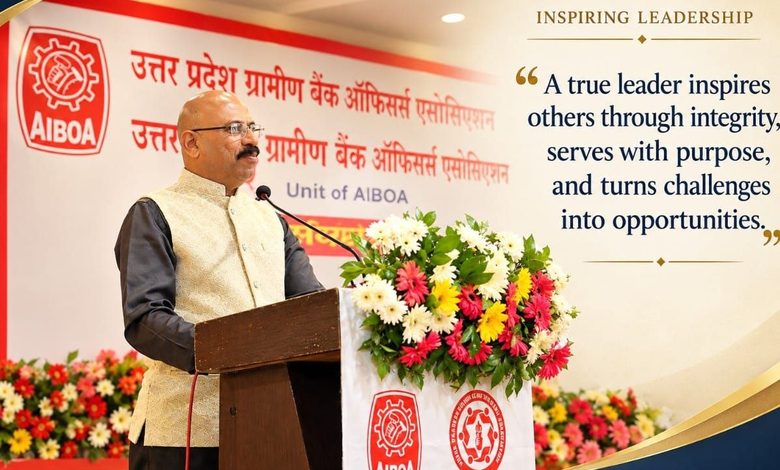
The Uttar Pradesh Gramin Bank Officers’ Association has announced a major organisational change, including its decision to affiliate with the All India Bank Officers’ Association (AIBOA) and the All India Gramin Bank Officers’ Association (AIGBOA). The development followed the merger of two officers’ organisations into a common platform.
Santosh Tiwari, former President and Chief Patron of the Uttar Pradesh Gramin Bank Officers’ Association, explained the reasons behind the organisational change, concerns over the postponement of the proposed September bank strike, and his vision for stronger representation of officers.
Q1. What major organisational changes have taken place in the Uttar Pradesh Gramin Bank Officers’ Association?
Santosh Tiwari: The Uttar Pradesh Gramin Bank Officers’ Association has taken a new direction to strengthen unity and improve the representation of officers’ interests. The two officers’ organisations have come together on a common platform. The general body also decided that the unified association would be affiliated with AIBOA and AIGBOA. Our objective is to build a stronger, more united, democratic and result-oriented organisation. We want to place principles above personalities and collective welfare above individual ambitions.
Q2. Who attended the joint convention, and what role did the national leaders play?
Santosh Tiwari: The joint convention was attended by Comrade S. Nagarajan, General Secretary of AIBOA, and Comrade D. N. Trivedi, General Secretary of AIGBOA, as chief guests. Both leaders addressed the representatives and discussed the importance of protecting bank officers’ interests, maintaining organisational unity, improving coordination and strengthening the role of officers’ organisations in the changing banking environment. Their participation reflected the importance of cooperation between organisations representing bank officers and regional rural bank officers.
Q3. Why did the association decide to affiliate with AIBOA and AIGBOA?
Santosh Tiwari: Our decision followed detailed discussions about organisational functioning, leadership accountability and the effectiveness of officers’ representation. We had more than 1,100 members and were previously affiliated with AIBOC. Over time, my colleagues and I felt that there was a gap between our expectations and the effectiveness with which members’ interests were being represented. We held discussions with senior leaders of different organisations to identify a platform that would prioritise bankers’ interests, transparency, accountability and principled leadership. After detailed deliberations, the executive committee decided to move forward with AIBOA and AIGBOA.
Q4. Did the proposed three-day bank strike in September 2026 influence this decision?
Santosh Tiwari: The circumstances surrounding the proposed United Forum of Bank Unions (UFBU) strike scheduled for September 28, 29 and 30, 2026, and its subsequent postponement prompted us to reflect seriously on collective action and leadership accountability. The strike was deferred after discussions with the government on the night of September 27. Many bankers had already made preparations and were ready to participate.
This development raised questions about the decision-making process, the reasons for postponing the strike and the communication provided to members. We recognise that negotiations and changing circumstances may require organisations to revise their decisions. However, such decisions should be accompanied by timely communication and a clear explanation of the reasons.
Q5. What concerns did you have regarding Sunday banking?
Santosh Tiwari: The issue of banks being directed to open on a Sunday also became an important part of our discussions. We took note of the position expressed by Comrade S. Nagarajan, General Secretary of AIBOA, regarding the government’s decision and the legal and procedural questions surrounding Sunday banking.
We believe that administrative decisions affecting officers and employees must be examined objectively in the light of applicable rules, official orders, existing agreements and statutory provisions. Such issues require clear explanations and responsible responses. Our concern was that officers’ interests should be represented effectively whenever important decisions affect them.
Q6. What influenced you about Comrade S. Nagarajan’s leadership?
Santosh Tiwari: We were influenced by Comrade Nagarajan’s leadership, ideological convictions and emphasis on principle-based decision-making. His position on Sunday banking reinforced our belief that organisational strength depends not only on membership numbers but also on the willingness of leaders to express their views and stand up for members’ interests. We believe that leadership is tested when members’ interests are at stake. An organisation must be prepared to represent its members firmly and responsibly, even when doing so is difficult.
Q7. What role did Convention play in joining AIBOA?
Santosh Tiwari: Comrade D. N. Trivedi, General Secretary of AIGBOA, attended the joint convention as a chief guest alongside Comrade S. Nagarajan of AIBOA. The convention brought together representatives of the officers’ organisations and provided a common platform for discussing unity, coordination and the protection of officers’ rights. The decision to affiliate with both AIBOA and AIGBOA reflects our intention to strengthen cooperation with organisations representing bank officers and regional rural bank officers. We believe that better coordination and collective efforts can help improve the representation of officers’ interests.
Q8. Why did you choose AIBOA instead of continuing with AIBOC?
Santosh Tiwari: We recognise and respect the historical contributions of different officers’ organisations to the banking industry. Each organisation has its own history, ideological orientation, priorities and methods of functioning. Our decision was based on our assessment of organisational values, leadership, accountability and the effectiveness of representation. We wanted a platform that would place bankers’ interests above individual ambitions and promote transparency, democratic functioning and principled leadership. Our decision was not intended to criticise any individual or organisation. We wanted to find a stronger and more effective way to represent officers.
Q9. Was the decision motivated by personal differences or a desire to leave existing leadership positions?
Santosh Tiwari: No. The decision was not driven by personal hostility, resentment or a desire to diminish another organisation’s standing. At the time, our colleagues held important positions, including President and General Secretary, in the two organisations. However, we believed that personal positions and organisational prestige should not take precedence over the larger interests of the banking fraternity.
Positions are instruments of service, not ends in themselves. Leadership carries a responsibility greater than the office it occupies. We therefore chose to prioritise the organisation’s future and the interests of bankers over the continuation of individual positions. For us, it was a conscious decision based on collective welfare rather than personal recognition.
Q10. How many members does the unified organisation represent?
Santosh Tiwari: Following the organisational integration, the combined membership has crossed 2,100. More than 1,100 members of the previously AIBOC-affiliated unit joined the new organisational arrangement. We consider this an important milestone that reflects collective strength, shared aspirations and the willingness of members to work together.
The association currently ranks second in the bank in terms of membership. We hope to work towards becoming the largest and most influential association through unity, transparency, accountability and determined leadership. However, our success should not be measured only by membership numbers.
Q11. What is more important: increasing membership or protecting officers’ interests?
Santosh Tiwari: Increasing membership is important, but it is not our ultimate objective. Our real success will depend on whether every banker feels heard, respected and represented, and whether members can trust the organisation to stand firmly for their rights and professional interests.
As membership increases, our responsibilities also increase. We must listen to members, address their concerns, improve internal communication and remain accountable while representing their interests. Preserving members’ confidence will remain one of our key priorities.
Q12. What challenges are banking officers facing today?
Santosh Tiwari: Banking officers are facing increasing workloads, demanding business targets, administrative pressures and service-related challenges. At the same time, their contribution to financial inclusion, agricultural credit, rural development, social security schemes and customer service remains essential to the country’s economic progress.
The growing imbalance between professional responsibilities and personal life is also a serious concern. An officers’ association must work to protect members’ legitimate interests and ensure that their grievances are addressed effectively.
Q13. What should an officers’ association do beyond submitting memorandums and organising protests?
Santosh Tiwari: An officers’ association must do much more than submit memorandums and organise protests. It must protect the legitimate interests of its members, pursue grievances through effective representation, uphold democratic values, maintain organisational transparency and remain accountable to the people it represents.
Members should have meaningful participation in organisational decisions. The leadership must explain important decisions clearly and remain answerable to its members. The ultimate objective should be to achieve meaningful results and improve the protection of officers’ rights and welfare.
Q14. What principles will guide the association’s future functioning?
Santosh Tiwari: Our future functioning will be based on member-first leadership, transparency, accountability, courage, democratic decision-making and lawful action. Every banker’s voice should matter, and every genuine concern should receive serious consideration.
Important decisions should be communicated clearly, and members should be able to hold their leadership accountable. Collective deliberation and mutual respect must guide the decision-making process. We also believe that the protection of bankers’ rights should be pursued through constitutional, legal and democratic means. Collective welfare must always take precedence over individual recognition or positions.
Q15. What responsibilities will you undertake as the newly elected Chief Patron?
Santosh Tiwari: As the former President and newly elected Chief Patron, I intend to contribute my experience and provide constructive guidance to the association. My efforts will focus on strengthening mutual trust between members and leadership, encouraging transparent and collective decision-making, and supporting initiatives that advance the interests of bank officers.
I am grateful to my colleagues, office-bearers and members whose cooperation and support helped make this transition possible. The decision is not merely about moving away from an existing organisational arrangement. It is about moving closer to the larger purpose of protecting bankers’ interests.
Q16. What is your long-term vision for the organisation?
Santosh Tiwari: We want to build a stronger, more united and credible organisation that earns respect through its actions and maintains members’ confidence through its commitment. Our priorities are to strengthen the collective voice of officers, promote transparency, improve accountability and ensure that members’ legitimate concerns receive proper attention.
We want to bring people together rather than allow differences to divide them. We also want to place bankers’ interests at the centre of our organisational activities. If we continue with this approach, the merger can provide a foundation for a more effective organisation.
Q17. What message would you like to give to bank officers?
Santosh Tiwari: My message is that unity, principles and accountability must remain at the centre of our collective efforts. Positions are instruments of service, not ends in themselves. An organisation should not focus only on becoming the largest; it should also strive to become worthy of the trust placed in it by every member.
We must reflect our unity through our actions, our principles through our decisions and our commitment through the results we deliver. Together, we can build an organisation that is stronger, more accountable and genuinely committed to serving the banking fraternity.