In a democracy, words do not fall equally. Some are uttered, heard, and forgotten. Others acquire a weight that travels far beyond the room in which they are spoken. In India, few voices carry greater institutional authority than that of the Chief Justice of India. When the head of the Supreme Court speaks, the echo does not remain confined to the courtroom. It reaches factory floors, bargaining tables, government offices, boardrooms, and the daily lives of citizens who may never read a judgment but instinctively understand what judicial language signifies.
It is precisely for this reason that many working people, trade unionists, and ordinary citizens across the country felt a deep sense of unease at the recent remarks attributed to the Hon’ble Chief Justice of India, Justice Surya Kant, on Indian trade unions.
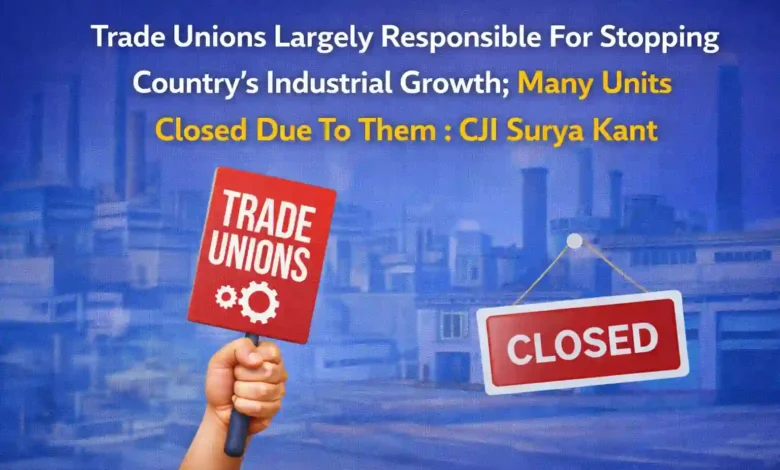
As widely reported, Your Lordship is quoted as asking: “How many industrial units have been closed thanks to trade unions?” and suggesting that traditional industries were shut down because of unions, with an implication that union intervention privileges agitation over work.
Perhaps the remarks were made in the context of a particular dispute. Perhaps they were not intended as a sweeping indictment. Yet when such generalised observations emerge from the highest constitutional office in the judiciary, they inevitably take on a life of their own. A Chief Justice’s words do not remain casual commentary; they quickly harden into “truth” in the public mind, amplified through headlines, repetition, and political convenience.
And that is why this moment matters far beyond one courtroom exchange.
The Supreme Court of India has long been the constitutional conscience-keeper of the Republic, particularly for those who possess little wealth, little influence, and little bargaining power. For generations, it has been the final refuge for the vulnerable against the arbitrary exercise of power. That legacy makes judicial language especially consequential when it touches the lives of workers.
Trade unions are not a historical accident, nor are they irritants to be tolerated. They are a deliberate constitutional guarantee. Article 19(1)(c) of the Constitution grants citizens the right to form associations and unions for a specific democratic purpose: to enable the individually weak worker to bargain collectively with concentrated economic power. This is not ornamental freedom. It is a structural safeguard, designed to secure dignity, fair wages, and safety—things that no isolated worker can realistically obtain alone.
Our statutory framework flows from this constitutional core. The Trade Unions Act of 1926 exists to recognise and regulate lawful collective organisation. More recently, the Industrial Relations Code of 2020 consolidates the framework for union registration, recognition of negotiating unions and councils, and collective bargaining mechanisms. Against this background, a broad statement that unions are “largely responsible” for industrial closures risks sounding, however unintentionally, like a moral indictment of an institution that the Constitution itself protects.
India’s international commitments further underline the importance of organising. We are a founding member of the International Labour Organization and have ratified many labour conventions. Yet India has still not ratified ILO Conventions 87 and 98, which directly protect freedom of association and collective bargaining. In that absence, the burden of safeguarding these democratic rights falls even more heavily on domestic courts. When international law is incomplete, judicial language becomes the primary guardian of the Indian worker’s right to organise.
This is why the question must be asked with care: are industrial closures truly the product of “unionism”?
Hon’ble Chief Justice, industrial decline in India has rarely, if ever, been monocausal. Closures have historically been driven by technological change, shifting policies, global competition, credit cycles, mismanagement, governance failures, delayed modernisation, asset stripping, and regulatory uncertainty. In some cases, industrial relations breakdowns contribute as well. But to attribute closures broadly to unions collapses a complex economic story into a single convenient scapegoat.
Even where unions may be militant, the real question is not whether unions should exist, but whether lawful collective bargaining and dispute-resolution mechanisms are strong enough to prevent disputes from becoming destructive. Our labour statutes were enacted precisely to promote industrial peace through negotiated settlements and adjudication, not to silence collective voices.
Indeed, the Supreme Court’s own jurisprudence tells a very different story about trade unions. Historically, unions have driven India’s labour rights movement and anchored constitutional protections for workers. They have not merely agitated; they have exposed exploitation and brought transformative questions of dignity and equality before the judiciary.
Consider the Asiad Workers case of 1982, where the Supreme Court revolutionised labour rights by ruling that Article 21 guarantees dignity and livelihood, and that sub-minimum wages amount to “forced labour” under Article 23. The Court even allowed the most vulnerable workers to approach it directly under Article 32. Can we ignore this legacy of worker advocacy when assessing unions today?
Or take SAIL v. National Union Waterfront Workers (2001), where the Court confronted the exploitation inherent in contract labour systems. The judgment affirmed that when unions fight for regular jobs and fair treatment, they are not undermining industry—they are seeking constitutional justice.
In Bharat Petroleum Corporation Ltd. v. Maharashtra General Kamgar Union (1999), the Court highlighted the importance of collective representation and procedural fairness, recognising unions as vital protectors of workers’ rights within industrial democracy.
Together, these judgments affirm something essential: trade unions do not weaken industrial peace; lawful collective action secures it through social justice. The Supreme Court’s own constitutional legacy forbids us from allowing sweeping generalisations to reshape public perception.
The relevance of this debate is not confined to history. One sees contemporary parallels in sectors like banking. The United Forum of Bank Unions has for years engaged in sustained dialogue with the Indian Banks’ Association, the Ministry of Finance, and the Department of Financial Services on legitimate issues affecting employees. Even when strike actions are proposed—including the recent call for a five-day banking strike—they emerge after long patience, repeated negotiations, representations, and attempts at resolution. Union leadership has consistently balanced public service obligations with lawful democratic assertion of employee rights.
To portray such collective action simplistically as agitation without reason risks creating profound public misunderstanding about the seriousness of worker grievances, the constitutional legitimacy of unions, and the delicate balance between uninterrupted service and labour justice.
This is why, with the deepest respect, one must register dissent.
A Chief Justice’s words possess extraordinary influence. When those words appear to place trade unions in the dock of public blame, the consequences extend beyond rhetoric. They shape how employers treat collective bargaining, how policymakers frame labour reforms, and how society views the worker’s right to organise.
Therefore, I humbly request that Your Lordship take a corrective step to restore balance to the public record—either by clarifying that the remarks were not a wholesale rejection of trade unions, or by reaffirming that lawful unionism is a constitutionally protected necessity.
The rule of law exists to protect the vulnerable and to balance power where inequality is stark. The Constitution does not ask workers to be silent; it grants them a lawful democratic instrument: association.
India cannot afford to see trade unions as a problem to be blamed. They remain, imperfect yet indispensable, a constitutional force that civilises labour relations and guarantees dignity at work.
When the highest bench speaks of unions, the nation listens. But the nation must also remember: unions are not the enemy of industry. They are the Republic’s promise that dignity will not be surrendered at the workplace gate.