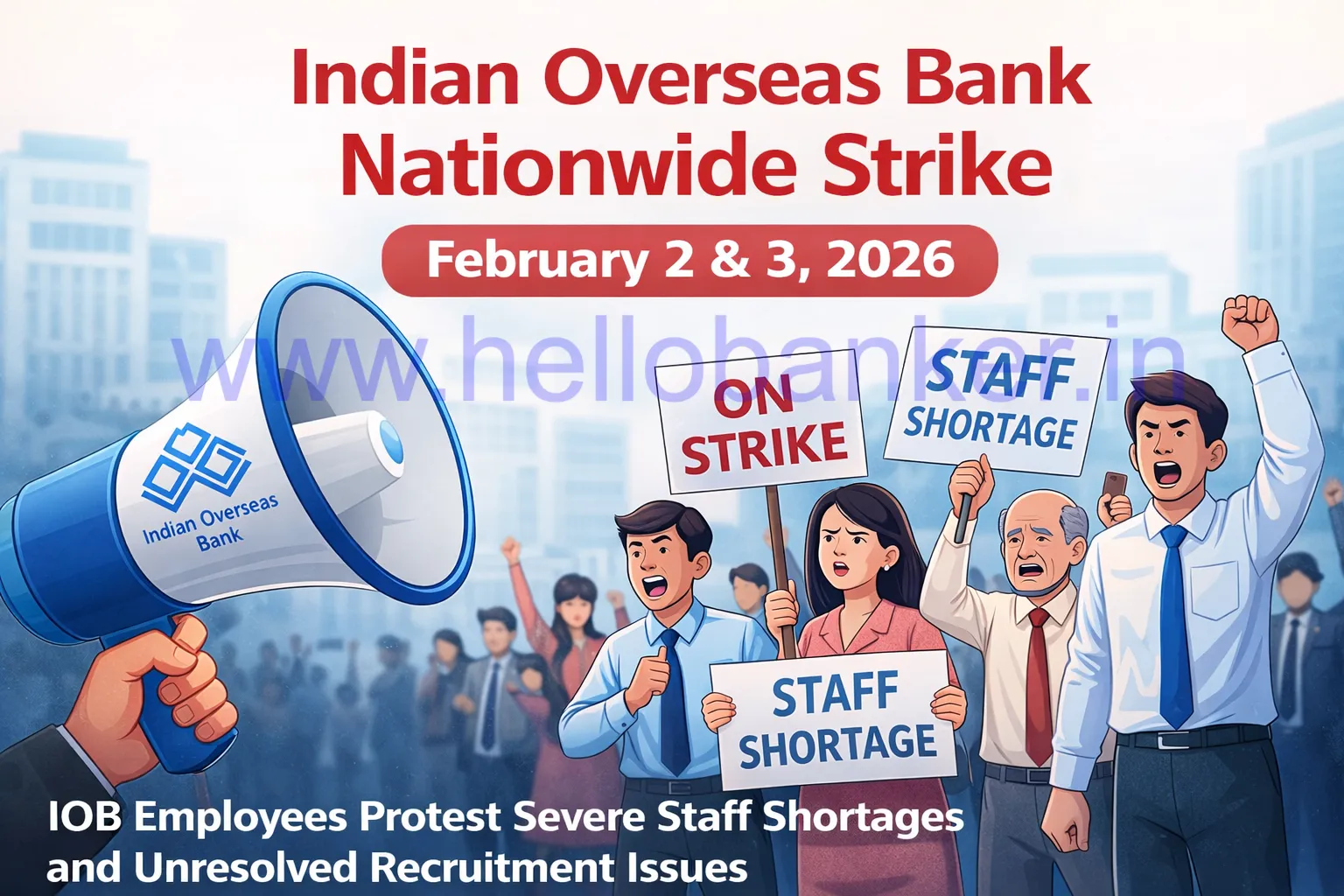
Employees of Indian Overseas Bank (IOB) had announced a two-day nationwide strike on February 2 and 3, 2026. This strike was against severe staff shortages and other unresolved issues in the bank.
But as per latest update, the strike has been deferred. A meeting was held between the union, DFS, Bank Management at the office of Chief Labour Commissioner. As per the information received the strike has been deferred due to positive response from the bank management.
Also Read: Government Plans to Install New ATMs to Dispense Smaller Currency Notes
The strike was called by the All India Overseas Bank Employees’ Union (AIOBEU), the recognised employees’ union of Indian Overseas Bank. The union said the strike was being held due to the bank management’s failure to recruit sufficient staff, especially Customer Service Associates, and against the unilateral introduction of a QR code–based employee evaluation system.
Also Read: How Much Debt Has NARCL Recovered So Far? DFS Holds High-Level Meeting with PSU Banks
The first strike notice was issued on November 10, 2025, proposing strike action on December 1 and 2, 2025. However, the strike was postponed due to conciliation talks. As the bank management did not agree to the employees’ demands, the talks failed. The union then issued a continuation strike notice on January 7, 2026, announcing the strike on February 2 and 3, 2026. The strike schedule was as follows:
| Date(s) | Programme / Activity |
|---|---|
| 09.01.2026 | Mass campaign through WhatsApp posters – to continue till the strike date |
| 14.01.2026 | Wearing of black badges |
| 19.01.2026 & 28.01.2026 | Social media campaign |
| 23.01.2026 & 29.01.2026 | Demonstration at all centres |
| 28.01.2026 | Press release |
| 02.02.2026 & 03.02.2026 | Two-day nationwide strike |
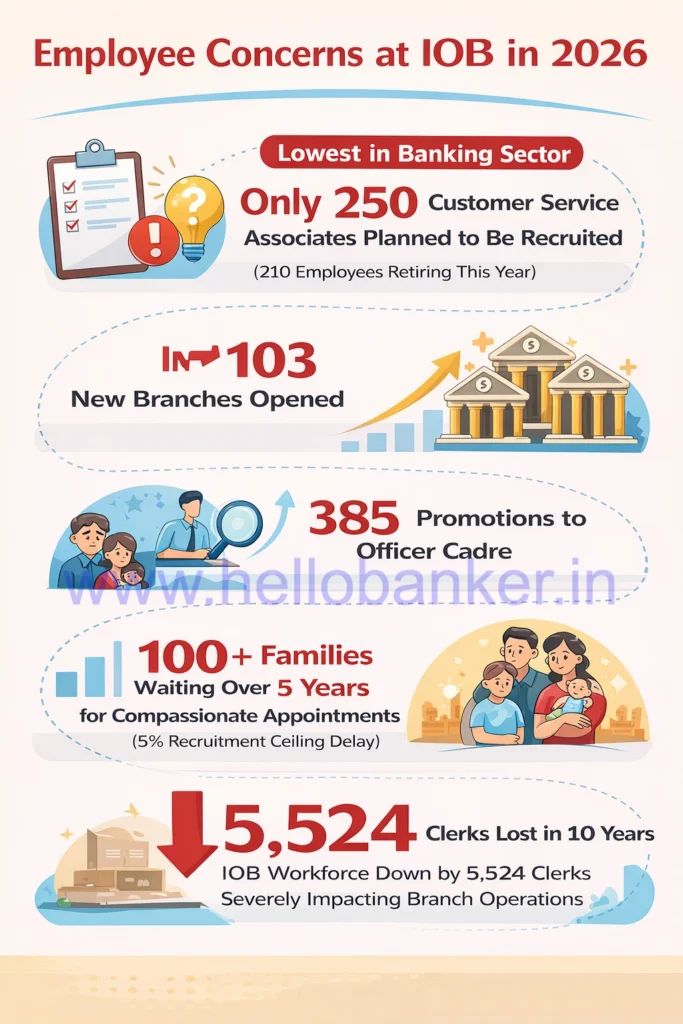
The union pointed out that for the year 2026, Indian Overseas Bank has planned to recruit only 250 Customer Service Associates, which is the lowest recruitment figure in the banking sector. This is despite the fact that more than 210 employees are retiring during the current financial year. In addition, the bank has invited applications to promote 385 clerical staff to officer cadre and has opened over 103 new branches in the last nine months, further increasing the workload on existing staff.
Also Read: Big Strike on 12 February 2026, 10 Central Trade Unions Announce Nationwide Strike
Over the past ten years, the clerical workforce of Indian Overseas Bank has reduced by 5,524 employees, severely affecting day-to-day operations at branch level. The union also highlighted that more than 100 families are waiting for jobs on compassionate grounds for over five years after losing their sole earning member, but appointments are being delayed due to the five percent recruitment ceiling.
After prolonged discussions, the bank management increased the proposed recruitment number from 250 to 300, but this increase is grossly inadequate and unacceptable given the current situation.
Also Read: SBI Circle Based Officer (CBO) Recruitment 2026 Notification PDF Out for 2050 Posts
Apart from staff shortages, the union has strongly opposed the bank’s new QR code–based evaluation system, under which standees with photographs of individual employees are placed in branches to collect customer feedback. The union said banking services are delivered by teams, not individuals, and customer feedback should be taken branch-wise, not by singling out employees.
Also Read: Goldsmith cheats India’s Largest PSU Bank, Fake Gold submitted in SBI
The union also expressed concern that employees, already under pressure due to staff shortages and heavy workload, may receive negative feedback because of system-level issues beyond their control. It further raised privacy, safety, and dignity concerns, especially for women employees, due to the public display and possible misuse of their photographs.
Earlier, Punjab National Bank (PNB) had also planned to introduce a QR code–based feedback system, but the proposal could not be implemented due to strong opposition from employees.