Government Employee Cannot Face Disciplinary Action for Seeking Permission to Form Association

| ➡️ Click here to Join Whatsapp News Group - Get instant updates of all Banking News |
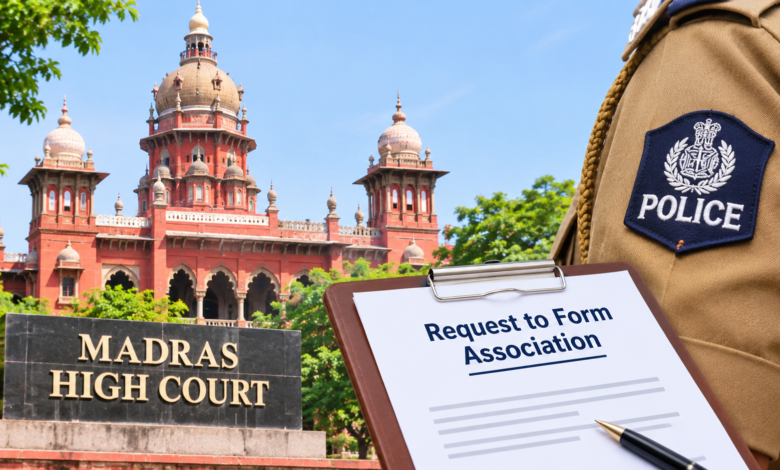
The Madras High Court has held that a government employee cannot be subjected to disciplinary action merely for submitting a representation to higher authorities seeking permission to form an association. The court observed that an employee has the right to submit a request to the authorities, and it is for the administration to decide whether such a request should be accepted or rejected. Merely submitting a representation cannot be treated as misconduct or used as a reason to issue a departmental charge memo.
Justice Krishnaswamy Govindarajan observed that employees are well within their rights to submit representations to their higher officials. The court said that the administrative authorities have the responsibility to examine such requests and take an appropriate decision. However, submitting a representation by itself cannot be considered misconduct that justifies departmental proceedings.
The court made these observations while hearing three petitions filed by V Nagalingam, a former police personnel who had faced disciplinary proceedings during his service. The first petition challenged the order directing him to face an oral inquiry. The second petition challenged the decision by which the charges against him were held to be proved. Through the third petition, he sought directions for the settlement of his retirement benefits.
The disciplinary action against Nagalingam was initiated on the allegation that he had approached the office of the Director General of Police (DGP) and the Chief Minister’s Special Cell with a representation seeking permission to form a police association.
During the proceedings, the Tamil Nadu Government submitted that no final punishment had been imposed on Nagalingam. It also informed the court that the inquiry order and the subsequent memo were still pending and had not resulted in any final order.
The High Court noted that because the writ petitions were pending, Nagalingam was allowed to retire from service subject to the outcome of the disciplinary proceedings. The court also observed that the disciplinary proceedings had remained pending since 2004, even though the allegation against him was merely that he had submitted a representation seeking permission to form an association.
The court further pointed out that there had been no progress in the disciplinary proceedings since 2007. It expressed concern over the fact that the employee had been facing disciplinary action for more than two decades without any final decision.
Considering the delay of over 20 years since the issuance of the charge memo, the High Court found that the charges were weak and could not be legally sustained. It observed that there was no justification for issuing or continuing the disciplinary proceedings against Nagalingam merely for submitting a representation to the authorities.
Accordingly, the Madras High Court held that the disciplinary proceedings were liable to be quashed and allowed the petitions. The decision makes it clear that submitting a request to higher authorities seeking permission to form an association cannot, by itself, be treated as misconduct warranting departmental action.
- Download Court Order PDF (This PDF is available for Premium Users Only. Click here to join premium)
Also Check This


Please login to comment