| ➡️ Click here to Join Whatsapp News Group - Get instant updates of all Banking News |
A message allegedly issued by Regional Head of Bank of Baroda of Chandigarh region has raised concerns over the pressure being placed on bank employees to achieve insurance business targets.
According to a WhatsApp message circulated in a business leaders’ group, Regional Head B. L. Meena instructed branches to complete the G-Pen 2Pay IndiaFirst business activity mandatorily. The message stated that all executive-headed branches must complete the activity on the same day, while other branches were required to complete it by the following day. The message also asked executive-headed branches that were not performing to report to the Regional Office at 6 PM.
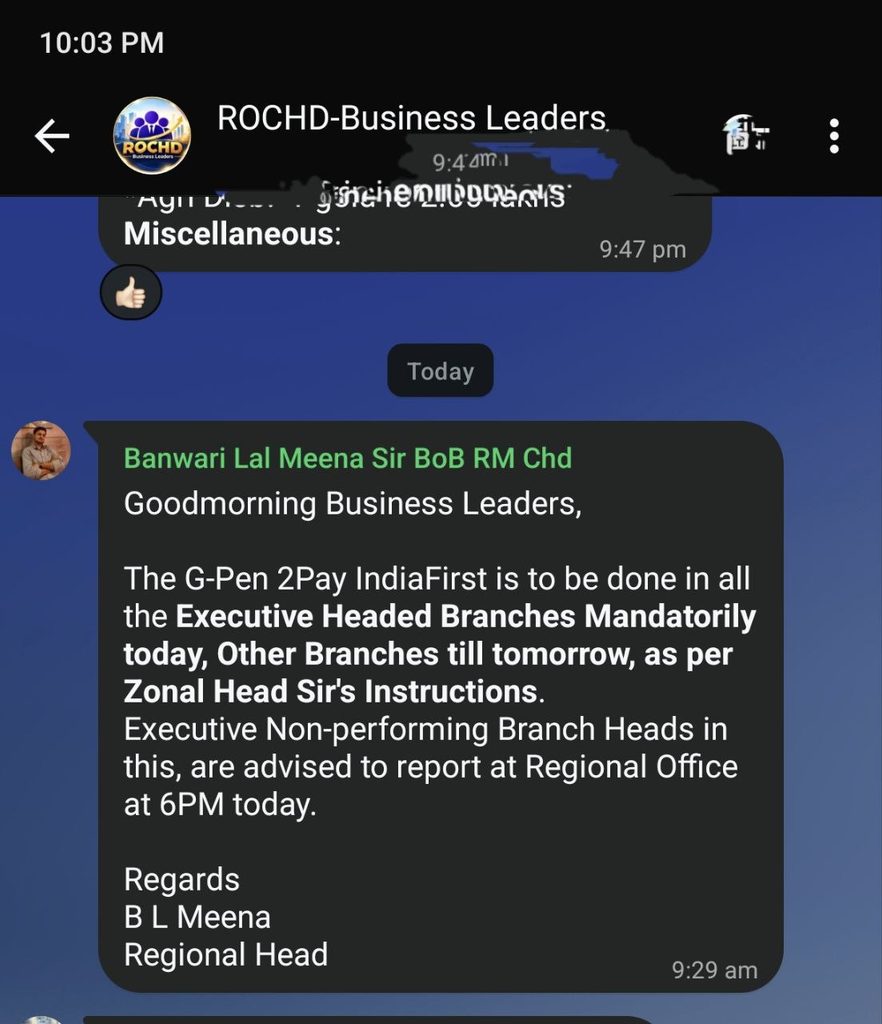
The communication has raised questions about whether bank employees can be subjected to mandatory insurance-selling targets and whether senior officials can use such instructions to put pressure on branch staff. Below are some important questions that need anwer.
1. RBI Requires Employees Dealing With Insurance Sales to Have Prescribed Qualifications
The RBI’s Master Directions on Undertaking of Financial Services by Banks clearly state that employees dealing with insurance agency or broking business must possess the qualifications prescribed by IRDAI.
This raises an important question: Are all bank employees being asked to achieve insurance targets properly qualified and authorised to solicit and procure insurance business? If not, how can they be expected to perform activities that require prescribed qualifications and training?
2. Why Are Bank Employees Doing the Work of Insurance Company Employees?
Insurance companies recruit employees, relationship managers, sales executives and other professionals specifically to market and sell insurance products.
IndiaFirst Life Insurance also has its own sales and distribution network. Why should ordinary bank employees be placed under pressure to achieve insurance targets when the insurance company has its own employees and sales infrastructure?
Insurance companies earn premiums and generate revenue by selling their products. They have dedicated sales departments, relationship managers, agents and marketing teams.
When bank employees are made responsible for generating insurance business, they are effectively performing an additional sales function for another financial institution.
Why should the responsibility of generating business for an insurance company be shifted to employees of a public sector bank?
3. Who Will Bear the Responsibility for Incorrect Information Given to Customers?
Insurance policies involve exclusions, waiting periods, surrender charges, premium commitments, claim conditions and other complicated terms. If an employee who is not adequately trained explains these products incorrectly, the customer may suffer financial losses. Who will take responsibility if the customer later discovers that the policy was unsuitable or its conditions were not properly explained?
4. What Happens to Banking Work When Employees Focus on Insurance Targets?
Consider a branch where employees are busy contacting customers, arranging insurance meetings, collecting proposals and following up on premium payments.
Meanwhile:
- Customers are waiting for banking services.
- Loan applications remain pending.
- KYC updates are delayed.
- Customer complaints remain unresolved.
- Regular operational work gets affected.
Should customers suffer because branch employees are occupied with achieving third-party business targets?
5. Why Are Employees Being Given Extremely Short Deadlines?
The WhatsApp communication reportedly asks executive-headed branches to complete the specified activity on the same day and other branches by the following day.
Insurance is a long-term financial commitment for customers. It requires proper explanation, comparison and informed consent.
How can responsible insurance selling be expected when employees are instructed to achieve targets within 24–48 hours?
6. Why Should Employees Risk Their Reputation for Third-Party Products?
Customers trust public sector banks because of their reputation and government ownership. If an insurance policy sold through a bank branch later results in a claim dispute, customers may hold the bank and its employees responsible.
Employees should not be placed in a position where their professional reputation is affected by disputes involving third-party insurance products.
7. Why Is There No Separate Insurance Sales Team in Bank Branches?
If insurance business is considered an important source of revenue, banks should consider deploying properly trained and authorised insurance personnel.
Dedicated personnel could handle insurance-related activities while regular branch employees focus on banking operations.
This would improve customer service, reduce operational pressure and help prevent mis-selling.
8. Does Bank of Baroda Have a Board-Approved Insurance Distribution Policy?
RBI requires banks undertaking insurance distribution to have a Board-approved policy covering the distribution model, customer suitability, appropriateness and grievance redressal.
Does the bank’s insurance policy permit the kind of target-driven instructions reportedly being issued to branches? Are these instructions consistent with the bank’s approved insurance distribution policy?
9. Who Will Handle Insurance-Related Customer Complaints?
When a customer purchases insurance through a bank branch, the customer often approaches the bank employee for assistance with policy servicing, premium issues and claim-related queries. This creates additional work for branch employees.
If the insurance company is responsible for policy servicing and claim decisions, why should bank employees be burdened with the additional responsibility of handling complaints arising from those products?
10. Why Is There No Clear Separation Between Banking and Insurance Distribution?
Banking and insurance are two different financial activities governed by different regulatory frameworks.
There should be a clear distinction between:
- Banking operations and customer service.
- Insurance marketing and solicitation.
- Insurance policy issuance.
- Premium collection and servicing.
- Insurance claims and grievance resolution.
A proper separation of responsibilities can reduce confusion, improve accountability and protect customers.
Also Check This


Please login to comment