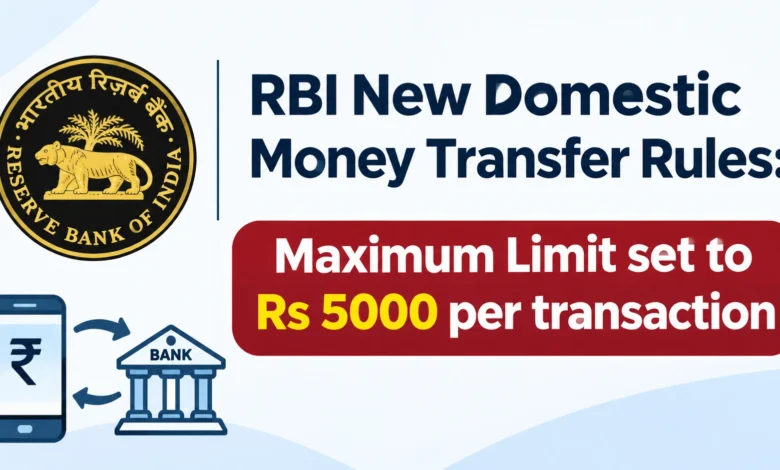
RBI New Domestic Money Transfer Rules: Maximum Limit for Cash Pay-in set to Rs 5000 per transaction

| ➡️ Click here to Join Whatsapp News Group - Get instant updates of all Banking News |
The Reserve Bank of India (RBI) has issued new guidelines for Domestic Money Transfer (DMT) services. The new rules aim to make domestic money transfers more organised, improve monitoring and strengthen safeguards against suspicious transactions.
Card-to-card transfers will not come under these directions. Such transfers will continue to be governed by the guidelines and approvals applicable to the respective payment instruments.
RBI Sets Limits for Cash Pay-out Services
Under the Cash Pay-out Service, banks can facilitate the transfer of money from a customer’s bank account to a person who does not have a bank account. The beneficiary can receive the money in cash through an ATM, a Business Correspondent (BC) or any other authorised payment channel.
The remitting bank will be required to collect and maintain the name and address of the beneficiary. RBI has prescribed the following limits for cash pay-out services:
- Maximum transfer amount: Rs 10,000 per transaction.
- Maximum monthly transfer limit: Rs 25,000 per beneficiary.
Cash Pay-in Services: Rules for Depositing Money into Bank Accounts
The RBI has also specified rules for Cash Pay-in Services, under which customers can deposit cash for transferring money to another person’s bank account. A walk-in customer visiting a bank branch can remit up to Rs 50,000 to a beneficiary’s bank account through NEFT.
Banks can also provide this facility through Business Correspondents (BCs), ATMs and other permitted channels. However, the following limits will apply:
- Maximum transfer amount: Rs 5,000 per transaction.
- Maximum monthly transfer limit: Rs 25,000 per remitter.
KYC Requirements for Remitters
RBI has made registration mandatory for customers using Cash Pay-in Services through Business Correspondents and other applicable channels. Banks and Business Correspondents will have to register remitters using the following details:
- A verified mobile phone number.
- A self-certified Officially Valid Document (OVD), as prescribed under RBI’s applicable Know Your Customer (KYC) Directions, 2025.
The registration process will help banks maintain proper records of customers using these money transfer facilities.
Additional Authentication Made Mandatory
RBI has directed that every transaction carried out by a remitter under the Cash Pay-in Service must be validated through an Additional Factor of Authentication (AFA).
Banks and their Business Correspondents will also have to comply with the applicable provisions of the Income-Tax Act, 2025, and the rules and regulations framed under it relating to cash deposits.
Further, the remitting bank will have to include the remitter’s details in the IMPS or NEFT transaction message. The transaction message must also contain a specific identifier to indicate that the fund transfer is a cash-based remittance.
RBI Directs Banks to Strengthen Monitoring of Transactions
The RBI has asked banks and non-bank entities to establish strong systems for monitoring Domestic Money Transfer transactions. These systems must include velocity checks and alerts to customers regarding credits received in their bank accounts through the facilities covered under the new directions.
Banks and non-banks will also have to investigate immediately if they notice an unusual increase in the volume of credits in a particular account or a group of accounts. Suspicious transactions must be reported to the appropriate authorities. The RBI has further stated that fund transfers under these directions are expected to be completed on a real-time or near-real-time basis.
Rules for Inter-Bank Settlement
Inter-bank settlement of funds under the Domestic Money Transfer framework must take place only through payment systems approved by the Reserve Bank of India.
Banks Can Decide Reasonable Charges
Banks and non-bank entities are allowed to fix reasonable charges for providing Domestic Money Transfer services. RBI has stated that the charges should be reasonable, with the objective of making these services more popular among customers.
Customer Grievance Redressal
Banks and non-banks may establish suitable systems to resolve customer complaints arising from Domestic Money Transfer services.
Click here to download RBI Circular
Also Check This

Please login to comment