| ➡️ Click here to Join Whatsapp News Group - Get instant updates of all Banking News |
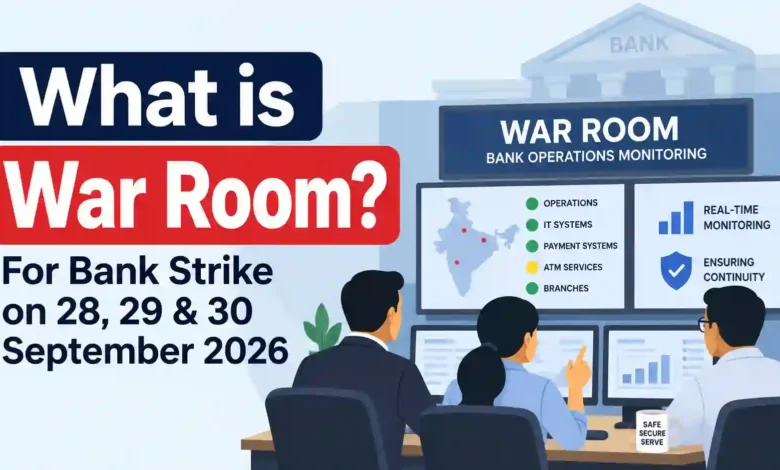
The government has asked Public Sector Banks (PSBs) to create a nodal officer/War Room to monitor banking operations during the proposed bank employees’ strike on September 28, 29 and 30, 2026.
The War Room will function as a monitoring and coordination mechanism to ensure that essential banking services continue during the strike and that any disruption is addressed quickly.
Each bank has to nominate a nodal officer and provide the officer’s details to the Department of Financial Services for coordination, including coordination with Ministry of Home Affairs representatives on law-and-order matters.
The War Room will monitor the strike situation and the functioning of important banking infrastructure in real time. This includes Currency Chests, Clearing Centres, Data Centres and Disaster Recovery Centres, Treasury Operations and payment systems.
Banks have also been asked to ensure that their IT platforms and digital banking channels remain fully operational, with adequate technical support and redundancy. If any major incident or disruption affects critical banking operations, it can be immediately reported to the concerned Crisis Management Team and the Department for necessary action.
The Chairmen, Managing Directors and CEOs should personally monitor the real-time strike position and take corrective action wherever required.
In simple terms, the War Room will act as a control and monitoring centre during the bank strike. Its purpose is to keep track of what is happening across the bank, ensure that critical banking and digital services continue to function, identify disruptions quickly and coordinate with the concerned authorities for immediate corrective action. It is therefore mainly a strike-period crisis management and operational monitoring mechanism, rather than a separate place created to deal with employees participating in the strike.
Should employees be worried about War Room?
No, employees generally should not worry about the “War Room” merely because they are participating in the strike. The War Room is a crisis-management and operational monitoring arrangement. Its focus is on monitoring the strike situation, maintaining critical banking infrastructure, keeping IT and digital channels operational, and responding to disruptions.
Were War Rooms also created in Past?
Yes. War rooms or similar crisis-management/control arrangements have been used by banks and financial institutions in the past.
For example, during the COVID-19 crisis in 2020, the RBI established a dedicated war room/business-continuity arrangement to ensure that critical financial-market and RBI operations continued during the lockdown. The arrangement was operational from March 19, 2020, with selected personnel working from a separate facility.
Banks have also used the term “war room” for other operational crises. For instance, Indian Overseas Bank had earlier created a war room to closely monitor recovery of bad loans, while Bank of Baroda used a centralised war room for monitoring lending decisions and implementation of its transformation programme.
More recently, in May 2025, banks including Punjab National Bank established a 24-hour war room to monitor operations and cybersecurity amid heightened security concerns.