Supreme Court Says Banks Must Compensate Digital Fraud Victims for Losses Caused by Negligence

| ➡️ Click here to Join Whatsapp News Group - Get instant updates of all Banking News |
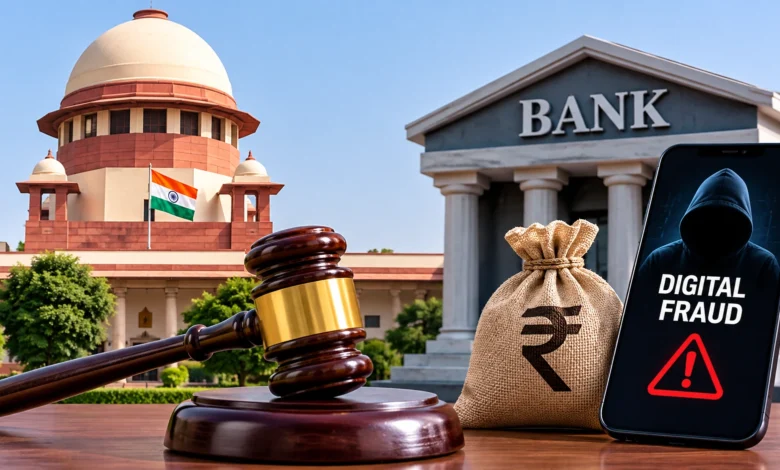
The Supreme Court of India on Thursday said banks and other financial institutions must be held accountable for losses suffered by victims of digital fraud if the fraud is found to have resulted from a failure to meet their due diligence obligations. The court said victims of scams, including digital arrest cases, should receive compensation of at least the amount they lost if the financial institution is found responsible for the failure.
A bench comprising Chief Justice Surya Kant and Justices Joymalya Bagchi and V. Mohana said it would examine the Reserve Bank of India’s (RBI) amended Know Your Customer (KYC) directions, which are scheduled to be operationalised by December 31, 2026. The bench stressed that the proposed regulatory framework should include suitable provisions for compensating victims when banks or other financial institutions fail to fulfil their due diligence responsibilities.
The Supreme Court noted that although digital crimes have reportedly declined by around 50%, victims have still lost approximately Rs 800 crore to such offences so far this year. The court’s observations underline the need for stronger safeguards and better coordination between banks, law enforcement agencies and financial regulators to prevent cyber-enabled financial fraud. The court also allowed WhatsApp to intervene in the suo motu proceedings related to digital arrest scams. During the hearing, WhatsApp informed the court that it had banned 9,400 suspicious accounts so far.
1. Compensation for victims: Banks should compensate victims by at least the amount lost when their failure to exercise due diligence caused the fraud.
2. Stopping suspicious transactions: Banks should be required to temporarily suspend unusual transactions that differ significantly from a customer’s normal transaction history until verification is completed.
3. Police notification: Banks should automatically inform the relevant police authorities about suspicious transactions and verify their genuineness.
4. Stronger bank accountability: The Court has stressed that responsibility should not be limited to individual bank employees where institutional failures are involved.
5. New RBI rules: The Court said it would examine the proposed RBI (Know Your Customer) Amendment Directions, 2026, which were expected to be notified by November 30, 2026, and operationalised by December 31, 2026. These are proposed timelines, not confirmation that the rules are already operational.
What does this mean for bank customers?
If a customer’s money is lost in cyber fraud, the bank’s responsibility may depend on whether it followed the required security and verification procedures, whether the transaction was authorised, and whether the applicable customer-protection rules cover the case.
The latest Supreme Court proceedings seek to strengthen protection where a financial institution’s negligence contributes to the loss. They should not be interpreted as a blanket guarantee that banks must refund every amount lost in online fraud.
Customers should report fraudulent transactions to their bank immediately and call India’s cybercrime helpline 1930 as soon as possible.
Also Read: Female Subordinate Staff turns out to be Mastermind in PNB Scam in Greater Noida
Also Read: Punjab & Sind Bank Officers Brutally Assaulted During Loan Recovery Visit in Jalandhar
Also Read: Did Indian Bank Suspend Employee for mentioning Bank Name on his Social Media Profile?
Also Check This

Please login to comment