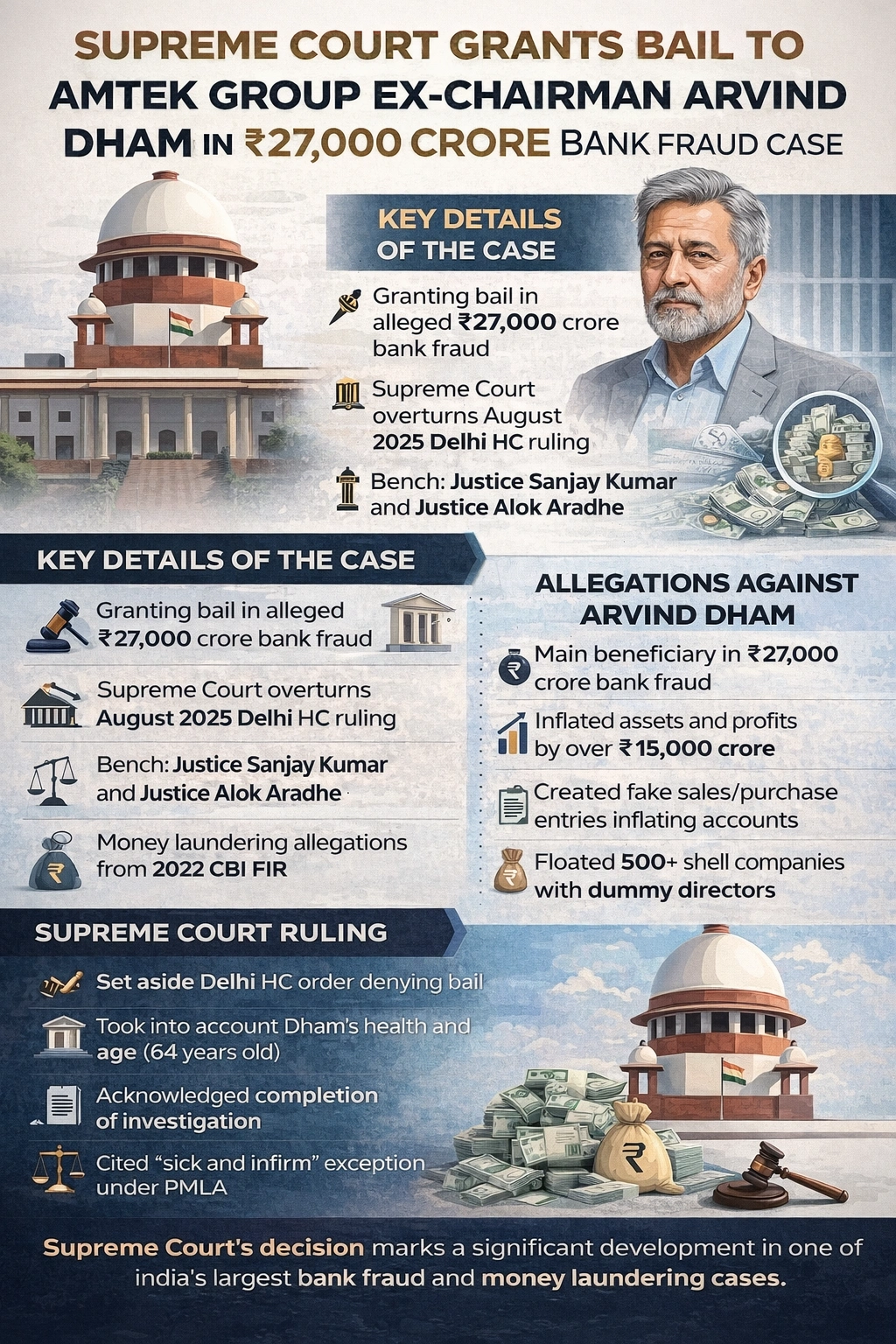
The Supreme Court on Tuesday granted bail to Arvind Dham, former chairperson of the Amtek Group, in a money laundering case linked to an alleged ₹27,000-crore bank fraud. The top court set aside an earlier order of the Delhi High Court, which had refused to grant him bail.
A bench of Justice Sanjay Kumar and Justice Alok Aradhe overturned the August 2025 ruling of the high court, which had said that releasing Dham could affect the trial and harm public trust in the justice system.
Earlier, the Delhi High Court had described the case as a serious economic offence, stating that it caused heavy losses to public sector banks. The court had warned that granting bail in such cases could weaken economic governance and said that illness alone was not enough to justify bail. It had also noted that Dham’s health issues could be managed while he remained in custody.


The money laundering case against Dham is based on a 2022 CBI FIR, filed after complaints from IDBI Bank and Bank of Maharashtra. The banks accused Amtek Group companies of cheating and criminal breach of trust by defaulting on large loans through fraudulent methods.
Following directions from the Supreme Court in February 2024, the Enforcement Directorate (ED) began its investigation and registered a case later that year. The ED alleged that Dham was the main beneficiary of the fraud and played a key role in manipulating company accounts.
According to the ED, the Amtek Group inflated assets and profits by over ₹15,000 crore, created fake sales and purchase entries, floated more than 500 shell companies, and used dummy directors to divert public money. Dham was arrested by the ED in July last year.
While seeking bail, Dham argued that he is a 64-year-old senior citizen, has spent more than a year in jail, and qualifies for the “sick and infirm” exemption under Section 45 of the Prevention of Money Laundering Act (PMLA). He also said the investigation was complete and the trial would take a long time to begin.
Under Section 45 of the PMLA, courts must apply strict conditions before granting bail in money laundering cases. Although the law allows some relaxation for sick and infirm persons, courts have repeatedly said that this relief is not automatic.
The ED strongly opposed Dham’s bail plea, saying the fraud was massive and complex. It described him as the “controlling mind” of the Amtek Group and accused him of planning and executing a large-scale financial scam involving falsified records and shell companies.
With the Supreme Court’s decision, Dham will now be released on bail, marking a significant development in one of India’s largest bank fraud and money laundering cases.
-

-

-

-

-
-

-

-

-
-

-

-