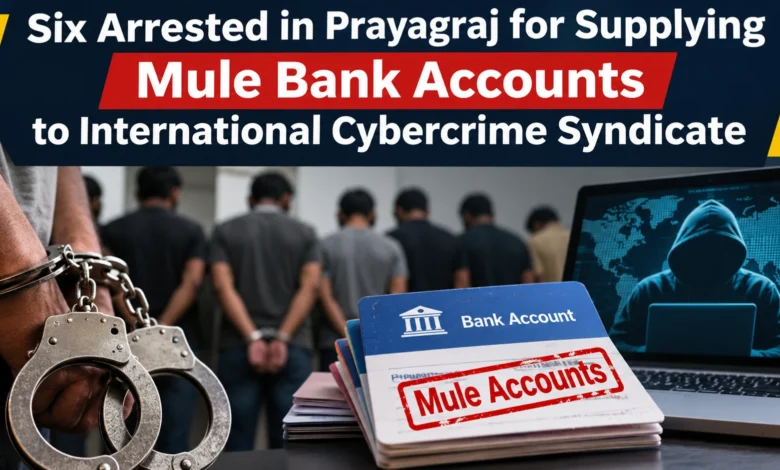
Six Arrested in Prayagraj for Supplying Mule Bank Accounts to International Cybercrime Syndicate

| ➡️ Click here to Join Whatsapp News Group - Get instant updates of all Banking News |
Prayagraj, Uttar Pradesh: A big cyber fraud has been discovered in Prayagraj, Uttar Pradesh. Prayagraj Police have arrested six people accused of supplying mule bank accounts to cybercriminals operating from China and Southeast Asian countries, including Cambodia, Thailand and Laos.
According to police investigations, the accused allegedly arranged bank accounts belonging to unsuspecting rural residents and supplied them to foreign cybercriminals to carry out online financial frauds. These accounts were reportedly used to route and launder approximately ₹56.04 crore obtained through various cyber fraud activities.
Six Accused Arrested
The six accused arrested in connection with the racket have been identified as:
- Sunny Singh – Mirganj, Prayagraj
- Mahesh Pal – Saha alias Peepalgaon
- Saurabh Singh Patel – Ganja village
- Aman Rastogi – Kalindipuram
- Pranjal Rastogi – Kalindipuram
- Vivek Jaiswal – Mutthiganj
Police said that the network was being operated through local agents who recruited financially vulnerable people and arranged bank accounts for international cybercriminals.
₹56.04 Crore Routed Through 12 Bank Accounts
Investigators found that 12 mule bank accounts linked to the network were allegedly used to transfer around ₹56.04 crore. According to reports, approximately ₹54 crore was transacted through just three of these accounts. Police have also identified 52 cybercrime complaints registered across different parts of the country that are linked to these bank accounts.
Indian Agents Received Cryptocurrency Payments
Police investigations have also revealed that the accused allegedly received commissions in cryptocurrency instead of conventional bank transfers. The arrested individuals reportedly received around 40,000 USDT, a cryptocurrency pegged to the US dollar, for supplying bank accounts and facilitating transactions. Investigators are examining cryptocurrency wallets, mobile phones and transaction records to identify other members of the network.
Police Investigating International Links
During interrogation, investigators reportedly found that the local handler, Sunny Singh, came into contact with other members of the syndicate through Telegram.
The police are now examining digital evidence to identify overseas handlers, additional account suppliers and other people involved in the alleged money-laundering network. The investigation is also focused on tracing the money trail connected with the 52 cybercrime complaints.
The case highlights how ordinary bank accounts can be misused by organised cybercrime networks to transfer money obtained through online fraud.
Also Check This

Please login to comment