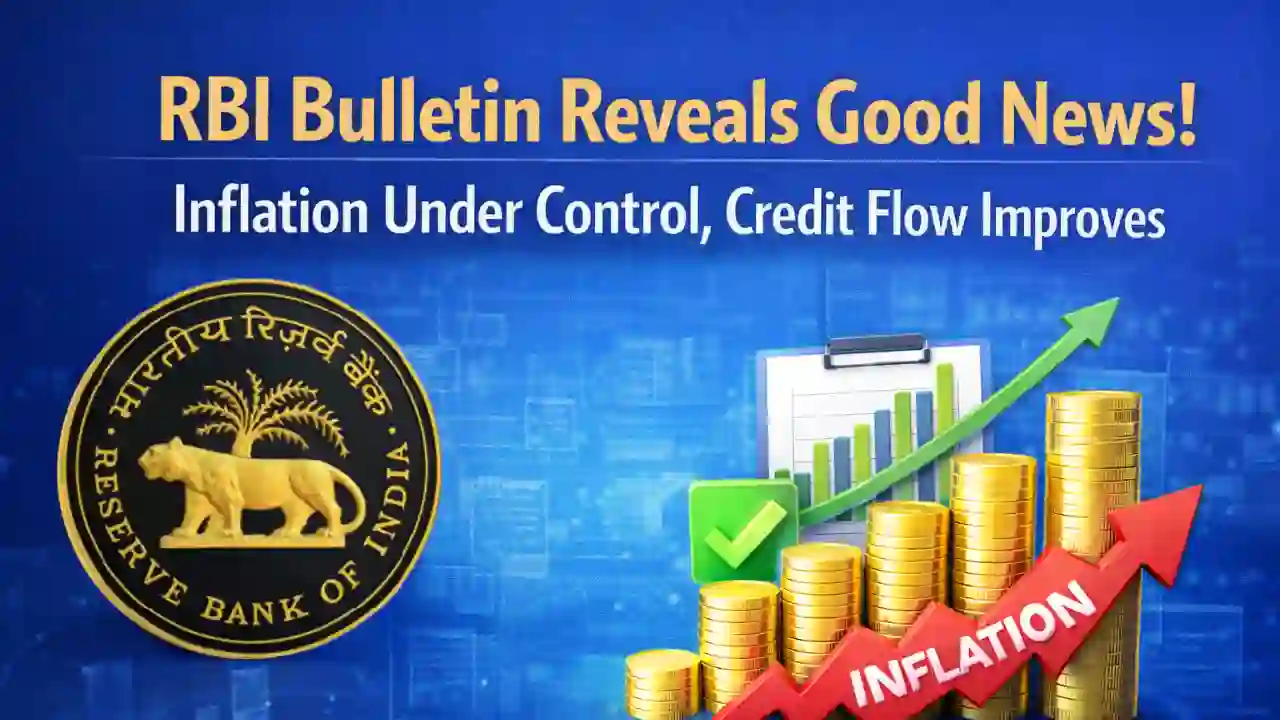
The Reserve Bank of India (RBI) on January 21, 2026, released the January 2026 edition of its monthly Bulletin, providing an overview of the country’s economic and financial situation. The Bulletin includes three speeches, two detailed articles, and the latest statistical data, offering important insights into India’s economic performance and financial trends.
Indian Economy Shows Strong Resilience
According to the article titled “State of the Economy”, global economic growth remained stable in 2025, even though uncertainties were high across the world. However, global uncertainty showed signs of easing towards December 2025.
The RBI noted that the first advance estimates of real GDP growth for 2025–26 reflect the strong and resilient nature of the Indian economy. This growth has been mainly driven by domestic demand and internal economic factors, despite difficult global conditions.
High-frequency indicators for December 2025 also suggest that economic activity remains strong. Demand in the economy continues to stay positive, indicating sustained growth momentum.
Inflation Remains Under Control
The Bulletin stated that headline CPI inflation increased slightly in December, but it still remained below the RBI’s lower tolerance limit. This indicates that inflation is under control and not posing a major risk to economic stability at present.
Credit Flow to Commercial Sector Improves
The RBI also highlighted that the flow of financial resources to the commercial sector increased over the past year. This rise in credit has come from both banks and non-bank financial institutions, supporting business activity and investment.
Financial Assets and Liabilities Rise in 2023–24
The second article, titled “Financial Stocks and Flow of Funds of the Indian Economy 2023–24”, was authored by Suraj S, Ishu Thakur, and Mousumi Priyadarshini. This article analyses financial transactions and balance sheets across various sectors of the Indian economy.
The study examines how funds moved between different sectors using a from-whom-to-whom framework, helping to understand inter-sectoral financial linkages and broader macroeconomic trends. Along with this article, the RBI also released sector-wise and sub-sector-wise data from 2011–12 to 2023–24.
Key Financial Highlights
- Financial assets of domestic sectors grew by 13.9% in 2023–24, compared to 9.9% growth in 2022–23.
- Financial liabilities increased by 12.7%, higher than 10.4% in the previous year.
- The financial resource deficit of the domestic economy reduced sharply to 0.9% of GDP in 2023–24, down from 2.3% of GDP in 2022–23, indicating improved financial balance.
Households Remain Strong
The RBI noted that households and financial corporations continued to remain surplus sectors, meaning they generated excess savings. These savings were used to finance the deficits of the general government and non-financial corporations.
The net financial wealth of domestic sectors increased significantly to 28.6% of GDP in 2023–24, up from 24.8% in 2022–23. This shows a broad-based improvement in the financial strength of households, government, and businesses.
External Sector Shows Increased Openness
Despite ongoing global uncertainties, the financial assets and liabilities of the rest of the world (RoW) increased during 2023–24. This indicates greater openness and stronger financial interaction with global markets.
The RBI also pointed out that currency and deposits, loans and advances, and debt securities together accounted for nearly two-thirds of total financial assets and liabilities as of end-March 2024.
RBI Clarification
The central bank clarified that the views expressed in the Bulletin articles are those of the authors and do not represent the official views of the Reserve Bank of India.
Click here to download RBI Bulletin PDF
-

-
![RBI released Bulletin December 2025 [Download PDF]](https://hellobanker.in/wp-content/uploads/2025/12/Orange-and-White-Geometric-Food-Vlogger-YouTube-Channel-Art-1-390x220.webp)
-

-
![Bank of England Finacial Stability Report [PDF]](https://hellobanker.in/wp-content/uploads/2025/12/Bank-of-England-Finacial-Stability-Report-PDF-390x220.webp)
-

-
-
![HDFC Bank Becomes India’s Most Valued Brand in 2025 [Check Top 10 and Rankings]](https://hellobanker.in/wp-content/uploads/2025/11/HDFC-Bank-Becomes-Indias-Most-Valued-Brand-in-2025-Check-Top-10-and-Rankings-390x220.webp)
-
-

-

-
![RBI released 45th Half-Yearly Report on Management of Foreign Exchange Reserves [PDF]](https://hellobanker.in/wp-content/uploads/2025/10/PSB-Manthan-2025_20251028_191103_0000.webp)
-