PNB rejected Compassionate Appointment, Allahabad High Court orders in favour of Petitioner

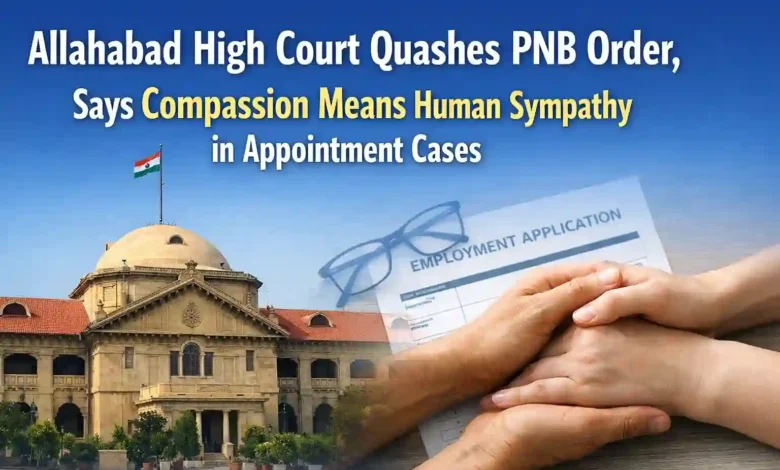
The High Court of Judicature at Allahabad, Lucknow Bench, presided over by Justice Shree Prakash Singh, set aside a one-line order issued by Punjab National Bank. The bank had rejected the request of a deceased employee’s son for compassionate appointment. The Court sent the matter back to the bank for fresh consideration within eight weeks.
The employee was working in Punjab National Bank and had died while in service. After his death, the required formalities were completed. However, the bank still rejected the claim without explaining the reasons.
The Court said that the word “compassion” means human sympathy and kindness. It also said that Article 51-A(g) of the Constitution guides authorities on how to deal with such claims. The Court referred to the purpose of the 1974 Uttar Pradesh Rules on dependent employment, which aim to support families of deceased employees.
The petitioner challenged the order dated 19.09.2023 issued by the Chief Manager of Punjab National Bank, Circle Office, Sitapur. The order rejected his claim without giving any reasons.
The petitioner’s father had joined the bank in 1982. He died in service on 04.08.2016. He left behind his family, including the petitioner. On 04.08.2018, the petitioner’s mother applied for compassionate appointment for her son. She stated that he had passed Intermediate and was studying for graduation.
On 27.08.2018, the bank asked the family to complete certain formalities. These formalities were completed as directed. Later, the bank office was shifted. According to the petitioner, the bank asked for a fresh application. The application was submitted on 27.01.2021.
The petitioner argued that the first application in 2018 was filed within the allowed time. He also said that the rejection order did not give any reasons. The bank argued that the 2021 application was filed after the time limit under the rules for compassionate appointment.
The Court noted that two facts were not disputed. First, the petitioner is the legal heir of the deceased employee who worked regularly in the bank. Second, the bank received the application dated 04.08.2018.
The Court also recorded that after receiving the 2018 application, the bank had asked the petitioner’s mother to complete the required formalities, and those formalities were completed.
The Court observed that the bank never claimed that the petitioner lacked the required qualifications or that no suitable job was available.
While examining the rejection order, the Court found that the bank’s Board had taken the decision through oral discussion. The rejection order was only one line long. The Court said this clearly showed non-application of mind. Therefore, the order dated 19.09.2023 could not stand.
The Court also referred to the Supreme Court judgment in Mohinder Singh Gill v. Chief Election Commissioner & Others (1978) 1 SCC 405, which says that an order must stand on the reasons given in it.
The Court explained that the main purpose of the 1974 Rules is to provide immediate financial help to the family of a deceased employee. Therefore, such claims should be considered keeping in mind the object of the rules. The Court further said that compassion cannot be seen in isolation. It means sympathy, kindness, and humane consideration.
Finally, the Court quashed the order dated 19.09.2023. It directed the Chief Manager, Punjab National Bank, HRD Section, Circle Office, Sitapur, to reconsider the matter. The bank must take a fresh decision within eight weeks from the date a certified copy of the order is submitted. With these directions, the writ petition was allowed.
- Download Court Order PDF (This PDF is available for Premium Users Only. Click here to join premium)