MP High Court: Accident Victims Cannot Be Forced to Open Union Bank Account to Receive Compensation

| ➡️ Click here to Join Whatsapp News Group - Get instant updates of all Banking News |
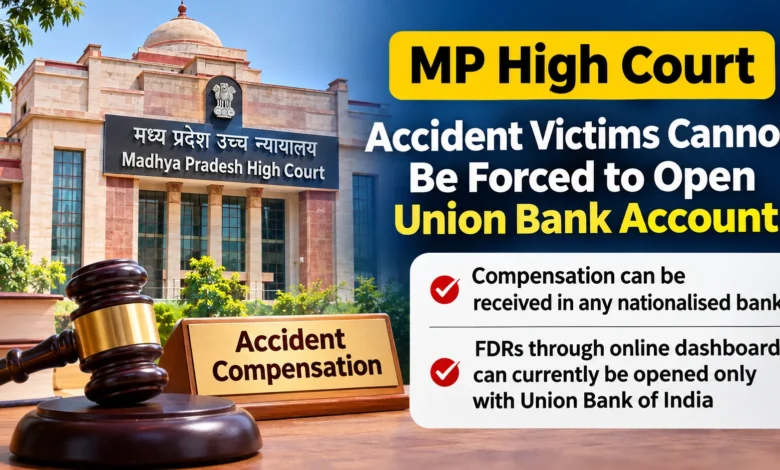
The Madhya Pradesh High Court has ruled that accident victims who receive compensation cannot be forced to open a bank account with Union Bank of India to get their money or invest it in a fixed deposit.
Justice Vinay Saraf, sitting at the Indore Bench, set aside two orders passed by the Motor Accident Claims Tribunal (MACT), Neemuch, which required the fixed deposit receipt (FDR) amount to be invested through a Union Bank of India account.
The High Court clarified that accident victims can receive their compensation directly in their accounts at any branch of any nationalised bank. They do not need to open a new account with Union Bank of India just to receive the compensation.
Background of the Case
The case was filed by Smt. Shahin and others through their advocate, Akhil Godha.
The dispute arose in MACC No. 141/2024. The Motor Accident Claims Tribunal, Neemuch, had passed an order on July 3, 2026, regarding the investment of compensation in fixed deposits.
On July 31, 2026, the Tribunal recalled its earlier order to the extent that it required the FDR amount to be invested only through a Union Bank of India account.
On August 5, 2026, the Tribunal explained that the High Court had introduced an online system for disbursing compensation. It referred to a direction dated September 25, 2025, and a Registry letter dated October 8, 2025, which it understood to require FDRs to be opened only with Union Bank of India.
The petitioners challenged this requirement. They argued that no direction from the Supreme Court, the Chief Justice or the High Court Registry required accident victims to open an account with Union Bank of India.
They also argued that compensation should be transferred directly to the claimant’s account at any branch of any nationalised bank.
High Court Sought Clarification from Registry Officials
The High Court asked the Principal Registrar to send an officer to explain the procedure for transferring compensation and opening fixed deposits.
Registrar (Judicial) Anil Kumar and Registrar (IT) Surya Prakash Sharma appeared before the Court through video conferencing.
They informed the Court that neither the Chief Justice nor the High Court Registry had issued any direction requiring accident victims to open an account with Union Bank of India.
They explained that the instructions were issued to follow the Supreme Court’s directions, which allow compensation to be transferred directly to claimants’ accounts with any nationalised bank.
The High Court also examined a compliance report dated October 27, 2026. The report confirmed that there were no administrative instructions requiring fixed deposits to be opened with any particular bank.
What Did the Supreme Court Say?
The High Court examined the Supreme Court’s directions dated April 22, 2025, in Suo Motu Writ Petition (C) No. 7/2024.
The Supreme Court’s directions state that compensation should be transferred directly to the claimant’s bank account. Money deposited for investment in fixed deposits can be placed with any nationalised bank.
The High Court also examined the procedure for using its online dashboard. The system’s instructions referred to accounts maintained by the Tribunals with Union Bank of India or State Bank of India.
However, the High Court clarified that this arrangement did not mean that claimants had to open accounts with Union Bank of India to receive their compensation.
What Did the Madhya Pradesh High Court Rule?
Justice Vinay Saraf clarified that there was no direction requiring claimants to open an account with Union Bank of India to receive compensation or create a fixed deposit.
The Court said that claimants could maintain accounts at any branch of any nationalised bank. The Tribunal must transfer the awarded compensation directly to the claimant’s account.
However, the Court also pointed out a technical limitation in the online system.
At present, only Union Bank of India is connected to the High Court’s online dashboard for creating fixed deposits. Therefore, FDRs created through this dashboard can currently be opened only with Union Bank of India.
The process of connecting other nationalised banks to the system is underway. Once other banks are connected, the facility will also become available through them.
Key Directions Issued by the High Court
The Madhya Pradesh High Court clarified the following points:
- Accident victims cannot be forced to open a Union Bank of India account to receive compensation.
- Compensation must be transferred directly to the claimant’s account at any branch of any nationalised bank.
- If compensation is not disbursed through the online dashboard, an FDR can be opened with any nationalised bank.
- If an FDR is created through the online dashboard, it can currently be opened only with Union Bank of India.
- Claimants do not need to open a separate Union Bank of India account for this purpose.
- Other nationalised banks will also be able to provide this facility once they are connected to the online system.
- The Motor Accident Claims Tribunal, Neemuch, must reconsider the claimant’s application in accordance with the High Court’s directions.
Tribunal Orders Set Aside
The High Court set aside the Tribunal’s orders dated July 31, 2026, and August 5, 2026.
It directed the Member of the Motor Accident Claims Tribunal, Neemuch, to reconsider the claimant’s application in light of the Court’s directions.
The ruling makes it clear that accident victims cannot be forced to open a bank account with a particular bank simply because the online system currently supports fixed deposits through that bank.
Also Check This

Please login to comment