Karnataka High Court Quashes SBI Case Against Homebuyer Who Stopped EMIs After Builder Resold Flat

| ➡️ Click here to Join Whatsapp News Group - Get instant updates of all Banking News |
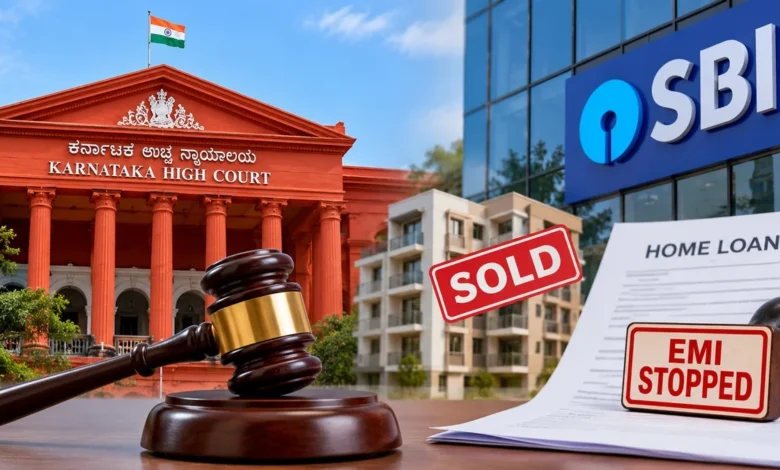
The Karnataka High Court has quashed criminal proceedings initiated by the State Bank of India (SBI) against a Mumbai-based homebuyer who stopped paying his home loan EMIs after discovering that the builder had allegedly sold his allotted flat to another person without his knowledge. The court observed that an outstanding loan or the failure of a property transaction cannot, by itself, be treated as a criminal offence.
The customer took a home loan of ₹39.92 lakh from SBI during the financial year 2019-20 to purchase a flat numbered B-306 in the Grandeur Park project in Bengaluru. On February 8, 2020, he signed a tripartite agreement involving himself, the bank and the property developer. As Bari lived in Mumbai, he could not regularly visit the construction site. However, he continued paying his equated monthly instalments (EMIs).
The matter came to light when Bari discovered that the builder had allegedly sold his allotted flat to a third party in March 2023 without informing him or SBI. After learning about the resale, Bari stopped making further EMI payments. Instead of limiting its action to the builder, SBI filed a first information report (FIR) against Bari in September 2024, accusing him of cheating, criminal breach of trust and misappropriation of the loan amount.
During the proceedings, SBI relied on Clauses 2, 4, 5 and 6 of the tripartite agreement. The bank argued that if the builder cancelled the booking because of the buyer’s default or the housing project was discontinued, the developer was required to repay the money received from the buyer to the bank. Clause 5 specifically required the builder to refund the entire amount collected from the homebuyer directly to the bank if the project failed to materialise.
While quashing the FIR, the Karnataka High Court noted that Bari had never received the title to the property, had not participated in the resale transaction and had not gained any financial benefit from the builder’s alleged actions. The court found no sufficient basis to treat the dispute as a criminal offence merely because the home loan remained unpaid.
The court also criticised SBI’s approach, observing that a public-sector bank is expected to exercise due care before initiating criminal proceedings against a customer. It emphasised that an outstanding loan or the failure of the underlying property transaction does not automatically establish criminal liability. Criminal proceedings cannot be used as a shortcut for recovering money in a civil dispute unless there is evidence of dishonest intent or other elements of a criminal offence.
However, the ruling does not settle the dispute over Bari’s property booking or the money already paid towards the flat. The court was dealing with the criminal proceedings against him, rather than deciding the final financial liability of the buyer, builder and bank.
Kalpit Khandelwal, a partner at Aekom Legal, told The Economic Times that the tripartite agreement placed the responsibility for repaying the bank on the builder if the project failed to materialise. In his view, the absence of dishonest intent on Bari’s part supported the court’s decision to treat the matter as a civil recovery dispute rather than a criminal case.
The case highlights the importance of carefully examining tripartite agreements before taking a home loan for an under-construction property. Homebuyers should pay particular attention to clauses covering builder defaults, project cancellations, refunds and repayment obligations, as these provisions determine how financial risks are handled if a housing project is delayed, cancelled or fails to materialise.
Also Read: PNB Bank Fraud: Nearly Rs 35 Crore Misappropriated from Customers Accounts in Greater Noida
Also Read: Bank of Baroda Ordered to Release Four FDs to Deceased Customer’s Son, Pay Rs 32,000 Compensation
Also Check This


Please login to comment