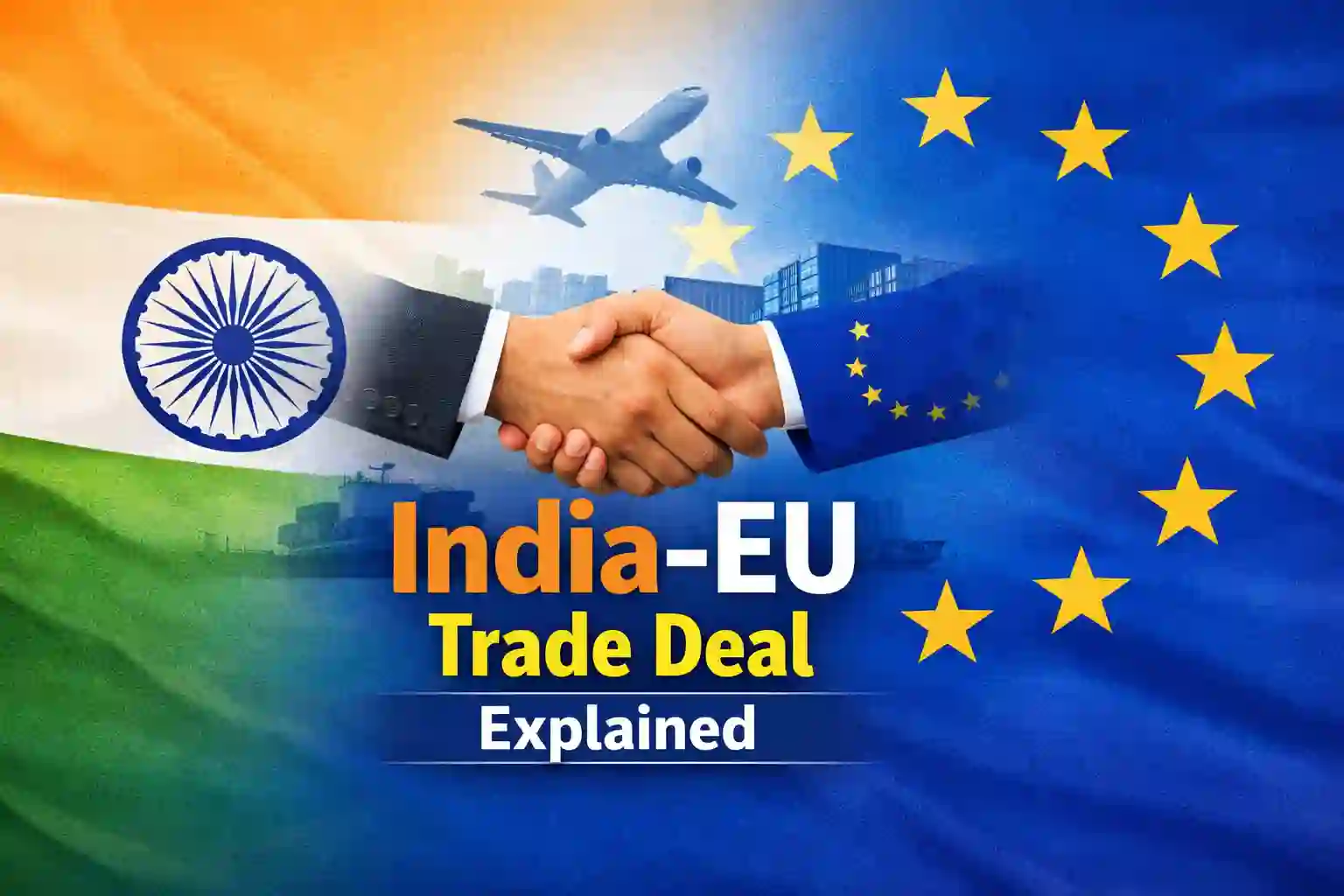
India and the European Union (EU) have finalised a free trade agreement (FTA) on Tuesday after 18 years of negotiations. The announcement was made during the 16th India-EU Summit. The FTA comes after intense negotiations since the re-launch of negotiations in 2022.
Why India was pushing for trade deal with EU?
The European Union is one of India’s largest trading partners, with bilateral trade in goods and services growing steadily over the years. In 2024–25, India’s bilateral trade in goods with the EU stood at INR 11.5 Lakh Crore (USD 136.54 billion) with exports worth INR 6.4 Lakh Crore (USD 75.85 billion) and imports amounting to INR 5.1 Lakh Crore (USD 60.68 billion). India-EU trade in services reached INR 7.2 Lakh Crore (USD 83.10 billion) in 2024.
India and EU are 4th and 2nd largest economies, comprising 25% of Global GDP and account for one third of global trade. EU becomes India’s 22nd FTA partner. The Government since 2014 has signed trade deals with Mauritius, UAE, UK, EFTA, Oman and Australia, and announced trade deal with New Zealand. In 2025, India signed trade deal with Oman and UK and announced conclusion of trade deal with NZ.
Also Read: PNB Cheated of Rs 68.60 Lakh! Fake Dairy Project Exposed in Madhya Pradesh
How will this FTA help India?
India has gained preferential access to the European markets across 97% of tariff lines, covering
99.5% of trade value, in particular:
- 70.4% tariff lines covering 90.7% of India’s exports will have immediate duty elimination for important labour-intensive sectors such as textiles, leather and footwear, tea, coffee, spices, sports goods, toys, gems and jewellery and certain marine products, amongst others;
- 20.3% tariff lines covering 2.9% of India’s exports will have zero duty access over 3 and 5 years for certain marine products, processed food items, arms and ammunition, amongst others;
- 6.1% tariff lines covering 6% of India’s exports will have preferential access by way of tariff reduction for certain poultry products, preserved vegetables, bakery products amongst others or through TRQs for cars, steel, certain shrimps/ prawns products, amongst others.
Key labour-intensive sectors (such as textiles, apparel, marine, leather, footwear, chemicals, plastics/rubber, sports goods, toys, gems, and jewellery), comprising more than INR 2.87 Lakh Crore (USD 33 billion) of exports that are currently subjected to import duty between 4% to 26% in the EU and are crucial for employment generation, will enter zero duty from entry into force of the FTA and thus gain enhanced competitiveness in the EU market.
Also Read: Big Legal Battle between Trump and Largest US Bank! JPMorgan Closed Accounts of US President
How will this FTA help EU?
The EU will eliminate tariffs on over 90% of tariff lines, and 91% in terms of value and India will eliminate tariffs on 86% of tariff lines, and 93% in terms of value. Moreover, both sides will partially liberalise a significant additional number of lines, thereby bringing the overall coverage of trade liberalisation to 96.6% for India and 99.3% for the EU.
India will remove high duties on industrial products (which, on average, are above 16%), such as:
- Chemicals (current tariffs of up to 22%, to be removed mostly at entry into force of the agreement).
- Cosmetics (current tariffs of up to 22%, to be removed mostly after 5 or 7 years).
- Plastics (some at entry into force, many after 7 years).
- Car parts (most tariffs to be removed after 5 to 10 years).
- Textiles and apparel (most tariffs removed at entry into force)
- Ceramics (most tariffs removed at entry into force)
- Machinery (half of the tariffs liberalised at entry into force and the rest in periods of up to 10 years)
- Boats (mainly at entry into force)
Also Read: Breaking! Salary of PSU Insurance Employees Hiked by Govt
These duty reductions and eliminations will facilitate EU exports of these products which could not access the Indian market so far given the high tariff barriers.
On the agri-food sector, considering the very high level of protection and the sensitivities of India, the Agreement is balanced because it opens market access in key export interests while preserving sensitivities. The agreement will eliminate duties on several key EU agri-food exports, such as:
- Olive Oil (current tariff up to 45 %, to be eliminated at entry into force or after a 5-year staging)
- Non-alcoholic beer and several fruit juices (current tariff up to 55 %, to be eliminated in 5 years)
- Processed food such as confectionary, breads, pastry, pasta, chocolates, pet food (current tariff 33%, to be eliminated at entry into force or after staging)
- Sheep meat (current tariff 33%, to be eliminated over staging)
Also Read: What’s the latest interest rate on Sukanya, PPF and Savings Account? Check Here
The agreement will also offer an important market access improvement for wine, spirits, beer, as well as fruits, such as:
- EU exports of alcoholic beverages currently subject to very high tariffs (reaching 150% in some cases) will be reduced over time to 30% for most wines, 40% for all spirits and 50% for beer;
- EU exports of fruits (e.g. kiwis and pears) will benefit from sizeable Tariff Rate Quotas (TRQs) allowing to expand EU market shares in India; and
- The agreement will establish a working group on wines and spirits, which will serve as a platform for the exchange of information and cooperation between the parties, including on oenological practices.
-

-

-

-

-
-
-
-
-
-
-
-