Delhi High Court Dismisses SBI Review Plea, Orders Full Benefits to Clerk’s Family After 32 Years

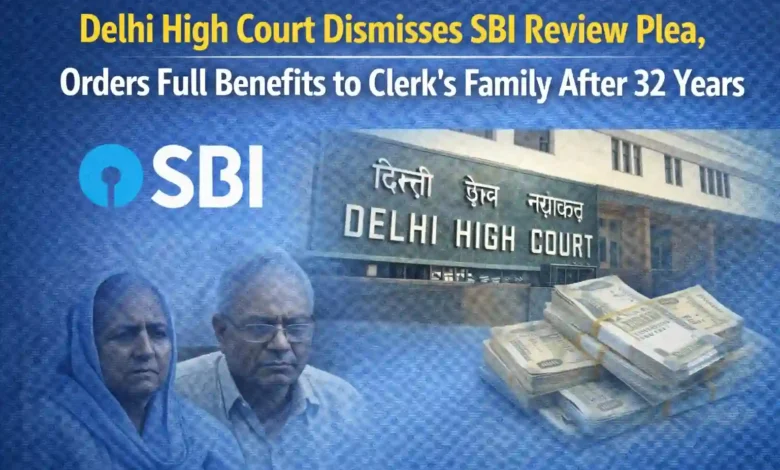
The Delhi High Court has dismissed a review petition filed by State Bank of India (SBI), bringing an end to a legal dispute that lasted for more than 32 years. During this long period, the clerk involved in the case, S K Taparia, passed away, and his family continued the legal battle. The court made it clear that the case cannot be reopened at this stage.
Background of the Case
The dispute began in 1994, when SBI took disciplinary action against S K Taparia. He had joined the bank in 1974 as a clerk in Rajasthan and later worked in different branches. He was suspended in 1989 over allegations of financial misconduct, including opening fake accounts, forging customer signatures, and making transactions beyond his income. An internal inquiry was conducted in 1993. While some charges were proved, others were not. However, the bank decided to remove him from service in October 1994.
Labour Court and Tribunal Decision
After his removal, Taparia challenged the decision and approached the industrial tribunal. In February 2003, the tribunal ruled in his favor and said that his removal was illegal. It ordered his reinstatement along with full back wages, 9% interest, and other benefits.
High Court’s 2023 Judgment
SBI challenged the tribunal’s decision in the Delhi High Court. During the case, Taparia passed away, and his family continued the proceedings. In June 2023, the High Court upheld the tribunal’s decision and directed SBI to calculate all dues and pay full financial benefits to his family, treating him as if he had continued in service until retirement or death.
Court’s Key Observation
Justice Shail Jain stated that sending the case back for fresh evidence is not possible now because the employee has died. The court said that doing so would be unfair and against the principles of natural justice, as the employee is no longer alive to defend himself. The court also emphasized that the rights given to the clerk’s family are final and cannot be disturbed on technical grounds.
Why the Review Petition Was Rejected
In its order dated April 6, the High Court said that SBI’s review petition was simply an attempt to re-argue the case. The court noted that a review petition cannot be used to challenge a judgment on merits. Such challenges should be made through an appeal, not through a review. The court clearly stated that reopening the case after the clerk’s death is not practical and does not serve justice.
SBI’s Argument and Court’s Response
SBI argued that it was not given a proper chance to present evidence before the labour court, and therefore the decision was invalid. However, the lawyer for Taparia’s family opposed this argument and said that SBI was trying to reopen the case. The court agreed with this view and stated that both employer and employee must get equal opportunity. Since the employee has died, this balance cannot be maintained.
Final Decision of the Court
The High Court concluded that reopening the case now would be unfair and would disturb the rights already given to the family. It also clarified that a review petition cannot be used for a fresh hearing. As a result, the court dismissed SBI’s review petition, finally closing a case that had been pending for over three decades.